

I didn’t get as much done as I would’ve liked to over the weekend. I had eight rounds of diarrhea that largely inhibited my energy. I barely even paid attention to the Craftsman Truck and O’Reilly races on Saturday even though I had them on in the background, although I don’t think I missed much since those were both debacles. There was also a mass at my church on Sunday commemorating the 100th anniversary of the first mass at my parish. Since that mass was held outdoors, they decided to hold this one outdoors in the parking lot under a tent as well. My counselor suggested I should volunteer there to try to make local connections, so last week, I asked if they needed volunteers for anything. They told me they might need folks to set up and take down folding chairs. Even though I arrived an hour before the mass started, they had already finished setting up. I did fold about a hundred chairs after the mass ended, and that honestly wore me out much more than I thought it would. But as a social engagement, this was a failure. One woman introduced herself to me, and somebody said “Bye” after I left, but that was about it. Most people attended with their families and friends and hardly talked to anyone outside their established friend groups and I couldn’t have gotten a word in edgewise even if I tried. I continue to find myself simultaneously too degenerate for real world communities and not enough for online ones. I intended to finish this column on Benny’s 85th birthday, but the mass in the morning, diarrhea in the afternoon, the on-again, off-again NASCAR race at night, and my decision to compile the 2026 NASCAR data didn’t really provide me much of an opportunity. I wrote almost all of this on the bus Monday while visiting Mom.
Parsons brings to mind one very specific memory for me. When I was in junior high school, I was in a class called humanities. It was a continuation of my middle school’s Talented and Gifted classes. Around three students from each elementary school were selected for TAG at the start of fifth grade. Even at the time, that seemed a little early to track students. While most of the students who did become the biggest academic stars in our class were pinpointed even then, there were a number of students who were selected who didn’t strike me as very gifted at all and several usually weren’t enrolled in any of the other gifted classes, while there were some people who were ignored who, in my opinion, were “smarter”, not that it matters now.
The humanities class was a smorgasbord of “enrichment activities”, even more so in the humanities years than the TAG years. We did logic puzzles (I even remember winning a $10 gift certificate to the late, lamented Media Play at a middle school dance and not even redeeming it - I was super cool!) We staged “theatrical plays” where we played famous characters from history. When my future junior prom date (the only date I ever went on 24 years ago) wanted to play Harriet Tubman, I decided to play Thomas Jefferson and attempted to “seduce her”, making fun of him for raping his slaves like a dirtbag leftist avant la lettre. Of course, as someone who strove and sometimes failed to be a goody-two-shoes and teacher’s pet who grew up on schlock like family sitcoms and 7th Heaven (cringe!), my knowledge of sex was rather… limited, so this is arguably the worst thing I ever wrote. I still have it, but you will never see it. In humanities, we also regularly wrote graded journal entries, had trivia contests (which I typically dominated), music listening hours, and class presentations where we even used overhead projectors. (I did a “class” on NASCAR back then and I might share that someday.) We had a Secret Santa gift exchange and an activity where we listed a bunch of facts about ourselves and then our classmates had to guess who wrote it. And our class sponsored a manatee named Hugh (snort).
My ever-living nightmare was Mondays when we had an activity called “good and new” where we reported on the events of our weekends. Almost all my classmates were yuppies/future denizens of the professional managerial class while I was trailer trash. So while my classmates would talk about going to concerts, the park, the mall, and basically doing things in the physical world, I spent most of those weekends at my dad’s just arguing with him during my parents’ custody dispute or, more often, I would just refuse to talk to him to avoid sharing anything incriminating about my mom. I utilized my nerdbrain like an iterative chess player to calculate the response to each of my dad’s interrogations to avoid hurting Mom, whom I sided with in the custody dispute. Ultimately, I usually decided in such conversations that “the only winning move is not to play.” The only things I did besides that were surf the Internet (really dating myself there), watch a shitload of auto races, and play the Papyrus NASCAR Racing 2 video game in the mornings. How would I even talk about that? I was ahead of my time in the worst ways possible, which is why I’ve called myself Zoomero Uno a few times lately. I mean, sure, one could argue that almost anyone who qualified for that class was a nerd by definition, but I was still way weirder than any of my classmates, and I don’t think I realized it. As a result of my unwillingness to participate in this ritual, I could tell the humanities teacher didn’t like me much, but I digress.
In the second half of ninth grade, our humanities class was entirely taken up by a mentor program where we shadowed adults in various industries. Now, at this point, I had no vision of what I wanted to do when I grew up, and I never really had a particular plan beyond getting good grades, going to college, then ??? Most of my classmates did have dream jobs, but I really didn’t at this point. In my earlier childhood, I dreamt of becoming a TV weatherman, but after getting a mere C on my meteorology test in eighth-grade earth science the previous year, I abruptly decided it wasn’t for me. I’m sort of glad I didn’t pursue that seriously, having watched the mainstream media degrade in the decades since. So many weatherpeople nowadays just seem to be cheerleaders for unseasonably warm weather. Local meteorological airheads go on about the “threat of rain” (hello? Nature needs rain) or talk about high temperatures by saying things like “80 or better” as if we all agree that the higher temperature, the better. Me, I could not bring myself to talk like that, especially since my preferred weather was usually upper 60s/low 70s and overcast. I remember Syracuse having vastly more days like that in my youth than in my old age. At a certain point, it’s almost a form of climate change denial.
Anyway, after I renounced my onetime dream field due to one bad test score, I kind of went through the motions and had no idea what I actually wanted to do. I was cynical about every industry, every profession. I especially didn’t want to have a position of power because I saw my mom be abused by doctors and health care workers and I certainly understood how politicians, cops, lawyers, counselors, and even teachers could abuse their power. I was ignorant about what jobs even existed because I was poor and had zero powerful adult connections besides teachers and people in school. My uncle, who worked at the University of Maryland Department of Computer Science, and my dad, who worked in a computer room, presumed that I would probably become some kind of programmer. By all rights, I probably should have, but even though I had the type of brain for it, I probably lacked the temperament. I was never an adherent to “The Californian Ideology”, which was pretty much the polar opposite of my values and my politics. I rarely had the urge to seek vengeance on society and rebuild it in my own image as a result of being picked on, as many successful programmers did. All these guys wanted to shock the normies, while I probably would’ve rather been a normie. The analog world was better. I grew up thinking hacking was wrong while the people who succeeded embraced it as part of their identity. I also believed file sharing was wrong back then, and only did it once or twice. My feelings haven’t entirely changed. Did information really “want to be free” or did people just want a consumer utopia? I tend to agree with Jaron Lanier that the Internet killed the middle class. It still tends to be the case that it costs more money to do worthwhile research, resulting in a world where, as Nathan J. Robinson put it, “the truth is paywalled but the lies are free”. We should have waited to liberate people from their intellectual property until we actually had a welfare state, but I’m sure 90% of programmers would disagree. How the hell would I have fit in that kind of culture?
In ninth grade, my world history teacher Mr. Oliver asked our class to predict where we’d be in 20 years. I was the only student who was unable to envision anything back then, and I think that’s a major reason why I failed as an adult. So, when I had to select a mentor for the humanities mentor program, I selected Mr. Oliver because I couldn’t come up with anyone else since I had no real connections to “pillars of the community”. The odd thing was that after I selected him, he didn’t want to talk about history teaching. He wanted to talk about NASCAR. Yes, as I said, I gave a humanities lecture on NASCAR, I wore driver T-shirts often, my humanities folder was Tony Stewart-themed as was my AOL screen name (which makes me cringe now), and I even had a NASCAR jacket and Dale Earnhardt backpack, but apart from showing off my fandom via naked consumerism, I mostly kept part of my life separate. I talked to teachers and classmates about school, seldom about racing (and even less about Scrabble, which was always just as big a childhood interest). I was looking for a mentor to give me a lifeline and tips for how to break through as a teacher - or really into ANY industry - since I never really had a specific industry in mind and still don’t. However, it felt like he was just wasting my time. Mr. Oliver never gave me any teaching tips, but he nonetheless encouraged my NASCAR research, commissioning me to find out information about driver salaries and how much money it costs to run a team, which weren’t talked about very often back then.
I ended up dropping the humanities mentor program (the only class I ever dropped in my K-12 career). Before I did so, I submitted at least one question to RPM2Night, the nightly ESPN2 racing show, which I watched religiously then even though it was fundamentally mediocre, and Benny answered it on the air. In that peak stranger danger era, it was considered proper “netiquette” at the time to never disclose your real name online. (People increasingly stopped doing this after Facebook, but perhaps this old cultural norm was better.) I was so paranoid about sharing personal information on the Internet back then that I claimed to be “Matt Wilson of Grand Rapids, Michigan”. While I’m sure multiple Matt Wilsons lived in that fine city, I knew my name wasn’t common, and I didn’t want to leave a paper trail. In retrospect, I find this hilarious now that real names online have been normalized. Who’s gonna contact some dopey teenager about some bland question about driver salaries? Absolutely no one. It was still exciting to have this kind of proto-parasocial interaction with BP since it was the first time I, or excuse me, “Matt”, had been acknowledged by NASCAR insiders. I had certainly always admired Benny, and the Bob Jenkins/Ned Jarrett/Benny NASCAR booth is still my all-time favorite.
Nowadays, I’ve done almost a complete 180, especially after becoming a niche celebrity gamer. I couldn’t hide my identity anymore if I tried at this point, so why bother? At least embrace the marginal amount of fame I have. Additionally, I now think that stranger danger is one of the worst things to happen over the past half-century. Several generations increasingly losing their ability to socialize and make offline friends or connections was, in my opinion, ultimately worse than a relatively small number of children being murdered. People are always asking how we ended up living in a gerontocracy, or as it has been recently called, an “oldigarchy” (please let this dad-joke-version-of-OK-boomerism not actually catch on). It’s obvious to me why this happened. Offline connections, particularly local ones, are the foundation for all the networks that ultimately result in happiness, money, and/or power. Online connections, by contrast, are less personal and intimate and more precarious and transactional. It stands to reason that people with established real-world local connections generally accumulated the lion’s share of the money and power, which I think is the main reason why older people control all levers of government. Meanwhile, the younger and more extremely online generations voluntarily dropped out of participating in the established mainstream monoculture in exchange for a more fragmented and transient culture that prevented us from building any real power. If you want to blame the boomers for this (which I don’t particularly - I’d rather blame rich people in all generations), you can. If maybe we’d been encouraged to talk to strangers, multiple generations would have ended up richer, happier, healthier, less anxious, and less alone.
For years, I’ve been nostalgic about trying to find that episode of RPM2Night featuring my question, and while doing my research for this post, I finally found it from April 3, 2000:
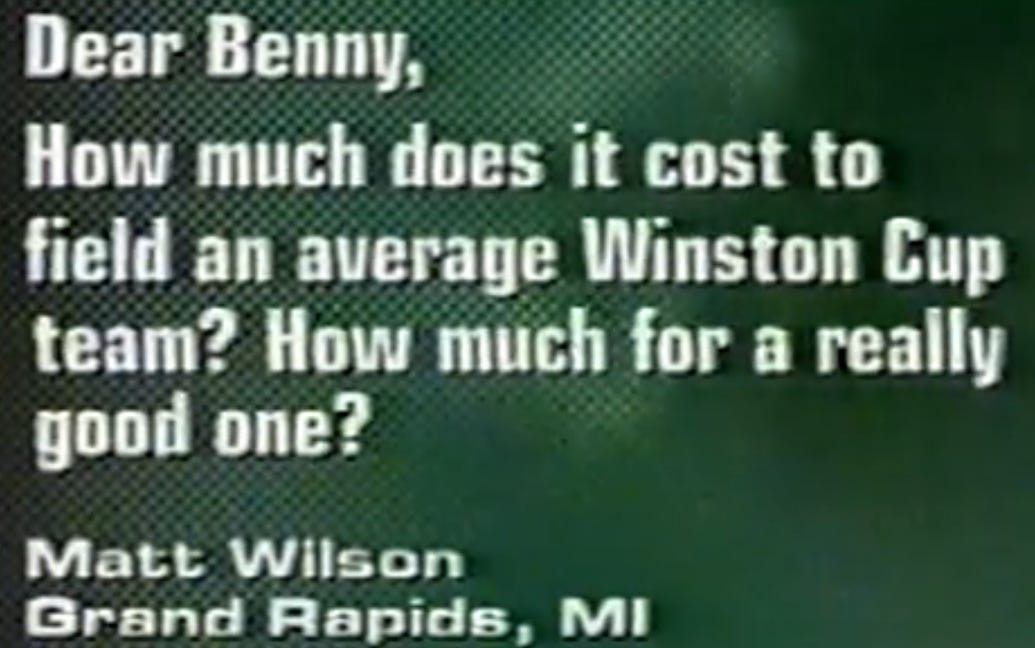
I thought my question was about driver salaries, so maybe “Matt” chimed in twice, but if so, I can’t find the other one.
