

Below is my statistical table for the 2025-26 Formula E season:
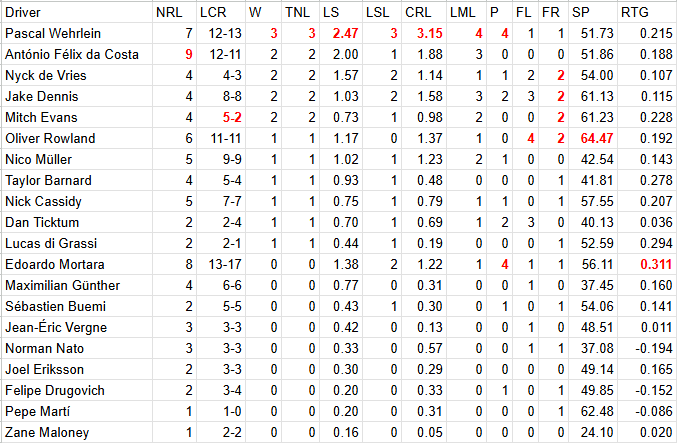
As you can tell, this series currently has more parity than any other in the world, as evidenced by the fact that every single driver who made a start not only led, but made an on-track pass for the lead, which makes analyzing this series particularly messy since you could more or less argue that almost everyone in the series was decent (indeed, 17 out of 20 drivers were rated as having above-average seasons, which definitely won’t happen in IndyCar this season and might not even in F1). There were 11 different winners, 12 different drivers with the most lead changes, 10 different drivers who led the most laps, 9 different polesitters, 9 different drivers with fastest laps, and 13 different drivers with fastest races, which is pretty remarkable considering there were only 20 drivers and 17 races. Normally the driver with the highest speed percentile has a speed percentile of over 80%, but this time defending champion Oliver Rowland’s speed percentile of 64.47% is probably the lowest I’ve ever seen to lead a series. Even more astonishingly, this year’s champion Pascal Wehrlein only had barely above average speed, although he led most of the other categories. Granted, it would be easy to argue all the incessant lead changes were rather gimmicky as drivers continually handed each other the lead to save energy, but I do think you can still draw conclusions by comparing teammates to each other.
Seven of the 20 drivers made noteworthy crossovers in endurance sports car racing, with Sébastien Buemi, Nick Cassidy, António Félix da Costa, Norman Nato, and most notably Nyck de Vries (who won overall at Le Mans alongside Mike Conway and Kamui Kobayashi in addition to his two Formula E wins this year) competing full-time in the World Endurance Championship, Jake Dennis competing full-time in the GT World Challenge Europe Endurance Cup, and Nico Müller making a one-off at Le Mans and finishing second in his class. I’m going to ignore all those drivers for the time being and wait until the end of their respective sports car seasons before rating them, but I thought it was time for me to try and nail down my placements for the other thirteen.
Even though Wehrlein’s speed percentile was a curiously low 51.73, he did win the title and lead the majority of statistical categories, so he probably should get an E. His teammate Müller finished ninth in points and was behind him in every single category, but he did still rate fairly highly relative to the field, ranking 7th in lead shares and 5th in CRL. Feels like a C. I will be ignoring Dennis, who finished 2nd in points, but his teammate Felipe Drugovich was 14th; he clearly shouldn’t be listed as evidenced by his miserable -.152 season rating along with getting crushed by Dennis in all statistical categories. I was rooting for Evans to win the title this year because he was the highest-rated Formula E driver for most of my open wheel model’s history and hasn’t won a title yet, but he didn’t really deserve to this year. While he had the best lead change percentage and finished third in points, his teammate da Costa who finished sixth led all drivers in natural races led and crushed him in dominance even though Evans beat him in points, speed, and narrowly in my teammate model. Evans feels like a C+ since I typically care more about dominance than consistency and in that regard, da Costa had the edge.
Even though Rowland failed to defend his championship and only finished fourth, I’ think I’m going to give him an E because he was the fastest driver in the series while his teammate Nato was the second-slowest. Not unlike last year when Rowland clinched the title early while Nato finished 20th in points, this time Nato was only one position better, which means for the second year in a row Rowland beat his teammate by the most positions in the championship. I don’t think anything Nato did in WEC this year will make me want to list him in spite of that. Mortara finished fifth in points while de Vries was seventh. Mortara’s 7-4 defeat of de Vries actually made him the highest-rated Formula E driver in my model (although Taylor Barnard would have been if I threw out the one race from 2025, which obviously won’t be relevant for my 2026 ranking). Even though he didn’t win and de Vries won twice, they were pretty close in all statistical categories otherwise and it honestly looks like Mortara was more dominant while de Vries was more clutch. When considering he won Le Mans and was one of the most dominant drivers in Formula E this year, de Vries is probably an E (but don’t quote me on that until the WEC is finished) and Mortara an E-.
Cassidy has been a perennial title contender for years and actually his eighth-place points finish is his worst since 2021-2022. Although Vergne’s 12th-place points finish wasn’t too far behind, when you look at the satistical table, Cassidy looks substantially better overall and honestly, Vergne is low enough in most statistical categories that he should probably be off. Buemi finished 10th in points while his teammate Joel Eriksson was 16th. Although Eriksson actually won the head-to-head this year, his statistics are too poor otherwise to list him. Barnard was in my top 50 last year and he remains the highest-rated active Formula E driver in my model. With his win at the London season finale, he became the youngest winner (he was already the youngest points scorer, polesitter, podium finisher, front row starter, leader, and driver to set the fastest lap). Although he only narrowly beat his teammate, 7-time winner Maximilian Günther in most statistical categories, he nearly tripled him in points and finished 11th to Günther’s 18th. I think another E- is in the cards for Barnard and Günther should be off. Weirdly, Pepe Martí finished higher than his teammate Dan Ticktum in points (13th-15th) in his rookie season and was way faster in races with a massive 62.48-40.13 gap in speed, but it was Ticktum who was one of only two drivers along with Dennis to have multiple poles, and he also won a race and factored for other wins while Martí really doesn’t for a Kiro team that still isn’t great. I’m thinking they should both get C-s. Finally, past champion Lucas di Grassi utterly destroyed sophomore Zane Maloney, who had a pretty lousy season, easily the worst in all statistical categories except for rating. Maloney obviously shouldn’t be listed. di Grassi did win in a pretty weak car that finished 17th in points and he keeps delivering highly-rated seasons in my model as well as Yamaha’s first win, but I think he’s drowned out by too many other drivers to rank him in the top 100. I’m thinking C.
So as I continue to work through each series, I’m going to try to construct a jigsaw puzzle to work on my top 200 list as the season progresses so hopefully it won’t be as late this time. Here is how it stands based on the FE drivers I feel comfortable rating.
E: Oliver Rowland, Pascal Wehrlein
E-: Taylor Barnard, Edoardo Mortara
C+: Mitch Evans
C: Lucas di Grassi, Nico Müller
C-: Pepe Martí, Dan Ticktum
definitely top 200 but more information needed for their exact placements: Sébastien Buemi, Nick Cassidy, Nyck de Vries, Jake Dennis, António Félix da Costa
probably not: Norman Nato (unless he was way faster than his WEC co-drivers)
not rated: Felipe Drugovich, Joel Eriksson, Maximilian Günther, Zane Maloney, Jean-Éric Vergne
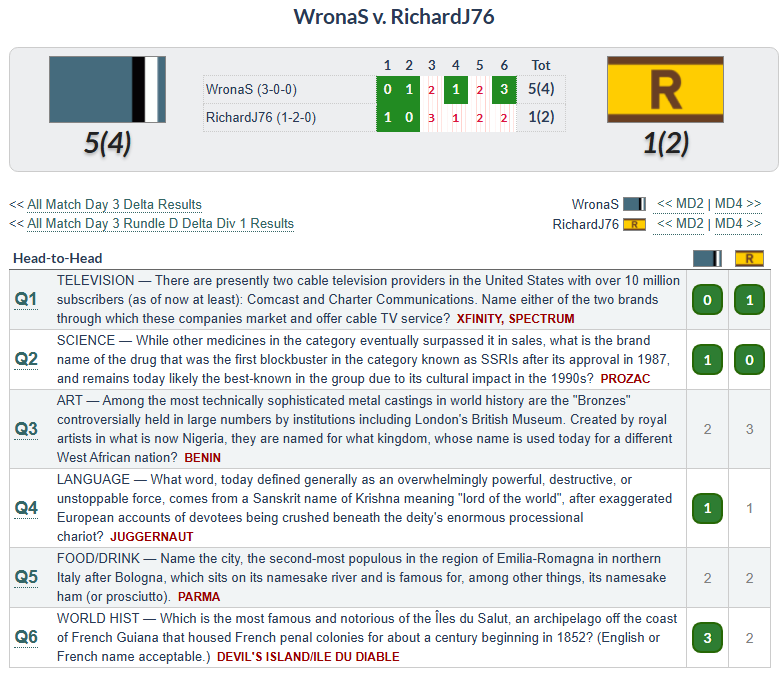
I might have missed Question 1 without my NASCAR fandom. The main Syracuse cable company has gone by many names over the years: Newchannels begat Adelphi, which begat Time Warner, which begat Spectrum, but I’m not sure whether I remembered the Charter/Spectrum connection, because I personally had switched to Verizon Fios in the interim. However, I certainly remembered Xfinity due to NBC’s silly self-promotional stunt by acquiring the rights to NASCAR and then simultaneously sponsoring its second-tier series under the Xfinity name. (That must have been what gave FOX the idea to buy a share of the IndyCar Series in exchange for putting all the races on FOX proper.) Prozac was easy. For Benin, I put Mali (that was really hard). Juggernaut and Devil’s Island were educated guesses I wasn’t 100% sure on but sounded like the best possible answers for those questions. I had never heard of Parma and put Salami, but it’s not a ham and also not a city. Oh, well. I didn’t know.
I kind of thought Sunday’s NASCAR race was the most enjoyable of the season for me. It prety much captured everything I like about the sport and few things I didn’t. It was a little annoying when all those cautions led to there being 30 cars on the lead lap, which sometimes in other races has led to demolition derby type races where the box score looks like it got run over by a random number generator, but that didn’t happen this time. Eventually, most of those guys who got lucky to get their laps back got lapped again, and I definitely prefer the wave-around rule to cars being on the tail end of the lead lap, which is one of NASCAR’s few recent gimmicks of the last 20 years that works. Ryan Blaney pretty much earned the win, and it was cool to see his pit crew giveth just as it had earlier taketh away in one race. After Josh Berry tapped Bubba Wallace to take the lead and then Wallace did the same thing to take it back, I was worried that was going to escalate into an all-out feud after the race, especially as Berry was chasing down Wallace for second, but it didn’t and that was cool. It was nice to see the Toyotas weren’t unbeatable for once, although the Chevies were still just as slow (and unlucky) as ever. And okay, after doubting whether Berry should still be in the Cup Series, he’s convinced me that he probably should. I’d welcome him to replace Austin Hill in the #33 or Ty Dillon in the #10 easily.
Here are two noted DTM champions and contemporaries, one of whom had his 43rd birthday Sunday and the other of which I skipped on his own birthday, July 14.
BRUNO SPENGLER…………….CANADA
Born: August 23, 1983
Best year: 2012
Best drive: 2012 DTM Race #10 at Hockenheimring Baden-Württemberg
The only North American champion of Germany’s Deutsche Tourenwagen Masters series, Spengler was nicknamed “The Secret Canadian” because he primarily raced in Europe and was simultaneously famous abroad while obscure at home. Born in France but raised in Quebec, he was so dominant in karting locally that he began commuting to Europe at age 12 to race. After winning the Formula Renault 2.0 Fran-Am championship in 2002,. While he went winless in the highly competitive Formula 3 Euro Series, Mercedes saw his potential and signed him to their Persson Motorsport DTM team in 2005.
Although Jamie Green utterly dominated Spengler that year when both were rookies, both were promoted to Hans-Werner Aufrecht’s perennial championship-contending HWA Team for 2006, replacing Jean Alesi and Gary Paffett alongside Bernd Schneider and two-time World Champion Mika Häkkinen. While Schneider won his fifth and final title, Spengler was the breakout star with a series-high four wins en route to a second-place points finish. After another runner-up in 2007, Spengler went winless in both 2008 and 2009 but led the championship for much of 2010 and 2011 before Paul di Resta and Martin Tomczyk overtook him respectively. Mercedes offered the 2011 Force India F1 ride to whichever driver won the 2010 DTM title; di Resta got it instead.
In 2012, Spengler abruptly left Mercedes to become a BMW factory driver. The marque was reentering DTM after a 20-year absence and hired Spengler as Schnitzer Motorsports’ lead driver. Improbably, Spengler won in his second start, then went on to win the championship. Entering the Hockenheim season finale three points behind Paffett, he qualified third behind Augusto Farfus and Paffett before taking the lead on Lap 1 in one of the greatest ever clutch drives. However, Spengler’s last seven seasons from 2013-2019 were much shakier, as he only won three races, finished outside the top ten in points four times, and bounced from one BMW team to another. BMW transitioned him into sports cars in 2020, where he earned his last major win in IMSA with Connor de Phillippi at Road Atlanta. His driving career wound down when he was named Bugatti’s “Pilote Officiel” in 2025.
The fact that Spengler was a star in Europe and utterly anonymous elsewhere gave him an odd legacy. Despite narrowly missing out on F1 opportunities, Spengler’s 14 DTM wins and his head-to-head records against Häkkinen and Ralf Schumacher suggest he was talented enough to be an F1 winner. Since di Resta’s F1 career was pretty anonymous in its own right, I don’t think Spengler has many regrets that he remained in DTM. His Mercedes performances were pretty amazing and he was the highest-rated DTM driver of 2011, but as great as his 2012 was, I find his BMW stint overrated. Nonetheless, the transition to European racing is typically difficult for North American drivers and he was one of the very few drivers of his era to make it internationally. He deserves better than being seen as a footnote in Canada’s racing heritage.
Touring car model: #89 of 1676 (.272)
Teammate head-to-heads: 197-139 (11-3 vs. Tom Blomqvist, 14-14 vs. Paul di Resta, 10-7 vs. Philipp Eng, 9-8 vs. Joel Eriksson, 7-5 vs. Augusto Farfus, 5-1 vs. Luca Filippi, 16-15 vs. Timo Glock, 24-19 vs. Jamie Green, 11-6 vs. Mika Hakkinen, 5-16 vs. Maxime Martin, 16-13 vs. Gary Paffett, 18-10 vs. Bernd Schneider, 23-3 vs. Ralf Schumacher, 3-6 vs. Martin Tomczyk, 5-1 vs. Giovanni Venturini, 15-3 vs. Dirk Werner, 5-8 vs. Marco Wittmann, 0-1 vs. Alex Zanardi)
Year-by-year: 2006: E-, 2007: E-, 2008: C+, 2009: C+, 2010: E-, 2011: E-, 2012: E, 2013: E-, 2015: C, 2019: C-, 2020: C-
MATTIAS EKSTRÖM…………..SWEDEN
Born: July 14, 1978
Best year: 2004
Best drive: 2009 Race of Champions
Possibly the 21st century’s most versatile driver, Ekström was primarily noted as a touring car driver, but he also won in rallycross, sports cars, off-road racing, while dabbling in numerous other series. Like many Scandinavians, he seemed to respect rally racers most, but he first drew attention in touring cars, where he won the Swedish Touring Car Championship in a privateer Audi at age 21 in 1999. That same year, he entered the World Rally Championship’s Swedish Rally; he eventually won his class in the same event in 2004, but that pales compared to his other accomplishments.
Audi signed Ekström as a factory driver in Germany’s Deutsche Tourenwagen Masters in 2001. He drove for the perennial championship contenders Abt Sportsline through 2017 and was sponsored by Red Bull starting in 2002, a year he won three times. He led Audi in the 2003 championship despite going winless, then won four races en route to the 2004 title. He was rather nonplussed about his accomplishment, saying he felt empty because he didn’t know what he would do next. He added another title in 2007 despite only winning once and finished tied for third with 23 wins.
However, his try-anything-once ambition was reflected in a myriad of other accomplishments. His unmatched ability to learn cars quickly resulted in him winning the Race of Champions four times (second-most behind Sébastien Loeb), most notably in 2009 when he defeated Tom Kristensen, current F1 champion Jenson Button, and Michael Schumacher to win. He won the 2011 24 Hours of Spa, then pivoted to rallycross racing late in his career, winning the 2016 World Rallycross Championship title over past World Rally Champion Petter Solberg in his own equipment, along with 12 wins overall. He next moved into electric cars, winning the first electric touring car championship in 2021 and two wins in the electric off-road Extreme E in 2023. Although it was a minor blip in his illustrious career, he and Jan Magnussen became the first Scandinavian NASCAR Cup Series starters at Sonoma in 2010 thanks to Ekström’s Red Bull connection.
Ekström was modest about his accomplishments, believing he was less talented than the F1 and WRC stars, but I don’t know about that. Reaching the pinnacle in an elite world championship usually requires single-minded dedication to one discipline, so Ekström’s decision to speedrun numerous side quests simultaneously may have prevented him from being a goat in any single discipline, but his versatility made him a lot cooler. This isn’t to say said side quests weren’t worthwhile, as Ekström believed his greatest strength was never using more grip than his tires could take, a skill he likely acquired from rallying. Although he was never the highest-rated DTM driver in my touring car model, he ranked fourth globally in both 2004 and 2005 despite being far more than just a touring car racer. Fans who regard F1 as the only relevant series may not respect him enough, but people who understand the global motorsports landscape definitely do.
Touring car model: #63 of 1676 (.300)
Teammate head-to-heads: 354-174 (27-15 vs. Christian Abt, 13-25 vs. Laurent Aiello, 2-3 vs. Mikel Azcona, 4-2 vs. Tom Blomqvist, 1-0 vs. Kelvin Burt, 0-1 vs. Paul Dumbrell, 1-4 vs. Heinz-Harald Frentzen, 7-0 vs. Rahel Frey, 1-1 vs. Robin Frijns, 10-1 vs. Jordi Gene, 5-3 vs. Jamie Green, 15-2 vs. Oliver Jarvis, 30-14 vs. Tom Kristensen, 4-0 vs. Katherine Legge, 0-1 vs. Craig Lowndes, 0-1 vs. Warren Luff, 8-0 vs. Allan McNish, 35-8 vs. Miguel Molina, 14-13 vs. Edoardo Mortara, 18-10 vs. Nico Muller, 5-0 vs. Daniel Nagy, 8-3 vs. Jan Nilsson, 1-1 vs. Kris Nissen, 7-3 vs. Mike Rockenfeller, 31-26 vs. Timo Scheider, 30-9 vs. Adrien Tambay, 7-0 vs. Peter Terting, 47-25 vs. Martin Tomczyk, 22-2 vs. Karl Wendlinger, 0-1 vs. Jamie Whincup, 1-0 vs. Markus Winkelhock)
Stock car model: N/A
Teammate head-to-heads: 0-2 (0-2 vs. Scott Speed)
Year-by-year: 1997: C, 1999: C+, 2000: C+, 2001: C+, 2002: C+, 2003: E-, 2004: 5, 2005: E, 2006: C, 2007: E-, 2008: E-, 2009: C+, 2010: E-, 2011: E, 2012: C+, 2013: C+, 2014: E, 2015: E, 2016: E, 2017: E, 2018: C, 2020: E-, 2021: E-, 2022: C+, 2023: C+