

I wanted to do an American driver for Independence Day, and I decided to push off the Sebastian Vettel post to get this done, but I ended up not finishing this before July 4 ended (at least in my time zone). I could have done one of the major drivers with a July 4 birthday (Yann Ehrlacher, Marc Lieb, Jan Magnussen, Johnnie Parsons), but the first three of those aren’t Americans, and I dropped Parsons from lock status to my bubble. So, I started thinking about drivers who won NASCAR’s Firecracker 400 back when the Cup Series raced at Daytona that weekend and decided to do Pearson today because his win there was one of the most iconic in Daytona history and, in my opinion, his best win.
In the wake of the NASCAR race at the Coronado Street Course two weeks ago, I’ve certainly been thinking about the 250th anniversary of America. I wish I could feel the patriotic spirit in my bones. I used to always watch either A Capitol Fourth or the Boston Pops Independence Day celebrations (usually Boston) every year as a boy, but I haven’t been able to get myself up for it for a long time. I just read Ryan McCafferty’s defense of Independence Day, and I rationally think he is correct, but I can’t feel it emotionally. I think my problem with all our national holidays is how they have become increasingly militarized. To celebrate our country is to celebrate the military, and I’m old enough to remember when these were viewed as more distinct. To be sure, most of our national holiday celebrations always had some level of military pageantry, but it really got to be too much to bear after 9/11. Although Memorial Day was always about honoring military dead, when I was a kid, I remember people celebrating it to honor their families’ non-veteran deaths too, and that part of it seems to have completely gone away. While obviously the War for Independence was a military endeavor, I remember that as well as more about celebrating the country than celebrating the military. As a NASCAR fan, I’m old enough to remember that in the ‘90s, a lot of the pre-race pageantry like the national anthem, the military flyovers (if they even existed then), and the invocation often weren’t even televised. There was a certain militaristic escalation of everything in our culture in the 2000s that I found truly nauseating, and like I said many times, it indeed made me stop watching NASCAR for a couple years. It was like if you opposed the Iraq War, NASCAR didn’t want you as a fan, so I said fuck it. Until I was so thoroughly rejected by hipster my college classmates who I shouldn’t have been trying to impress that I got back into it again. I think I’ve outgrown that sort of sentiment two decades later - I didn’t boycott the Coronado race weekend even though I was against the race on principle, even though I still talked shit about it. And I certainly admit the Cup race at least was excellent, even though I don’t want to see another race there ever again.
In most of my early adulthood, I was really Michael Moore-pilled. I hardly agreed with everything he said in his movies, mind you, but I definitely liked most of them, and for a long time there, I had the consistent attitude of “Europe-good-because-welfare-state and America-bad-because-lack-of-welfare-state”. I know a lot of even further left people would say that America is the worst country in the world because a lot of leftists rather pedantically calculate morality exclusively by death tolls. Whoever kills the most people is the worst by definition. It’s a metric for sure, but completely un-nuanced. It’s really just a reaction to America having the most power, but power can be used for good and for evil. I know most leftists say George W. Bush was the worst President and significantly worse than Trump because he killed the most people in the Iraq War, but on the other hand, he’s considered a hero to Africans because his PEPFAR program to fight AIDS in Africa saved many more times the number of people who were killed in Iraq and Afghanistan, even over the entire war. I’m not going to say I admire Bush or that his administration was more good than bad. He mainstreamed a lot of terrible things (besides his war crimes, helping tank the economy, and Hurricane Katrina, there was his opposition to environmentalism, militarizing everything, increasing a lot of people’s paranoia and fear about being attacked, and making most educated people think all religious people are stupid). I do not like that the Democrats are now pandering to his own base of neocons who nobody really likes anymore, but it’s telling that everybody is now judged exclusively by the worst actions and nothing can seemingly ameliorate that.
You see it everywhere. Because antisocial media apps thrive on outrage, embarrassments go viral while anything uplifting or heartwarming does not. Fomenting discord is profitable for corporations, which helped accelerate people’s inability to believe others can be trusted. Although this has existed for a while, as things like cable news also led to these tendencies, people increasingly judge entire groups by their worst members. All cops are bastards. All priests are pedophiles. All lonely men are incels. Or alternatively, all poor people are moochers. All homeless people are mentally ill. All Muslims are terrorists. The fewer people we interact with in real life, the more we judge entire groups by a strawman of a group if we’ve never interacted with someone from that group. And since, by and large, what you see in the media is negative portrayals of every group, it literally foments hate. I was all over this when I published Nerds per Minute in 2021:
“Basically, I guess I was to the right of my Cornell classmates socially and to the left on economics, which was about the least cool ideology you could have on a campus in the early 2000s. I viewed this as more consistent than either of the actual party platforms because it seemed to be best opposed to selfishness and hedonism, both of which I saw as bad things. However, the culture was obviously moving in the exact opposite direction as the general bipartisan consensus was that runaway capitalist consumerism and a fetish for corporate branding was something to be embraced and that all traditional social mores should be rejected, not merely the bigoted ones. Everybody now just wants to shock the ostensible establishment probably mostly for marketing reasons, because that’s what gets you the most clicks. This of course leads the cultural left to too often act like anyone who is religious is a bigoted moron because people like the Westboro Baptist Church stole the spotlight, and likewise the cultural right too often acts like anybody who is not religious is a militant provocateur in the manner of the New Atheist school (this was of course before the New Atheists gradually turned into a right-leaning movement themselves). It’s infuriating to see people in echo chambers seeming to judge their ideological opponents primarily based on media perceptions of the fringe minority on the other side, particularly now that the images have been taken so seriously that they actually became the reality. However, I suppose that’s entirely a ramification of what happens when clickbait journalism is more profitable than nuance and whatever creates the most outrage and fear wins. Lately it seems like the only difference between intellectuals and anti-intellectuals is whether they use proper spelling and grammar in their ad hominem attacks, rather than actually avoiding them in the first place.”
Do I still agree with everything I wrote there? Maybe not, but I think I might have been a little ahead of the curve on this (especially since I actually wrote this around 2017 and 2018, not 2021 when I published). I’m old enough to remember when the conventional wisdom was “never speaking ill of the dead” and maybe it is still is in “meatspace” (a word I hate), but I am so very tired of “rest in piss” culture, although I see where it came from. I’m old enough to remember when the states didn’t even have flippin’ colors (blue states and red states were an invention of the media during the 2000 election recount, like I’ve said). And I’m sure as hell old enough to remember when we didn’t celebrate the deaths of regions where the plurality of people voted for the other party (including the people in the minority who voted the same way we did)! I’m always whining about the breakdown of civility and too often I sound like an Aaron Sorkin character, and I’m not sure how I feel about that.
McCafferty cited the famous speech from Sorkin’s The Newsroom. I was a big Sorkin fan in my late childhood/early adulthood. I loved The West Wing, The Social Network, and Moneyball, and I liked A Few Good Men, The American President, Sports Night, and The Newsroom (albeit with big reservations). He lost me with Steve Jobs, which I thought was dreadfully boring, and I haven’t watched anything since, although I’m sure I’ll check out The Social Network 2 at some point. I continue to like his writing style even though I’ve drifted away from his politics. If his entire oeuvre can be summed up in one line, I guess it’s this: “Liberals are the real patriots”. That did really capture the Democratic Party zeitgeist in the 2000s in the Kerry and the Obama years, so it’s obvious why Sorkin was so popular then. But the conservatives hated him because he was a liberal, the liberals grew to hate him because of his casual sexism (which was always his biggest flaw), and the leftists hated him for his bland Clintonesque neoliberal politics, so I imagine a lot of it aged really badly.
It seems like a lot of discussions about civility politics are just saying that we shouldn’t be civil towards politicians or CEOs or the 1% and I agree with that. People should be able to talk back and criticize people in power, so the whole Chapo Trap House attitude of punching up is not something I’m against intrinsically. The problem is that so many people thought punching up meant working class people in underprivileged groups attacking working class people in privileged group. Even though it’s easier with social media, it’s still hard to actually contact the real people in power, so mainstreaming this culture of anti-civility online effectively meant powerless people are attacking powerless people in both directions while the rich people laugh their way to the bank. I’m not saying people should be civil to politicians, but we should be more civil to each other, and I’m old enough to remember when the Internet was more civil before all that Something Awful and 4chan crap filtered through everything and made everyone start making quips like they’re stand-up comics without realizing that stand-up comics often wind up miserably unhappy. I’ve already used that line before. I don’t remember whether I have here.
The problem is that the Democrats tried civility and it lost because civility doesn’t sell. I don’t know how you incentivize people to trust their neighbors rather than just believing the worst of everyone. I guess getting offline may be the only way, and I do want to. I was trying to push hard to finish this book even though it wasn’t in my best interest financially or monetarily just so I can go off somewhere in some small town or something, and become a recluse in some corny place where everybody knows my name. I thought I’d get that when I moved back to North Syracuse, but I never really did.
I know even orthodox Marxists acknowledge the American Revolution as a great thing since it was an example of capitalists overthrowing a feudal society, and it’s really only radical liberals who care entirely about liberation and social dynamics and not much about economics who don’t. Nonetheless, those people do have a lot of institutional power because opposing middle American mores creates outrage, and outrage is the engine that builds power and clout. As I mentioned in my own self-quote, I don’t believe that “all traditional social mores should be rejected”, so based on my own principles, I know I need to love this country more than I do, but I’ve really struggled to feel love for anything for a long time. I wish people would draw a clearer distinction between loving the country and loving the military, but it doesn’t seem like anyone wants to make that distinction anymore, so it makes sense that if conservatives say the military = the country, then a lot of people will hate the country too. I know a lot of hippies tried to say “We’re not against the soldiers, we’re against the war”, and there’s the whole Sorkin/John Kerry “Liberals are the real patriots”, but neither of those arguments seemed to work either. I get why a lot of liberals have renounced patriotism because they feel they can’t beat conservatives at their own game, but on the other hand, I think anti-civility is worse than civility, and the reason a lot of the Chapo-type leftists thought civility was bad was that it covered up bad politics. But ultimately, the problem was the bad politics, not the civility, and I probably just need to get out of my own head.
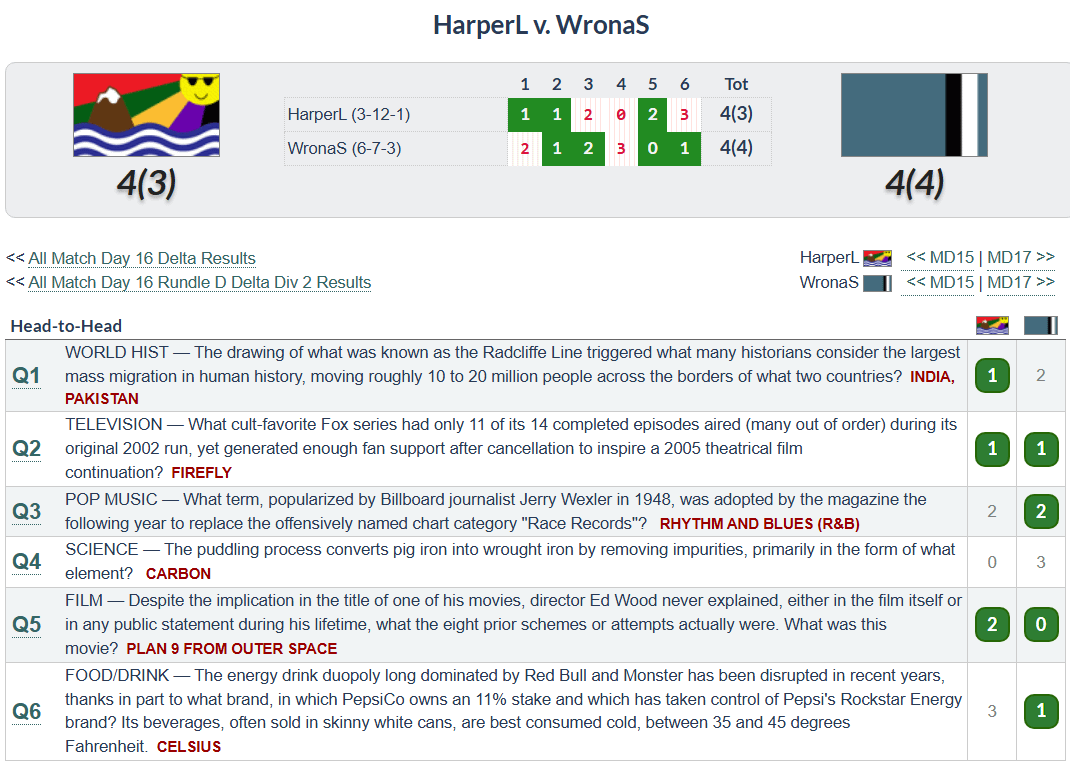
I would have won this if I simply didn’t assume Question 4 was the easiest question when it was judged as the hardest question by the plurality of players. I guessed copper. India and Pakistan makes sense, especially since the line was obviously named for a British guy and obviously India was a British column. I guessed West and East Germany. I had heard of Celsius and figured Fahrenheit was a hint. That left Question 5. Now, I love the movie Ed Wood so I was certainly familiar with the existence of Plan 9 from Outer Space (I even stupidly bought it once), but the problem was that I just couldn’t remember what the preposition was. I couldn’t decide whether it was Plan 9 in Outer Space or Plan 9 of Outer Space. I put Plan 9 of Outer Space. They gave it to me anyway even though I was wrong, although it wouldn’t have mattered if I’d missed it.
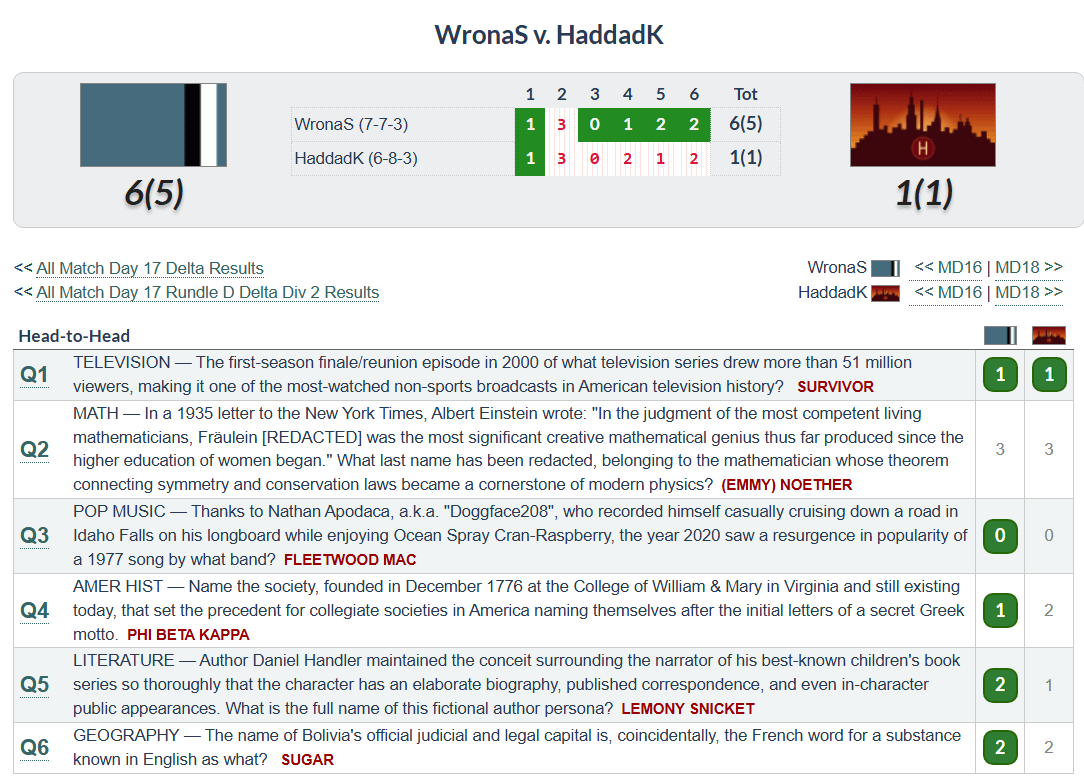
I thought these were mostly obvious, although Phi Beta Kappa and sugar/Sucre were educated guesses, and Lemony Snicket was too. I never read any of those books but I knew they were billed as “Lemony Snicket’s” so I pulled that too. As usual, the math questions are more obscure than any other category. I had never heard of Noether and put Marie Curie.
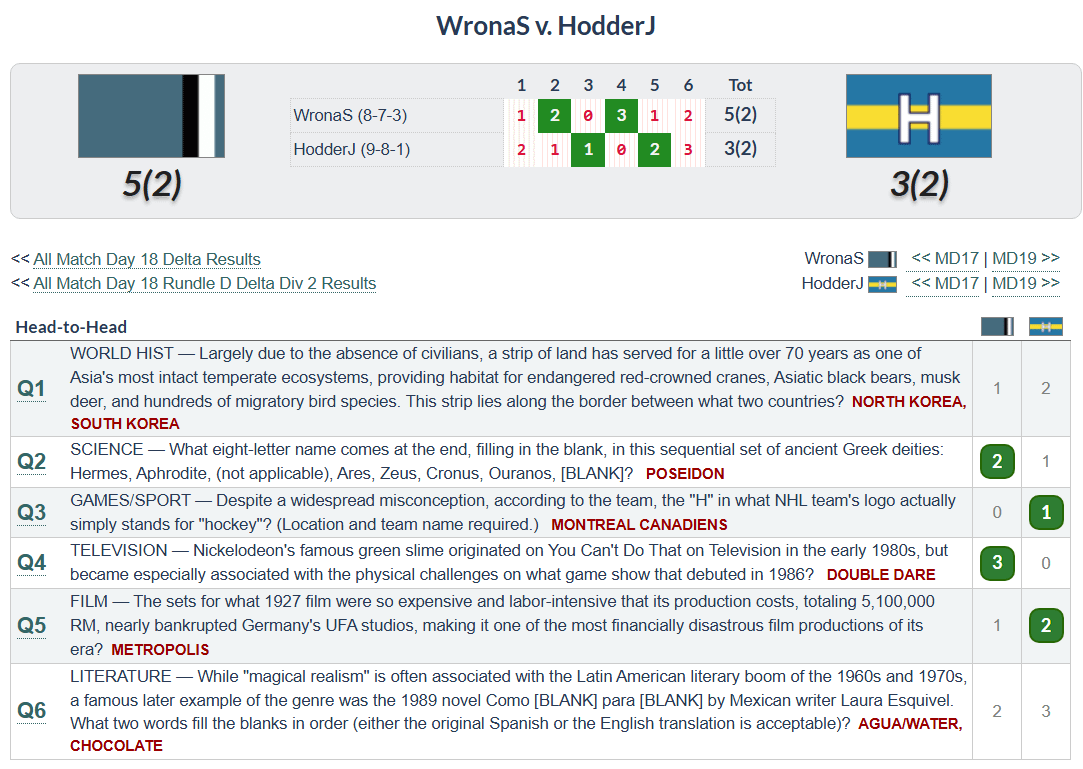
If I’d been reading Question 1 carefully and thought “what happened in Asia a little over 70 years ago”, I’d have gotten that. I ended up putting Mongolia and China, which was not a good answer. I knew that Hermes, Aphodrite, and Ares translated to Mercury, Venus, and Mars, so I knew it was the planets. I just had to remember what Neptune translated to and guessed correctly that it was the god of the underworld. I haven’t watched any hockey nor looked at hockey team logos in a long-ass time. I put the Chicago Blackhawks. Probably almost anybody in my age cohort remembers Double Dare, but I’m guessing most of the LearnedLeague players are now too young for that show. That was a weird question for me to score three points. I guessed Greed for Question 5, and that was a great answer as I know it was one of the biggest and most ambitious movies of the ‘20s. I’ve heard of Like Water for Chocolate I think, but I’d never be able to pull that. I guessed hombre and mujer.
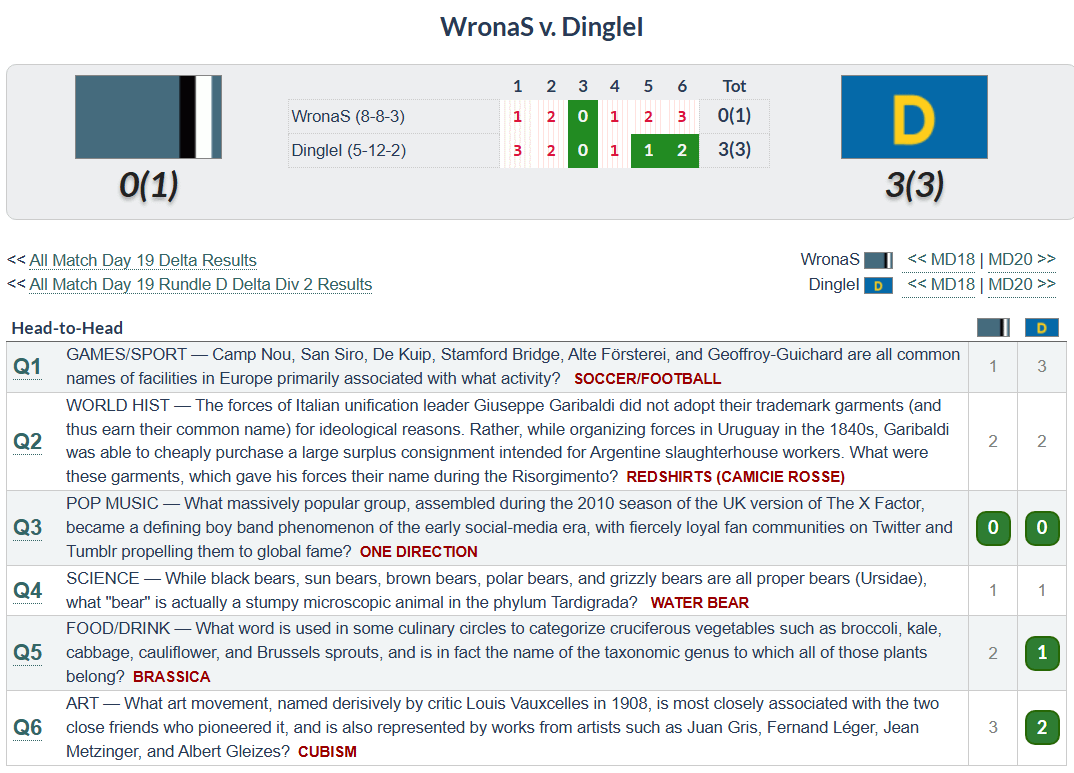
I should’ve known that in the contest that was running at the start of the World Cup that there’d be soccer questions. My bad. I put fencing. I’ve certainly never heard of any of those arenas. Redshirts made sense but I had nothing. I put chinos. I always forget what a tardigrade is and I put “bearfly”, which doesn’t exist. Never heard of brassica, put legumes. The last one is the only one where I think I was close. I put Dadaism, and that certainly emerged in the same time period.
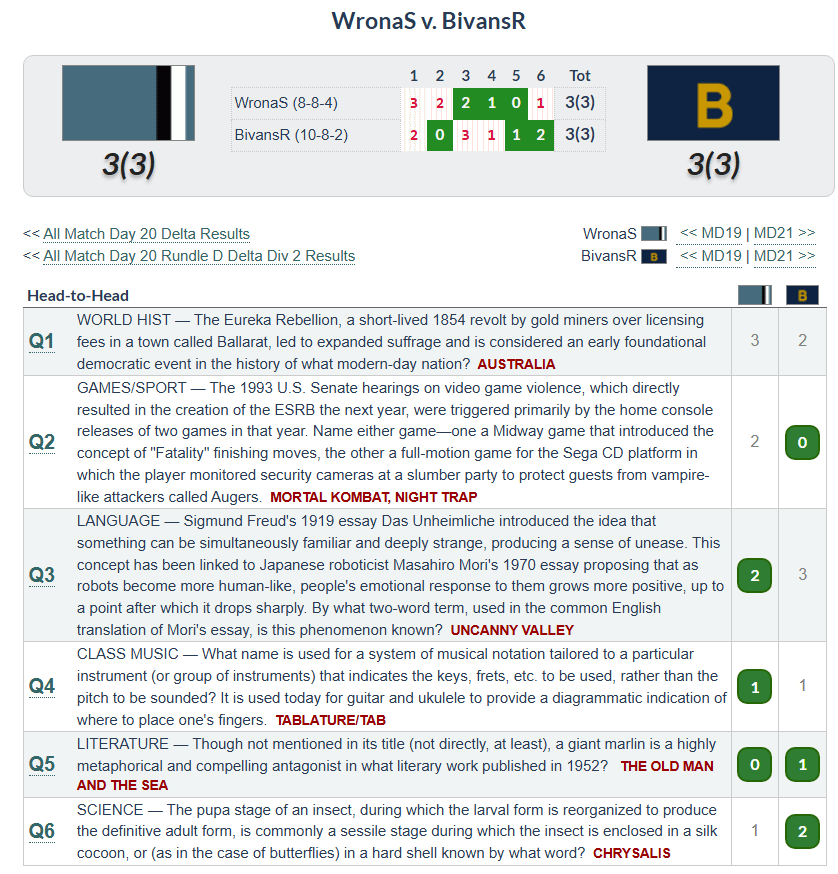
I put Mexico for #1, which I don’t think was a bad guess since I knew that was around the same time as Mexican independence and also because I associate Eureka and gold rushes with California. I knew Eureka was in California, which used to be a part of Mexico, so I thought that was a safe guess (even though it looks like Eureka is not in the part of California that was Mexican territory). I actually had Mortal Kombat initially for Question 2 and changed it to Doom. Oh well. Those were what I thought the two games would be. I have never heard of Night Trap. I’m glad I reasoned out uncanny valley. I’m embarrassed I couldn’t remember chrysalis. I had nothing. My mom even wrote poems about chrysalises.
DAVID PEARSON…………………….USA
Born: December 22, 1934
Died: November 12, 2018
Best year: 1973
Best drive: 1974 Firecracker 400 at Daytona International Speedway
Often cited as the best NASCAR driver in history, Pearson was overshadowed by his chief rival Richard Petty because Petty ran full-time while Pearson typically didn’t, but Pearson nonetheless became the second driver after Richard’s father Lee to win three titles. After winning the track championship at Greenville-Pickens Speedway in 1959, a fan club helped Pearson buy his first Grand National car in 1960, when he won Rookie of the Year.
Having shut down his own team due to lack of funding, he took on a roofing job before landing a last-minute ride at the 1961 World 600 for John Masoni’s factory team. Improbably, he won that race and two others that year before hooking up with Cotton Owens in 1963. After losing the 1964 title to Petty, they both skipped most of the 1965 season due to the Chrysler boycott, instead entering drag races and USAC Stock Car races, but Pearson won the 1966 title on his full-time return. After switching to Holman-Moody in 1967 (a season he also became the first NASCAR driver to win a Trans-Am race), he won back-to-back titles in 1968 and 1969 and 27 wins to Petty’s 26.
He left Holman-Moody in 1971 after they stiffed him out of appearance money but hit his career peak when he joined the Wood Brothers in 1972. The team typically skipped all races except superspeedways, Martinsville, and the season-opening Riverside race. In 1973, he posted the best single-season winning percentage of 61.1%. He gained the nickname “The Silver Fox” for both his early gray hair and his tendency to emerge as a late-race threat. In the 1974 Firecracker 400, he faked a blown engine to prevent Petty from making a last-lap slingshot pass, instead doing so himself. In 1976, he won his only Daytona 500 after he and Petty crashed on the last lap because only he could keep his car running. He then won the World 600 and Southern 500 to become the second driver to sweep all three. However, he abruptly quit the team after a botched pit stop at Darlington in 1979, only winning two races afterward before slowly stepping away to focus on his Busch Series team, which won back-to-back titles with his son Larry in 1986 and 1987.
I used to consider Pearson the greatest driver in history, but I’ve since changed my mind. Petty and Pearson were very evenly matched, with Pearson beating Petty 33-30 in their 1-2 finishes, although Petty led 290-261 in all finishes. Pearson’s 105 wins in 574 starts give him a better winning percentage, but Petty had a better winning percentage when comparing their prime seasons. I ultimately favor Petty overall for the raw volume, but I think Pearson was better on superspeedways. Ultimately, I take Dale Earnhardt and Jimmie Johnson over both because IndyCar drivers were the best oval drivers in the world in the ‘60s and ‘70s and they weren’t by the ‘90s. While he’s no longer my goat personally, I understand if he’s yours.
Stock car model: #58 of 319 (.068)
Teammate head-to-heads: 18-10 (1-2 vs. Bobby Allison, 1-0 vs. Mario Andretti, 0-1 vs. Buddy Baker, 0-1 vs. Ivan Baldwin, 4-0 vs. Earl Balmer, 2-0 vs. Charlie Blanton, 2-0 vs. A.J. Foyt, 1-0 vs. Dick Hutcherson, 0-1 vs. Fred Lorenzen, 1-0 vs. Tiny Lund, 0-1 vs. Cotton Owens, 0-2 vs. Jim Paschal, 1-0 vs. Swede Savage, 5-1 vs. Billy Wade, 0-1 vs. Joe Weatherly)
Year-by-year: 1959: C+, 1961: C+, 1962: C, 1963: C, 1964: E, 1965: C+, 1966: E, 1967: C+, 1968: E, 1969: E, 1970: C+, 1971: C+, 1972: E, 1973: 5, 1974: E, 1975: E, 1976: E, 1977: E-, 1978: E-, 1979: C+, 1980: C+