

I already voiced my displeasure with the jingoistic display of patriotic fervor that flashed back to everything bad about 2000s NASCAR, but I must begrudgingly admit that the race itself was a banger. It seems what makes NASCAR races interesting these days is not knowing what to expect. Although the competition was great, one thing that made the 2000s and early 2010s a real drag was how stagnant the schedule was. No era in NASCAR history had so little rotation between tracks as that one, and that is one big reason why I find that era more boring than a lot of people do. Racing on the same tracks in virtually the same order every single season made it easier to optimize, and perfect optimization makes sports boring (which is why I understand why some people hate analytics). Once you figure out how to optimize performance over a certain set of tracks, it’s easier to remain on top when the schedule never changes. It’s telling that Jimmie Johnson’s five-peat occurred during this period. Not to take anything away from him since that is one of the greatest accomplishments in NASCAR history, and I would take him second all-time after Earnhardt, but I don’t think a five-peat even could have happened in any other period when the schedule was less sterile. (To be fair, he did still have to deal with a new generation of car and a couple minor changes to the Chase format in those years.)
So while a lot of younger fans absolutely hate the current car and 2020s NASCAR in general and desperately want the 2000s or 2010s back, I have enjoyed this decade vastly more than the last two. Not only is a lot of the cultural baggage I hated gone, but Jim France as NASCAR President has shown a willingness to throw anything against the wall and see what sticks as opposed to the sterile Brian France era. I know Kyle Busch hated the loss of practice sessions, but I honestly think that improved the racing since it made the racing harder to optimize for the teams (the loss of qualifying during COVID did suck though, especially the stupid metric starting grids). The addition of several road and street courses where NASCAR had never raced before, finally racing in the rain for the first time in over 50 years, drafting at Atlanta, the Bristol dirt race, racing on infield road courses, the tire-shedding Bristol race with 54 lead changes, experimenting with optional tires, and the introduction or reintroduction of short tracks like North Wilkesboro, Iowa, Bowman-Gray, and the Los Angeles Coliseum, where many of the drivers had minimal experience really shook things up. Races became more difficult to predict since the frequent changes to the schedule and the tire compounds made things harder to optimize. Not all these changes worked (the Bristol dirt race and the Indianapolis road course race particularly were duds), but those things along with off-track stuff like finally denouncing the Confederate flag and so on and a far less egotistical generation of drivers really revitalized NASCAR in this decade and I don’t get why so many people are whining about the Next Gen car specifically for its aero push. I was around in the late ‘90s, 2000s, and 2010s and there was a hell of a lot of aero push in those eras too and it’s been a constant complaint the entire time! Sure, there wasn’t as much aero push on short tracks then and the short track racing has indeed been pretty bad this decade, but at least NASCAR is no longer complacent.
So, while I hated and still hate the idea of racing on a naval base and I feel the circuit itself was pretty unsafe because so many cars hitting the wall caused indentations into the wall causing lengthy repairs, at least the track conditions were so bumpy and grimy that no one really knew what they were doing, which, as usual, made the racing better. It also meant experience didn’t really mean anything as all the teams were starting at square one, and you could tell because the drivers who were talented but had underachieved because they hadn’t properly figured out the Next Gen car this year were competitive, what with Corey Heim winning, Connor Zilisch having arguably his best run, and even Austin Hill taking the lead on a restart before his typically obnoxious overdriving took him, Zilisch, and Shane van Gisbergen out. I was kind of disappointed SVG got taken out because I wanted a foreigner to win to combat the nationalism, but it certainly made the race more interesting. I know in my early years as a fan in the ‘90s that NASCAR always used to talk about how “15 guys can win every race” and I always laughed because that was never true (except on plate tracks I guess). Sunday, it actually felt true. At various points in the race it looked like any of the following drivers could have won: Ryan Blaney, Chris Buescher, Heim, Kyle Larson, Ryan Preece, Tyler Reddick, Zane Smith, SVG, Bubba Wallace, Zilisch. Maybe 15 is pushing it, but there were times I thought all those guys were going to win.
For most of the race, I thought it would be Buescher just because it seemed like the Fords were consistently faster than anyone else, particularly in that point of the race when Preece shockingly took the lead on merit, and Buescher in my opinion is the best Ford driver on road courses. He was indeed leading but after Larson had his electrifying stint late in the race, I assumed Larson would run Buescher down just like he did at Sonoma in 2024. Then the caution came out for oil on the track and Buescher and runner-up Smith pitted for tires, but I guess it didn’t really help because they only had scuffed tires left. I really expected Larson would win after that, but then Heim and Reddick blasted through the field better and it looked like Reddick had him until he cut a tire, although admittedly, Heim had already passed Reddick before Reddick’s tire went down. It was a bit of a disappointment that it was another Toyota win and it’s also annoying that Heim probably intentionally wrecked Carson Hocevar as part of their long-standing feud en route to victory, but it still felt something like a breath of fresh air. The way to make racing better: give the teams insufficient time to prepare. I know I didn’t expect there to be 11 on-track lead changes in that race, and you could argue there were more since I didn’t count a couple in the middle of pit cycles. Blaney’s 12 laps led were the least for a driver who led the most laps in NASCAR history. We don’t know that 100% for sure because there are a lot of Cup Series races in the ‘50s and ‘60s with incomplete lap leaders, but most of those were 200 lap races on half-mile dirt tracks, so I think we can be pretty sure.
Definitely no one was expecting a Heim win, least of all me. I had actually signed him for my All-Racing Fantasy League team, which I have been competing in since 2009. We select 12 drivers across Formula 1, IndyCar, NASCAR, Formula E, IMSA, and the WEC with all drivers scoring points according to that era’s IndyCar points system (basically the 2000s IRL points system without any of the Indy 500 qualifying points, etc…) When there are both oval and road races in a given weekend, you start up to eight drivers with a maximum of five drivers in either discipline, but when there are only oval races or road races on a given weekend, you can only start five. My team is: Nick Cassidy, Ty Gibbs, Ross Gunn, Corey Heim, David Malukas, Oscar Piastri, Zane Smith, Dries Vanthoor, Rinus VeeKay, Bubba Wallace, Ye Yifei, Nick Yelloly. I started Cassidy, Malukas, VeeKay, Gibbs, and Smith, which I thought was probabilistically correct given Heim’s inexperience and Wallace’s historical road course struggles, but then Heim and Wallace finished 1-2 while Cassidy DNFed in his Formula E race and VeeKay had a mediocre run. However, we are allowed one mulligan where we are allowed to make post-hoc adjustments to our team and I figured this was definitely the race to do it, and that put me into the lead. My decision to go all in on Toyota has clearly reaped dividends, and it helps that Malukas, Gibbs, Smith, Heim, and Yelloly are also exceeding expectations. I signed Heim in the very last round because we are allowed one “keeper” a year where if we keep one driver the entire year, we can keep them the next season and take them in the previous round. I really didn’t like Gibbs’s trajectory after last year and I wanted to sign Heim so I could bail if it seems like he has a better trajectory. I honestly had a tough decision between Gibbs and Malukas entering this year since I had Malukas last year as well, but even though Malukas is my favorite IndyCar driver and Gibbs is one of my least favorite NASCAR drivers, I made the correct decision to keep Gibbs. Sure, Malukas’s performance is better even though he still hasn’t won yet while Gibbs has, but Gibbs will certainly outscore him due to the much larger number of races. Gibbs vs. Heim next year is going to be an even harder decision if I continue. My team name this year by the way is Autism Whimpers, a parody of Autism Speaks.
While I talked about NASCAR not being complacent in this decade, IndyCar has very much been complacent this decade. This is why I enjoyed IndyCar much more than NASCAR in the 2010s, but enjoyed NASCAR much more this decade. I’m even saying this even though I acknowledge this decade’s IndyCar fields are vastly superior to those lackluster 2010s fields that were dominated by aging CART/Champ Car stars, with nearly every Indy Lights prospect busting and seemingly only Josef Newgarden able to gain a foothold against the old veterans. Field quality and racing quality do not always have much to do with each other. Even though IndyCar has always had new tracks cycling in and out, usually what that means is established oval races falling by the wayside, and even most of the “new” tracks are tracks where they had already raced before, except for boring street races nobody wants. IndyCar’s schedules and cars are as sterile as 2000s/2010s NASCAR now, but what makes it worse is that Álex Palou is a way more boring driver than Jimmie Johnson. Indeed, he might be the most boring driver in history at that talent level. It definitely made me underrate him for years and assume that it was inevitable that either Colton Herta, Scott McLaughlin, and/or Pato O’Ward was going to overtake him, but now it seems pretty clear that will never happen. I guess it’s going to be either Kyle Kirkwood, Christian Lundgaard, or David Malukas who eventually dethrones him now (probably Kirkwood, but it could be any of them, and they seem very close talent-wise; that 2022 rookie class is now maybe looking like it could be the best ever).
That being said, in spite of how sterile the racing has been on paper, I’ve enjoyed this IndyCar season more than the last few (although definitely less than I’m enjoying NASCAR right now). Several of the races I expected to be boring ended up having more entertainment value than usual, what with Kirkwood’s impressive pass against Palou at Arlington, Lundgaard’s impressive pass against Malukas at the Indy road course, not to mention the instant classic Indy 500. Road America was another example. Palou really is showing more signs of vulnerability this year than he has the past few even though he’s still going to win the title because I don’t think Kirkwood/Lundgaard/Malukas are ready to challenge yet. He’s definitely raised his game on ovals and the five straight poles is amazing, but how many people expected him to win only one of those races? After years of seemingly never making an incorrect strategy call as seemingly only Ganassi knows how to strategize in IndyCar, they botched the strategy at both the Indy road course and Gateway and this time Palou threw away a race he probably would’ve won otherwise despite the correct strategy after speeding. I think he’s just been really lucky that Herta left the series and O’Ward and McLaughlin didn’t develop into what we thought they would a couple years ago.
After the Gateway race, I offered my mea culpa on selling Marcus Ericsson too short after he had the best drive of his life and now I must do the same for another Marcus. For a long time, I struggled to take Marcus Armstrong seriously. I thought it was ridiculous when Chip Ganassi hired him on the basis of three consecutive 13th-place points finishes in Formula 2. Yes, he won Rookie of the Year, which in a Ganassi car he’d better, but he only barely beat Agustín Canapino, who was as much of a bust in his IndyCar crossover as Jimmie Johnson was (and the decade’s second-biggest asshole to boot!) Yes, I know Canapino ran the full schedule and Armstrong ran road courses only, but still… I think what really irritated me about Armstrong the most was that he remained in the series while the next year’s Rookie of the Year Linus Lundqvist did not even though they were teammates and I think Lundqvist was better. Lundqvist won five minor league titles, which I think trumps a triumvirate of thirteenths, and he already had a pole, two podiums, and two fastest laps in barely a year’s worth of starts. Yeah, sure, Armstrong barely beat Lundqvist in points but Armstrong was in his second year and Lundqvist was in first. I don’t think either of them deserved Ganassi rides immediately, but Lundqvist shouldn’t have been jettisoned never to return and I think he had a higher trajectory. I will grant that the name redundancies amongst the Scandinavian drivers are getting ridiculous at this point. Linus Lundqvist’s first name rhymes with Rinus VeeKay’s while his last name feels like a portmanteau of Christian Lundgaard and Felix Rosenqvist. There are now two Christians and two Marcuses (although Armstrong is from New Zealand, not Sweden). I can get how all of this can get confusing for a casual fan, or even a seasoned racing archivist, as the below immortal screenshot proves, but if all these drivers are deserving (which they are), who cares? And thank you Dennis Hauger for being the first active Scandinavian driver whose name can’t be confused with someone else’s!
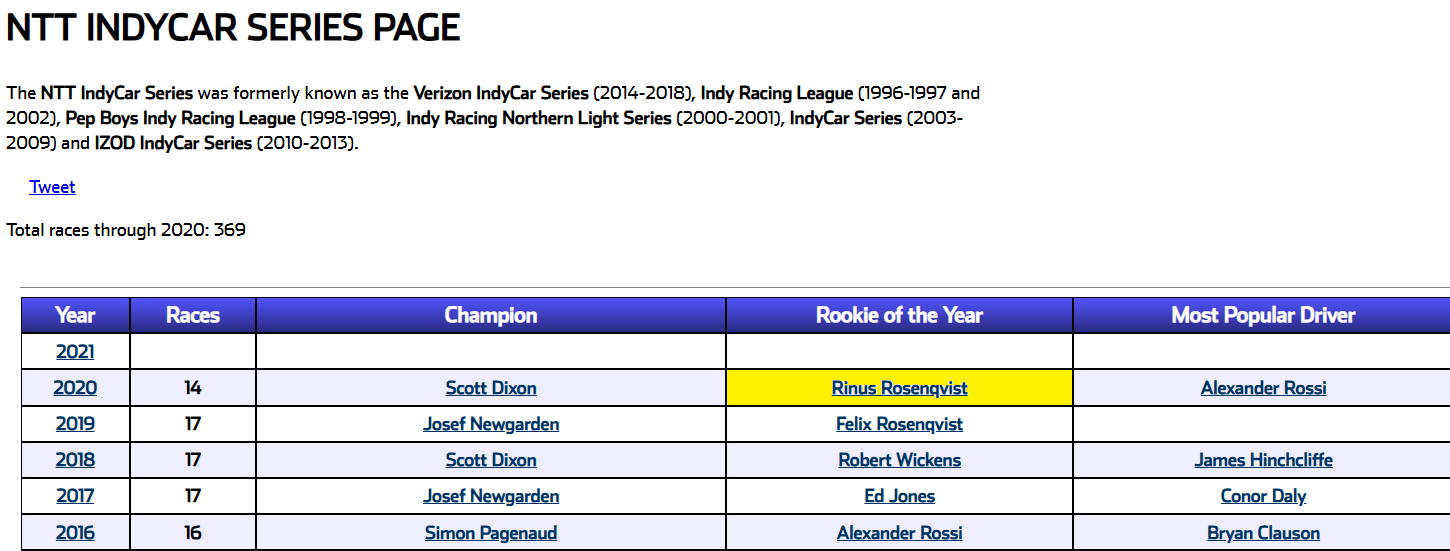
Yeah, Lundqvist only finished 3rd in Indy Lights in 2021, but he lost to Kirkwood and Malukas and they swept the season. Sure, Kirkwood tied Greg Moore’s single-season record with ten wins, but Malukas won seven and Lundqvist won three and they weren’t that far apart. Considering what Kirkwood and Malukas have been doing, he shouldn’t have been gone, especially since he dominated the 2022 season after Kirkwood and Malukas both advanced, and crushed several drivers who are still active now (Sting Ray Robb, Christian Rasmussen, and Kyffin Simpson - yes, Rasmussen is good and he has a bunch of minor league titles himself, but blech on those other two).
I think that’s the main reason why Armstrong rubbed me the wrong way, much like how I started disliking Conor Daly because he had such insane longevity, while Carlos Muñoz was out of the series quickly after outperforming him. It didn’t help that in Armstrong’s 2025 season, he seemed to turn mediocre runs into eighth-place finishes every single week. After begrudgingly listing him at the very bottom of my top 200 list last year, I compared him to Charlie Kimball due to being a wildly undeserved Ganassi hire and propelling that into longevity he did not exactly deserve, and I predicted that he’d have essentially the same career as Kimball: about seven years with one and only one strategy win and a couple finishes in the back of the top ten in points before everyone quickly forgets he ever existed. Despite my typical aversion for fake red flags at the end of races, I was actually excited about this year’s Indy 500 red flag because it prevented Armstrong from winning. The Ericsson win was bad enough since I consider him one of the top ten worst Indy 500 winners, but I would’ve definitely put Armstrong in the bottom five and even lower than Ericsson if he had won. Now, I guess I have to admit I was wrong.
After qualifying third, Armstrong immediately took second from Malukas and was coming pretty close to keeping up with Palou. The Road America race had several ridiculous strategy reshuffles that threatened to ruin the race, as the caution came out several times in the middle of pit stops. Armstrong’s teammate Rosenqvist seemed poised to steal the race until he got caught out by the caution (and even Townsend Freaking Bell called the team out for this even before the caution came out), but the funny thing was Armstrong got his track position back by being aided by that caution as well as Palou’s speeding penalty. Since he was running second to Palou before all the strategy reshuffles and then Palou sped, he obviously deserved the win and he would’ve won had his engine not blown with three laps remaining. Granted, I think eventual winner Lundgaard had the better drive as he was last and 100 seconds behind Palou for the entire first stint after clipping his wing on the opening lap and came back to win, but although he was catching Armstrong at a rapid pace, I don’t think he would’ve gotten him. Okay fine. After begrudgingly admitting at Gateway that the other Marcus had earned his place when I was skeptical, I now must for this Marcus as well. He and Rosenqvist are certainly benefiting from the fact that Ganassi has dominant cars since Meyer Shank Racing is a Ganassi satellite, but they’ve also been pretty consistently outperforming Scott Dixon this year, and I can’t say I saw that coming.
I was going to try to do two at once, but Ingram took me forever because identifying a best season and race for a driver who peaked in an era when none of the races were properly archived was a challenge. I literally went through all his wins listed on The Third Turn to pick the right one, and I think I did.
JACK INGRAM……………………….USA
Born: December 28, 1936
Died: June 24, 2021
Best year: 1974
Best drive: 1980 Sportsman 300 at Daytona International Speedway
The most successful driver in what is now called the NASCAR O’Reilly Auto Parts Series, Ingram led all drivers with five championships and at least 183 wins. Many fans misunderstand the full context of his career because most of Ingram’s wins and titles came in the Late Model Sportsman era that preceded the formation of the Busch Series, but he remained successful into the Busch era and won the series’s first title. The Sportsman races were never properly archived and are difficult to research, but enough information is available to prove that he has vastly more wins in the series than Kyle Busch, even if he likely faced worse competition on average.
For most of Ingram’s career, he raced his self-owned #11 car, where he became both the most consistent and most dominant driver in series history with 24 consecutive winning seasons from 1964-1987 and 19 consecutive top ten points finishes from 1971-1989. In all but two seasons from 1965-1986, Ingram had at least five wins. In his era, the Late Model Sportsman championship was a rather haphazardly structured array of local track races, much like today’s Weekly Series. Competing for championships required entering a grueling number of races. When Ingram won his three consecutive Late Model Sportsman titles from 1972-1974, he won four races in four consecutive days on Labor Day weekend. The next year when he earned a career-best 17 wins in 66 starts, he worked 80-100 hours a week to compete before he stopped competing for championships until the advent of the Busch Series in 1982.
When that series began and introduced a full-time touring schedule for all drivers, Ingram won the first championship and remained a dominant force, winning the 1982 and 1985 titles, bookending Sam Ard’s two titles. He was also poised to win the 1986 title until being suspended for intentionally ramming and injuring Ronnie Pressley in a local track race, then getting into a brawl. He held a 250-point lead before the suspension, but lost the points lead and the championship as a result. His career never recovered.
I can’t rate any of Ingram’s seasons as elite because he rarely competed against fields with 30 or more cars, and he seldom beat current Cup Series stars head-to-head, although he did win multiple races against Darrell Waltrip, Bobby Allison, and Dale Earnhardt, and did earn a then-record 31 Busch wins to Dale Jarrett’s 2 when they both competed full-time. He also had at least 117 Sportsman wins to Harry Gant’s 84 when they simultaneously before Gant switched his focus to the Cup Series. Ingram’s biggest win came when he passed Gant at the Daytona 500 support race in 1980 against a 40-car field. Although he rarely entered Cup Series races, he earned a second-place finish at Hickory during Richard Petty’s ten-in-a-row streak in 1967. While I find some of the minor league NASCAR Hall of Famers and 75 Greatest Drivers to be overhyped (especially Jerry Cook and Hershel McGriff), Ingram’s reputation is certainly deserved.
Year-by-year: 1965: C-, 1966: C-, 1967: C-, 1968: C-, 1969: C-, 1970: C-, 1971: C, 1972: C+, 1973: C+, 1974: C+, 1977: C-, 1978: C, 1979: C, 1980: C+, 1981: C+, 1982: C+, 1983: C, 1984: C, 1985: C, 1986: C-