

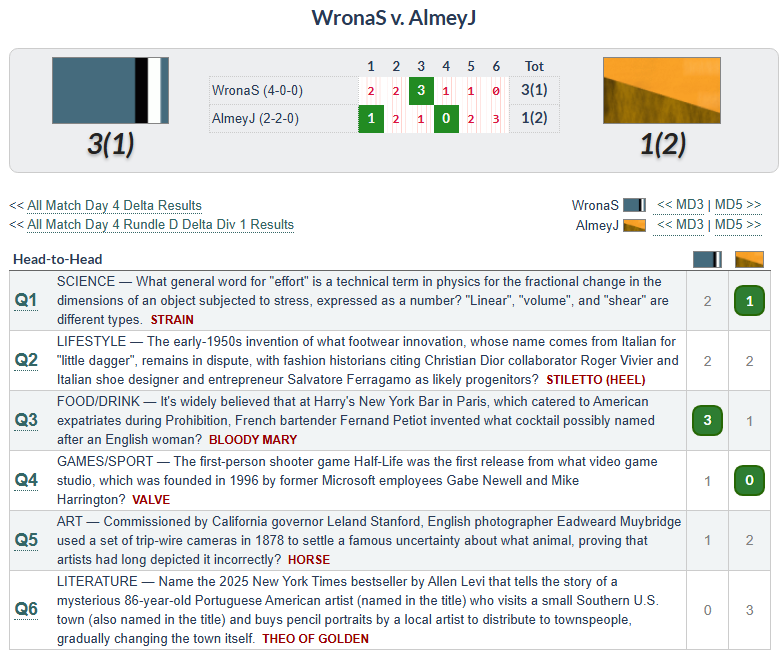
On Day 4, I suddenly took over the lead despite only getting one question right. I expected to miss that question since I don’t drink and my opponent definitely expected me to miss the question since I had only gotten 2 out of 27 food/drink questions right before that, but I got it based on the English woman clue. I did take physics once in ninth grade, not in college, and I don’t remember us talking about strain at all (I put work, which wasn’t a bad guess). For Question 2, I put Velcro, also not a bad guess (although I didn’t realize that word was always supposed to be capitalized until Google Chrome spell check told me so). I know nothing about conventional video games, especially post-Nintendo. I couldn’t afford that hobby and I just had no interest in the first-person shooters that dominated the market and didn’t really spend much time trying to find the more obscure games in other genres that I would have liked (besides Scrabble and typing games, which I imagine most gamers would say don’t count as “real games”), so while I know all these modern gaming companies are massive, I certainly couldn’t tell you who made which game. I guessed Blizzard, which again wasn’t a bad guess. I put condor for Question 5 because I knew that the Californian condor has been extremely endangered for a while. I considered horse but I rejected it because I assumed the reason an animal would be difficult to photograph would be because of its rarity, not because it ran so fast. And I had obviously never heard of the book in Question 6 and couldn’t even think of a stupid guess. Literary fiction is far from being in the cultural zeitgeist these days, I always preferred nonfiction anyway, and I imagine most people - even most intellectuals these days - haven’t heard of most recent Pulitzer Prize winners. What’s the last one I can think of? Oscar Wao? (I didn’t even like that book.) Still, I think all four of my posted wrong answers were solid ones. However, after improbably winning two matches in the first week despite only getting one question right, my luck as expected caught up to me and I’ve now lost my last four matches to fall to seventh. Hopefully, I banked enough points to not get relegated. I probably did, and I’ll probably still have more wins after this.
The woman at the in-home care agency is finally back from vacation and scheduled another housing inspection for Friday morning to assess whether the house is ready for my mom to come back home. I think that it should be now that I had the roof repaired, the ramp installed, the car removed, the deep cleaning finished, and paths cleared through all the spaces where she is likely to walk or need to have a wheelchair pass through. But I imagine there are still going to be weeks more of paperwork and runarounds.
Here’s another twofer as I’m trying to keep up with my originally desired pace and I haven’t gotten an assignment at day job yet. When trying to decide what driver to pair with Roger McCluskey, who was originally scheduled for yesterday, I could have gone in a bunch of different directions. Maybe I should’ve just grouped him with George Follmer (scheduled for tomorrow), a contemporary of his who also won in a bunch of different series, but even though McCluskey won an IndyCar championship, I honestly think his greatest legacy is in USAC Stock Cars, where he so thoroughly dominated his teammate/car owner Norm Nelson in his 1969 and 1970 seasons to become the #1 highest rated driver of all time in my stock car model. Sure, you can argue Nelson was maybe a little washed up by then since he was 7.5 years older, but Nelson wasn’t that far from his peak since he himself had won back-to-back titles (his second and third) in 1965 and 1966, and Nelson was actually blowing out Richard Petty and David Pearson when they briefly competed in the USAC Stock Car Series at the start of 1965 after the Chrysler boycott kept them out of NASCAR races that season, so I don’t think McCluskey’s #1 rating is as spurious as you might think. Because I consider McCluskey’s stock car career as the most significant part of his record and not his overrated IndyCar career, I decided to group him with Don White (originally scheduled for June 24?) because White was the winningest driver in USAC Stock Car history, even if he is now obscure due to his relative lack of success in NASCAR and USAC dropping out of major league competition. He wasn’t that unsuccessful in the Cup Series, mind you, with 7 top fives (including three seconds - two of them in his own equipment) and 12 top tens in 24 starts, but he certainly wasn’t successful enough for NASCAR fans to realize he was a great driver elsewhere without this additional context.
ROGER MCCLUSKEY…………………USA
Born: August 24, 1930
Died: August 29, 1993
Best year: 1966
Best drive: 1972 Pennsylvania 500 at Pocono International Raceway
The only driver other than his fellow Texan A.J. Foyt to win USAC’s IndyCar, sprint car, and stock car championships, McCluskey started racing stock cars in Tucson in 1948 before transitioning to USAC sprint cars in 1959. Although McCluskey was highly versatile on all track types, he was probably best on dirt, as evidenced by his 23 USAC Sprint wins, four USAC Midget wins, and two USAC Sprint titles in 1963 and 1966 over Foyt and Mario Andretti respectively in their IndyCar title seasons.
As an IndyCar driver, McCluskey was quite impressive in 1966, when he won his first race at Langhorne and posted the best lead change record of 4-1 that year. However, most of his IndyCar seasons were rather middling. Admittedly, he seldom had top-notch cars, spending most of his career driving for the forgotten Lindsey Hopkins. In 1972, Hopkins procured a drastically superior McLaren chassis, which helped McCluskey win the 1972 California 500. In 1973, he ran out of fuel on the last lap at Pocono to hand Foyt the win, but then won the next race at Michigan, which along with three second-places handed him a highly improbable title. His fifth win came in his final start against a lackluster field at Milwaukee in 1979, as he remained loyal to USAC during the CART/USAC split.
However, his USAC Stock Car career has heretofore been relatively unacknowledged even though I think he was at his best in stock cars. McCluskey is the all-time highest-rated driver in my stock car model thanks his astonishing 20-3 record against his three-time championship-winning teammate and car owner Norm Nelson. He won his fourth start at Mosport in a race both Foyt and Richard Petty entered. Demonstrating comparable strength on road courses, dirt, and pavement, McCluskey went on to win the 1969 and 1970 championships and 23 races, 20 of them from 1968-1972 alone. His biggest win came at the 1972 Pennsylvania 500 at Pocono, which was originally a USAC race before the track switched its affiliation to NASCAR. McCluskey led 180 of 200 laps, won by four laps, and was in front of Petty before he suffered an oil line failure.
McCluskey is frequently criticized for his weak IndyCar record for a sries champion. He only won five times, only led seven laps and never finished on the lead lap at the Indy 500, and his title resulted from consistency rather than dominance. On the other hand, he gave Hopkins his only title and certainly proved capable of beating all the major IndyCar and NASCAR stars in other races. McClusky was renowned for his ability to defuse feuds between drivers, owners, and sanctioning bodies. As a result, he served as USAC’s executive vice president competition director, and chief operating officer, most notably instituting the Indianapolis Motor Speedway’s Rookie Orientation program. The shutdown of the USAC Stock Car Series caused much of his legacy to be lost. Nonetheless, even if his IndyCar and NASCAR careers weren’t exceptional, his overall career certainly was.
Stock car model: #1 of 319 (.520)
Teammate head-to-heads: 20-3 (20-3 vs. Norm Nelson)
Open wheel model: #234 of 931 (.080)
Teammate head-to-heads: 35-11 (2-0 vs. Gary Bettenhausen, 1-1 vs. Tom Bigelow, 3-0 vs. Wally Dallenbach, 1-0 vs. A.J. Foyt, 4-2 vs. Elmer George, 0-1 vs. Dan Gurney, 1-0 vs. Janet Guthrie, 1-1 vs. Jim Hurtubise, 10-0 vs. Mel Kenyon, 6-1 vs. Lee Kunzman, 2-3 vs. Joe Leonard, 1-0 vs. Larry McCoy, 2-1 vs. Lloyd Ruby, 1-1 vs. Bentley Warren)
Year-by-year: 1962: C, 1963: C+, 1965: C, 1966: E, 1967: C+, 1968: E-, 1969: E, 1970: E, 1971: C+, 1972: E, 1973: E-, 1974: C-, 1975: C, 1976: C, 1977: C-, 1979: C-
DON WHITE………………………….USA
Born: June 24, 1926
Died: April 29, 2016
Best year: 1967
Best drive: 1967 State Fair Century at Indiana State Fairgrounds
Arguably the best stock car driver you’ve never heard of, White was the first of four major stock car stars to emerge from the small river town Keokuk, Iowa, White, his brother-in-law Ernie Derr, Dick Hutcherson, and Ramo Stott combined at least 583 of 897 races and win all but two titles in the International Motor Contest Association’s stock car tour from 1953-1971. White started out painting and taking on construction and erosion control jobs before beginning racing in 1948. Derr initially helped prepare White’s cars, but ultimately became his rival. From 1950 to 1958, White won at least 90 IMCA races and the 1954, 1955, and 1958 titles, giving him the edge over Derr’s 58 wins and one title. He also notably won at every track on the IMCA schedule.
In 1959, White began racing in both MARC (the forerunner of today’s ARCA) and the USAC Stock Car Series. He won the title in his first full-time USAC season in 1963. After running as an independent in 1964 and 1965, he landed a factory-backed Dodge ride with Ray Nichels from 1966-1970 and won 36 races over that timespan while many IndyCar stars simultaneously competed there; he was even nicknamed the “Richard Petty of the North”.
The manufacturers dropped out of both NASCAR and USAC in the early ‘70s, leaving White as an owner-driver. He still won occasionally and finished with a record 53 wins, including 14 at the Milwaukee Mile, the most of any driver at the track in any series. At the Indianapolis State Fairgrounds, he led IndyCar stars Parnelli Jones and Al Unser in 1-2-3 finishes in both 1967 races, passing Jones for the win both times. He was noted for a smooth driving style, charging only when necessary to conserve his equipment the finish, and A.J. Foyt praised him for his fairness and clean driving.
History is written by the winners, so NASCAR winning the stock car war caused USAC’s Stock Car Series to be forgotten. White wasn’t a bad NASCAR driver with seven top fives including three second-place finishes in 24 starts, but that’s not his main legacy. Even if he was the Petty of the north, he never won Petty’s recognition and seldom found sufficient funding after Chrysler withdrew. He believes this is because he frequently criticized USAC, Goodyear, and many of the other power players in the sport. Additionally, the IndyCar stars who frequently competed in USAC Stock Car races tended to monopolize the sponsorships and attention, leaving the stock car-only drivers fighting for scraps. The best way to understand White’s career is to compare him to Foyt. From 1962-1969, White won only one fewer race (22-21) in races they both started and he actually beat him 54-42 in finishes. White obviously couldn’t match Foyt’s versatility, but as a stock car racer, he was pretty close. When considering Foyt won 7 of 128 Cup Series races, White probably could’ve become a fairly prolific NASCAR winner as well… if he’d been given the chance.
Stock car model: #96 of 319 (-.011)
Teammate head-to-heads: 8-10 (1-0 vs. Mario Andretti, 1-0 vs. Larry Frank, 0-4 vs. Paul Goldsmith, 0-1 vs. Skip Hudson, 0-1 vs. Jim Hurtubise, 1-2 vs. Sam McQuagg, 0-1 vs. Fireball Roberts, 0-1 vs. Lloyd Ruby, 1-0 vs. Fred Lorenzen, 4-0 vs. Dick Rathmann)
Year-by-year: 1953: C+, 1954: E-, 1955: C+, 1956: C-, 1957: C-, 1958: E, 1959: C+, 1960: E-, 1961: E-, 1962: C+, 1963: C+, 1964: C, 1965: C+, 1966: E, 1967: E, 1968: E, 1969: E, 1970: C+, 1972: C+, 1974: C, 1975: C