

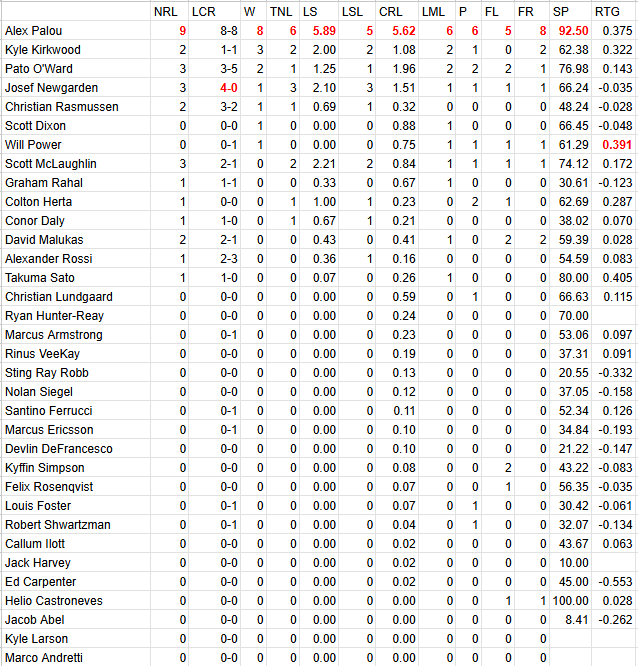
After updating my IndyCar statistical table last week, I completed it yesterday during Stage 1 of the Southern 500. It is linked here, but I’m going to copy and paste it and plug the graphic here as well:
Some brief thoughts:
It’s funny that Will Power ended up beating Palou in my model and I obviously don’t take that seriously at all. Palou was basically hurt because one of his teammates was Kyffin Simpson, which limits how much you can gain when you have a teammate that far below average while Power benefited from the fact that McLaughlin and Newgarden were maddeningly inconsistent.
But don’t get it wrong: Newgarden and McLaughlin were still better than Power as usual. For all the shit people gave Newgarden this year, he had an undefeated lead change record (marking the sixth time he has had the best lead change record in a season) and he ranked second in TNL, third in lead shares and CRL, and sixth in speed. Although he did have one self-inflicted mistake after another that resulted in a 12th-place points finish, he also had bad luck and I definitely wouldn’t say he’s washed up on ovals. McLaughlin meanwhile had two TNL and just tended to be very, very unlucky despite ranking second in lead shares and third in speed. Yes, the Indy 500 crash was stupid but what really let him down was that Penske tended to have incompetent strategies this year while Ganassi had brilliant ones. Most people would say Power was better than them because he had that dominant win at Portland, but he only inherited the win in the first place because polesitter Pato O’Ward (who was previously dominating) pitted, and ultimately, Power made a lot of mistakes too and wasn’t as consistent as people think. He beat McLaughlin by one point and even Newgarden by only 41 (less than one full race). That’s not nearly a big enough consistency advantage to overcome their advantage in dominance. While even as a Malukas fan, I’m not convinced that Power should be replaced, there’s a reason he is the driver being replaced despite beating the other two in points and leading my model.
I would say most of the rest of these results look fairly straightforward, although I’m surprised that Colton Herta actually had a faster speed percentile than Kyle Kirkwood and I was also pretty surprised by how fast Callum Ilott was (11 points over Shwartzman; really? It didn’t feel like that.) and how slow Rinus VeeKay was. I do think all the Ganassi-related drivers are overrated based on the speed of their cars. That doesn’t mean I’m not going to make Álex Palou #1 because I probably am (although Broc Feeney might overtake him for that), but it does mean I’m not really that impressed by Scott Dixon (who had no natural races led when Palou had nine) and was 26 percentage points slower in speed, or for that matter Felix Rosenqvist and Marcus Armstrong, who did give Michael Shank Racing its highest points finishes ever, but I think more because they had access to the dominant Ganassi setups now that they are an official Ganassi satellite than because they were all that impressive themselves. I mean I’m probably listing all of them, but I don’t really think any of them should be higher than C-.
One funny note is that Hélio Castroneves ended up being the fastest driver in the Indy 500, earning both the fastest lap and the fastest race. Would you have guessed that? I don’t know, maybe it’s not that shocking. He did win the Indy 500 for Shank before in 2021 and now they’re a Ganassi satellite and Castroneves’s 2021 sparring partner Palou did win the race this year after never having won on an oval before…
I’m almost certainly going to list all the top 14 points finishers in IndyCar this year. After that, I have Rossi, Ferrucci, and Daly on the bubble and I don’t know which way I’m going to go on them. I think everyone else is a flat no. I will almost certainly be listing Dennis Hauger.
Carlo Facetti
1963: C-
1971: C-
1972: C-
1977: C+
1978: C
1979: C+
Cumulative points: 11
Pretty much indistinguishable with Pierre Dieudonné, another European Touring Car Champion I narrowly rejected, Facetti won the ETCC title with Martino Finotto in 1979 and earned 15 overall wins and three more class wins including the 1971 24 Hours of Spa in addition to ten World Sportscar Championship class wins including a Daytona class win in 1977 and a Le Mans class win in 1980, but his touring car rating was only barely above average (although slightly above both Finotto and Dieudonné) and I don’t think the competition in either ETCC or his specific WSC classes was very good.
Juan Manuel Fangio II
1990: C+
1991: C+
1992: E
1993: E-
Cumulative points: 21
The nephew of the great world champion was pretty awful as an open wheel driver himself with a rating of -.236 and his touring car rating of -.039 isn’t great either. However, he had a short-lived dominant run in IMSA’s premier GTP class from 1990-1993, where he won 21 races overall including a record 19 solo wins. His only wins with a co-driver came in the 12 Hours of Sebring, which he won back-to-back in 1992 and 1993, although he never won a 24 Hours of Daytona. I do question how strong the competition was, but it was definitely stronger in 1992 when he had to beat Geoff Brabham, Davy Jones, and P.J. Jones than in 1993 when his only real competition came from P.J.
Augusto Farfus
2004: C-
2005: C
2006: E-
2007: C
2008: C+
2009: C+
2010: C-
2011: C
2012: C+
2013: E
2018: C-
2019: C-
2020: C+
Cumulative points: 37
Farfus only won one major league title in his career in the Intercontinental GT Championship in 2020 (which wasn’t that major) but he had a prolific career with two overall Nürburgring 24 Hour wins and two more in class, overall wins in the Dubai 24 Hour and Bathurst 12 Hour, back-to-back class wins in the 24 Hours of Daytona in 2019-2020, 15 World Touring Car Championship wins including two Macau Guia Races and two Pau GPs, four DTM wins, and an FIA GT World Cup. Although he fell off in the 2020s, he still has flashes of relevance and his Bathurst win and second Nürburgring win both came this year, so I might list him, but I’ll need to do more research before I decide if I will.
Red Farmer
1956: C
1957: C-
1959: C
1960: C
1961: C
1962: C+
1963: C+
1964: C+
1965: C+
1966: C
1967: C
1968: E-
1969: E-
1970: C
1971: C
1972: C-
1973: C-
Cumulative points: 41
I thought Farmer might be sort of like Jerry Cook in that he was overhyped and overrated by the NASCAR industry because of his longevity and his rivalry with another local talent: in Cook’s case Richie Evans and in Farmer’s case, the Allison brothers. I didn’t have him as a lock because I kind of suspected that he was overrated due to his association with the Alabama Gang. I originally had him listed with 109 wins, which is not much more than the 95 I had for Cook. However, when I checked the win counts on The Third Turn again, a lot more Farmer wins have been added since I last checked and now I have a mind-boggling 251 wins for him, so now he’s a lock. From 1962-1965, Farmer and the Allison brothers were all competing head-to-head and they were pretty even (although Bobby kept winning all the titles). Although I don’t have win counts for any of them in 1962 when Farmer finished third in points behind both Allisons, in the years they all competed together, Farmer had 45 wins to Bobby’s 40 and Donnie’s 36 right before both Allisons switched to the Cup Series. But I’m most impressed by his late ‘60s when he had a career-best 24 Modified wins in 1968. The next year, he won his first of three consecutive Late Model Sportsman titles with 27 wins and he beat runner-up Harry Gant by the staggering margin of 8276-5495 (Gant only won 6 times by current count). Okay, if he was outwinning Bobby Allison and thrashing Gant, he’s obviously a lock. The competition he faced was way greater than the competiton Jerry Cook faced and he was also a vastly more dominant force. There’s substance here. It’s not all hype like Hut Stricklin.
For the record, based on those early Modified seasons in the ‘60s, Donnie was close enough to the other two that I bumped up and rated some of his early seasons that I didn’t rate previously and now I consider him a lock too. I should at least give him more points than near-lock/fellow-ten-time-winner Clint Bowyer, right? And on this basis, I retract some of my previous criticisms of Donnie Allison as a Hall of Famer too.
Marcel Fässler
2000: C
2001: C+
2002: C+
2003: C+
2004: C+
2005: C-
2007: C-
2008: C+
2009: C+
2010: C-
2011: C+
2012: C+
2013: E-
2014: C+
2015: C+
2016: C+
2017: C-
Cumulative points: 44
A slightly better version of Farfus, Fässler won the premier inaugural WEC LMP1 championship in 2012 with his teammates André Lotterer and Benoît Tréluyer and ten overall races in that series including the 2012 and 2014 24 Hours of Le Mans (he also won in 2011 before the WEC existed when the race counted as part of the Intercontinental Le Mans Cup). Additionally, he earned overall wins at the 24 Hours of Spa in 2007, the 12 Hours of Sebring in 2013, class wins at both Daytona and Sebring in 2016 and Spa and Nürburgring in 2009 and 2011 respectively. He also won the International GT Open in 2009, a year he won six times, and he won five DTM races in his early years from 2001-2003. I didn’t give him many elite seasons because from what I recall, Lotterer was clearly the team leader in that era of the Audi juggernaut, but I’m willing to reconsider if I discover his lap times were closer to Lotterer than I thought they were.
Ricardo Feller
2021: C
2023: E
Cumulative points: 12
Very much a relevant driver today, he ranks 118th of 1,626 drivers in my touring car model with a .258 rating, and his 2023 when he won the GT World Challenge Europe Sprint Cup and finished third in DTM points was pretty amazing. However, the only other season I felt like rating was 2021 when he won the ADAC (German) GT championship and a lower-class championship in the GT Europe Endurance Sprint Cup simultaneously at the age of 21. I actually didn’t have that season rated then (maybe because he was so young I assumed his teammates were doing most of the work), but based on what he’s done since I bumped it up. Feller is probably going to eventually make the list and all he likely needs is more time to do it. (I definitely don’t like his current season much though…)
Enzo Ferrari
1923: E-
1924: 4
Cumulative points: 12
Prior to founding his eponymous car company, Ferrari won four early Grands Prix in 1923 and 1924 including the 1924 Coppa Acerbo, but he fell off quickly after being shaken by the death of bigger star Antonio Ascari, the father of Alberto who won the first two F1 titles for Ferrari. I can see a case to be made for Ferrari, but ultimately he had too short a run in an uncompetitive era, and I suspect I may be leaving him off just because it would feel weird to include him when he is primarily known as a company founder and car owner. That didn’t stop me from listing Louis Chevrolet, but Chevrolet IMO had a much more successful career.
John Fitch
1951: E
1952: C+
1953: E
1955: C
1957: C+
1958: C-
1960: C-
Cumulative points: 30
Arguably the first great American sports car driver, Fitch won the first SCCA National Championship in 1951 and won the first competitive 12 Hours of Sebring overall in a shared drive with Phil Walters in 1953, which doubled as the first World Sportscar Championship event. That year, he also won his first of two 24 Hours of Le Mans class wins and three SCCA National Championship races and another in class. Overall, he earned nine overall SCCA wins, twelve more in class, two overall WSC wins and five more in class (including two more Sebring class wins), and a win in the Buenos Aires GP for sports cars. Fitch even co-drove a winning entry in the 1955 RAC Tourist Trophy with Stirling Moss. Moss was obviously impressed by him since he entered Fitch in the 1955 Italian Grand Prix as a car owner, which about says it all, right?
Ed Flemke
1961: C+
1962: C+
1963: C
1964: C-
1966: C-
1967: C
1968: C
1970: C-
1972: C-
Cumulative points: 16
This one feels kind of dodgy to me. Believe it or not, even though you probably haven’t heard of him, Flemke has more Modified wins listed on The Third Turn (118) than Jerry Cook (84), although Cook has more Late Model Sportsman wins (11) than Flemke (9). Flemke really seems to have been a more dominant force than Cook overall as he had five seasons with 10+ wins while Cook only had two. On the other hand, Cook did win six titles while Flemke never did although he did finish second back-to-back seasons in 1961 and 1962 when he won a combined 37 races. But when I actually looked up Cook’s record, I discovered that he kept winning titles because he entered far more races than anyone else, so maybe Flemke just never entered enough races to win titles. I have tentatively awarded Flemke enough points to make the list on the basis of his greater confirmed wins than Cook, but I expect I’ll eventually talk myself out of it. “You mean you don’t think Jerry Cook is deserving yet this no-name modified driver is?” Since I don’t think Cook should be listed, I’m probably going to eventually deny Flemke a few points somewhere to keep him off the list since like I said, there were a lot of drivers who had similar win counts to Cook and Flemke wasn’t the only one. I think the driver I really probably want to list is Bugs Stevens, who seems to have been better than all these guys and he did have three consecutive Modified titles.
Ron Flockhart
1956: E-
1957: E-
1959: C
Cumulative points: 12
Flockhart won back-to-back 24 Hours of Le Mans overall wins with different drivers (Ninian Sanderson and Ivor Bueb) but he did so for an overwhelmingly dominant Jaguar team and it seems like he had a lot of help, particularly in 1956 when the much faster eventual World Champion Mike Hawthorn had a misfire in the pits in the first hour and lost 21 laps in the other Jaguar. I think 1957 was better as he and Bueb set the distance record and they did beat the other Jaguar co-driven by Sanderson and “Jock” Lawrence by eight laps, but even in that one, they took the lead in the pits. It seems to me that Flockhart’s success was more car than driver, particularly because he didn’t have much besides those wins except three non-points F1 wins against shitty fields and his open wheel rating of -.085 wasn’t very good. If I had to rank the Jaguar Le Mans winners of 1955-57, I think it would be Hawthorn > Bueb > Flockhart > Sanderson. I’ll probably only list the first two.
Jon Fogarty
2004: C-
2007: E-
2008: C+
2009: E-
2010: C+
2011: C+
2012: C-
2013: C-
Cumulative points: 22
As I look out my back door to survey an era of sports car racing no one has much nostalgia for, I must admit that Fogarty had a bizarre sports car career that I’ve never really known what to do with. In his impressive run in the second half of the Grand-Am era, Fogarty and his teammate, Dan Gurney’s son Alex, were probably the closest rivals to the Scott Pruett/Memo Rojas pair, with two Grand-Am titles in 2007 and 2009 and 16 overall Daytona Prototype wins to Pruett/Rojas’s four titles and 28 wins, but they never won the 24 Hours of Daytona and rarely even contended and a lot of people would say that matters more than the titles do. After their dominant GAINSCO/Bob Stallings Racing team shut down in 2013, Fogarty and Gurney completely fell off the racing map and were basically never seen again even though they were only 38 and leading IMSA drivers often continue on into their late 40s or even 50s, so I have no idea why no one ever gave them any kind of full-time ride again. I know Fogarty was the team leader, but Gurney was closer to him than I remember him being as the gap between Fogarty’s 957 laps led and Gurney’s 872 is pretty narrow, although the gap between Fogarty’s 24 poles and Gurney’s 5 is not (I’m pretty sure my own race-database site is the only place that has Grand-Am laps led distinguished by driver). Fogarty seems like one of the biggest racing what-ifs of the 21st century because although he won two titles in the Champ Car Atlantic Series (where he did significantly outperform Gurney), he was offered the #15 Rahal IndyCar after Kenny Bräck’s injury, which Buddy Rice immediately won three races with including the Indy 500 after Fogarty turned it down. He seemed like he overall deserved better than he got since he beat the likes of Ryans Hunter-Reay and Dalziel, Danica Patrick, and Andrew Ranger in Atlantics, but he still had a successful career. The facts that he never really contended at Daytona and that he flat out disappeared after his power run makes me wonder if his Grand-Am success was more about the car, which is why I denied him lock status.
Norberto Fontana
1995: C
1996: C
1997: C
1998: C-
2001: C
2002: C+
2003: C+
2004: E-
2006: C+
2008: C
2009: C
2010: E-
2012: C
2014: C+
Cumulative points: 37
A promising open wheel talent who dominated the German F3 championship winning ten races as a 20-year-old in 1995 and dominating an older part-timer in Jarno Trulli, Fontana never really attracted F1 interest but has a very high rating of .183 in my open wheel model as he also won three Formula Nippon/proto-Super Formula races before he went back home to Argentina, where he won 32 major touring car races, two TC2000 championships in 2002 and 2010 and a Turismo Carretera championship in 2006 but although he became a bit of a domestic legend, it almost seems like a waste of his talent considering how long - and how successfully - Trulli raced in F1.
Giorgio Francia
1977: C
1979: C
1980: C-
1981: C+
1982: C
1989: C
1991: C+
1992: E-
1993: C-
Cumulative points: 21
Francia spent the first half of his career from the mid-’70s to the mid-’80s competing in sports cars and the second half from the mid-’80s to the mid-’90s competing in touring cars. Although he narrowly has a negative touring car rating, I think I am more impressed by him as a touring car driver mainly because I admit I have a bias towards successful solo drives rather than shared sports car drives where I can’t always tell which driver was doing more of the work. As a sports car driver, Francia won four overall WSC wins and eight class wins from 1977-1982 as well as two European Sportscar Championship wins. What I’ll say for this portion of his career is that I do think he was better than all his co-drivers with the exception of Henri Pescarolo, so he was probably doing more of the work himself. But I like his sports car career better, where he won 16 Italian Touring Car Championship races from 1988-1992. He never won a title, but he did beat his teammate (lock Nicola Larini) in wins and in their teammate head-to-head in 1991 the year before Larini beat Francia for the 1992 title. He also earned a top ten points finish in DTM in 1993 and two wins in the Spanish Touring Car Championship in 1995, but by that point he was falling off.
Paul Frère
1953: C-
1955: C
1956: C-
1958: C-
1960: C+
Cumulative points: 8
Oh, brother! I can see a strong case being made for Frère since he earned an overall Le Mans win in 1960 and three more in class along with two Mille Miglia wins in class, an F1 top ten points finish, and two non-points F1/F2 wins including an early South African GP. His .066 open wheel rating is pretty solid too. But the more I looked at each individual accomplishment, the less I was impressed. In his two Mille Miglia class wins, he finished three hours behind. In his 1958 Le Mans class win, he finished 15 laps behind. His overall Le Mans win came in 1960 when most of the faster Ferrari drivers DNFed. His tied for seventh-place points finish in F1 in 1956 was based on only a single race, a second at Spa where he finished nearly two minutes behind his Ferrari teammate Peter Collins. Ultimately, it’s a no. He was a good driver but not a great one.
Robin Frijns
2011: C-
2012: C
2015: C+
2016: C
2017: E-
2018: C-
2019: C+
2020: C+
2021: E-
2022: C+
2024: C-
Cumulative points: 29
Frijns looked like an all-time great after three straight minor league titles in consecutive seasons in Formula BMW Europe, Eurocup Formula Renault 2.0, and Formula Renault 3.5 from 2010-2012. Although much like Nico Hülkenberg, he never lived up to his stellar junior record, he still had a respectable career worthy of recognition with two titles (one in the GT World Challenge Europe Sprint Cup in 2017 and one in the LMP2 class of the WEC, which included a Le Mans win in 2021). Frijns’s primary role has been as a Formula E driver where he won only twice but earned four top ten points finishes and often performed admirably against teammates who won more races in other years. He also had three DTM wins, an overall Nürburgring 24 Hour win, and an overall Bathurst 12 Hour win. I think he’s a lock, but I’ll admit he’s a fairly shaky one.
Antonio Fuoco
2022: C+
2023: E
2024: E
Cumulative points: 23
An inevitable lock, possibly as soon as this year, I considered Fuoco to be the best sports car driver on last year’s list and he’s the only one I gave a full E to the last two seasons as he seemed to be the overwhelming linchpin of the WEC Ferrari squad. This year obviously is giving me cause to reconsider since the other Ferrari co-driven by James Calado, Antonio Giovinazzi, and Alessandro Pier Guidi is leading the points while the Fuoco/Miguel Molina/Nicklas Nielsen car has barely half as many points and is currently sitting fourth, although Fuoco’s team did win the season-opening race. Based on how much faster Fuoco has typically been than his Ferrari teammates, I imagine he’s still fast enough to warrant at least a C giving him the two points he needs for lock status, but I haven’t done anything with WEC lap times this year yet. I will say: it’s probably not gonna be a third straight E when the other Ferrari looks like it’s going to win the championship.