

Well, I finally archived all my Twitter private message conversations, so maybe I will finally purge it if I continue to receive zero engagement there. I also finished archiving all of this year’s Nürburgring Langstrecken-Serie winners today. That took me almost the entire week, since there were a couple of hundred winners this year alone. I also had to look through a bunch of drivers who weren’t already on my master driver list and see if I could find their nationalities and birthdates, but I got that done, so now I only have several hundred more historical drivers to integrate from that series. (Maybe it’s still over a thousand even…)
Michael Christensen (17)
Summary: A long-running and successful factory Porsche sports car driver, but not necessarily an elite one, Christensen won 24 major races from 2012-2024, including the 2019 24 Hours of Spa and 2021 24 Hours of Nürburgring overall and the 2018 24 Hours of Le Mans, 2017 24 Hours of Daytona, and 2014 12 Hours of Sebring. He also won the 2018-2019 WEC GTE title with Kévin Estre, but that is his only major championship.
Case for: Since the marquee endurance races are generally more important than the actual championships in sports car racing, it’s hard to dismiss a driver who has won almost all of the major ones, and it’s also hard to dismiss a driver with that many wins and a decade of longevity. He was also Richard Lietz’s co-driver in Lietz’s 2015 WEC championship season, and only didn’t share in that title because he missed one race while Lietz started every race. He also had a faster speed percentile than Lietz that season (60.99-55.51).
Case against: His WEC teammate for most of his glory days (2017-2022) was Kévin Estre, who is arguably the best sports car driver of his generation, and I have the sneaking suspicion he was the Memo Rojas to Estre’s Scott Pruett. He’s obviously better than Rojas (who I don’t even have on the bubble at all), but almost all of Christensen’s big accomplishments were shared with Estre, and he was vastly less successful without him, suggesting to me that Estre significantly carried him. Christensen is recent enough that I do have a lot of advanced data on him, and I don’t love it. His speed percentiles are generally weak as he was usually one of the slowest drivers on his teams. I have calculated speed percentiles for 2014-2016 and 2022-2026 in IMSA and 2015-2016 and 2022-2025 in WEC. In his one full-time IMSA season, he was the slowest of four drivers on his team at 46.08. His WEC speed percentiles have been middling at best (60.99, 19.75(!), 37.41, 46.07, 68.20, 54.22), and he has an 0-2 lead change record in both IMSA and WEC in the seasons I have covered (but I don’t have complete lead change data prior to 2022).
Even in context, his speed percentiles look kind of meh, especially compared to Estre:
2014: Tandy 72.44, Lietz 60.34, Long 48.05, Christensen 46.08
2015: Pilet 63.68, Makowiecki 62.79, Christensen 60.99, Lietz 55.51
2016: Christensen 19.75, Lietz 10.93
2022: Estre 79.81, Bruni 52.31, Lietz 42.33, Christensen 37.41, Makowiecki 30.00
2023: Makowiecki 67.20, Estre 66.88, L. Vanthoor 58.59, Lotterer 51.97, Christensen 46.07, Cameron 36.14
2024: Estre 82.42, Christensen 68.20, Campbell 66.73, L. Vanthoor 64.69, Lotterer 60.35, Makowiecki 59.96
2025: Estre 76.16, L. Vanthoor 61.05, Andlauer 60.31, Jaminet 58.96, Christensen 54.22, Campbell 47.16
But I acknowledge that I don’t have data for 2017-2021 yet, and that era is generally considered to be his best. One thing this is telling me is that maybe I was a little too hasty to declare Richard Lietz a lock since his speed wasn’t any better, and Christensen was actually faster in Lietz’s title season, even though the two drivers who didn’t win the championship were faster than both. Also, Christensen’s solo drives aren’t terrible but don’t swing me in any particular direction (one Porsche Supercup win and one Porsche Carrera Cup Germany win in a short career in single-driver entries and a rating of .111, which is fine, but doesn’t make him an obvious selection either, especially when compared to Estre’s rating of .451).
Verdict: Keep. I just don’t have the data yet to make this call. The post-race PDFs from those WEC seasons are still there for now, so I’d better get on that at some point. While I don’t doubt that Estre was probably faster than Christensen and the team leader for all their 2017-2021 stuff as well, based on their later trajectories, what matters to me is the margin. If Christensen was only like 5-10 percentage points behind Estre in his peak seasons, I might still list him. But if, as I suspect, he was averaging 20 points slower (which I kind of think is more likely), he might end up being a surprise drop.
Ted Christopher (17)
Summary: I have some personal nostalgia for this guy, since he was just beginning to cross over to the NASCAR national series when I went to my first race, the 1997 Lysol 200 at Watkins Glen. I have pictures of his badly mangled car, although I think my dad took this:
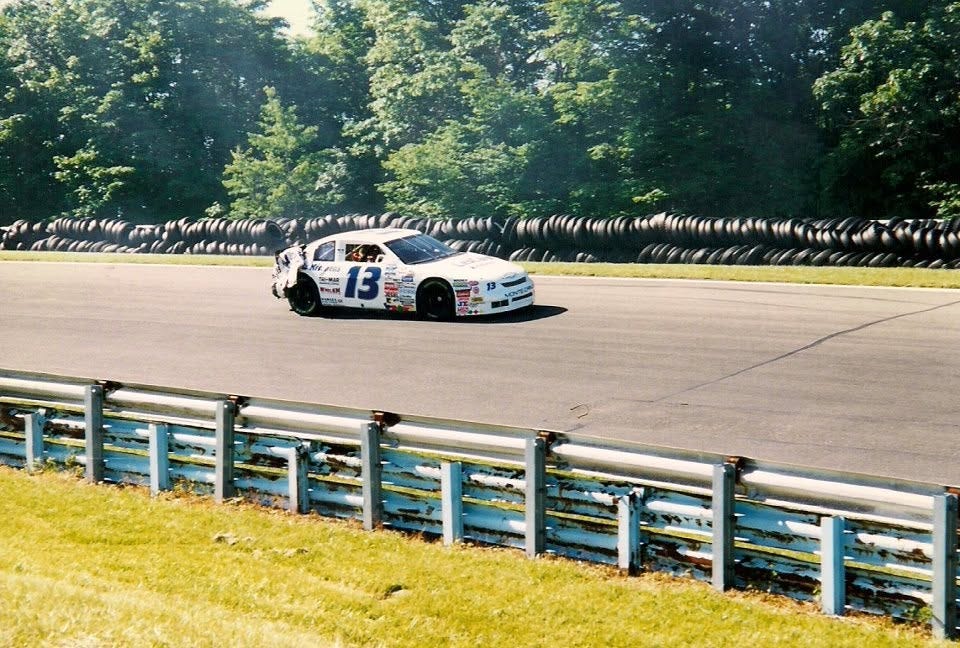
Does that nostalgia mean I’m going to be more inclined to list him? Not necessarily. He does have an unusual number of wins and titles, including the 2001 NASCAR Weekly Series national championship, another regional championship in 2000, the 2008 NASCAR Modified championship, and eight World Series of Asphalt Stock Car Racing Tour-Type Modified championships.
Case for: I think the eight World Series of Asphalt titles are why Christopher isn’t an immediate dismissal. He also has 284 overall wins listed on The Third Turn, but most of those are in weekly-series type racing. This does give him substantially more confirmed wins than Jerry Cook or even Ron Hornaday, Jr., or many of the other more obscure modified drivers I am going through, even if most of them weren’t NASCAR-sanctioned.
Case against: The problem is that I think the NASCAR Modified tour is more prestigious than most of the lower-level modified series he dominated and he only won one title there in 2008, which is probably how most people judge his overall career. (However, it’s worth noting that he did win or tie for the most wins in the NASCAR Modified Tour six times, which is second to Justin Bonsignore’s seven and ahead of Mike Stefanik’s four, and that wasn’t even his best modified series by any means.)
Verdict: Keep. You know, I ended up in a different position than I thought I would when I started writing this. I expected him to be an easy drop, but he has over twice as many verified wins as Stefanik, Cook, or Hornaday across all series, even though his NASCAR career is not the most important part of his overall career. That makes him more similar to Dick Trickle or Stewart Friesen, drivers whose mediocre NASCAR careers mask their actual greatness. This feels like way too many wins and titles to be an immediate dismissal. He’ll never make the NASCAR Hall of Fame or any of their greatest drivers’ lists, nor should he, but he seems way better than the vast majority of either the Modified champions or the Weekly Series champions, and winning both is an interesting distinction. Still, by no means a guaranteed keep, but he shouldn’t be an immediate dismissal.
Rob Collard (15)
Summary: British Touring Car Championship career compiler with 15 wins from 2005-2018, followed by two British GT titles, one with Sandy Mitchell in 2020 and one with son Ricky in 2024.
Case for: While crossovers between BTCC and British GT are not unheard of, few drivers have been successful in both, and 15 BTCC wins and 7 British GT wins may be too many to dismiss.
Case against: Both of Collard’s British GT titles came in his 50s, and it’s hard to imagine he was at the peak of his powers by then (I don’t know much about Mitchell, but Ricky was clearly faster and the team leader by 2024). Even though he won a lot of BTCC races, he never finished better than fifth in the championship, and his touring car rating of -.026 is pretty weak. I also don’t think his peak in the 2010s was a particularly strong era for the series. One out of every three BTCC races a reverse grid race, and he had a slightly higher percentage of reverse grid wins (6/15) than wins where the grid was determined by speed (9/15).
Verdict: Drop. There’s nothing really wrong with his career except for the lack of a high ceiling, but while I’m not against career compilers on principle, I think he had neither the longevity or the peak to make up for his weak teammate comparisons.
Stefano Comini (18)
Summary: After the World Touring Car Championship, the ostensibly most prestigious touring car series, split in 2015 with the new TCR International Series taking its most prestigious race (the Macau Guia Race) before the WTCC and TCR International Series re-merged as the World Touring Car Cup (which was abbreviated WTCR to reflect the influence of both sanctioning bodies). Comini was the TCR International Series’s dominant driver with 12 wins, including two titles and two Macau Guia Races, achieving both in 2015 and 2016.
Case for: While the TCR International Series wasn’t as prestigious as the WTCC, having Macau gave it instant credibility even if the quality of the fields weren’t there to match. Comini beat the 2017 TCR champion and 2010 Indy Lights champion Jean-Karl Vernay for the 2016 title when they were teammates, and his 9-8 record against Vernay and 10-2 record against Frédéric Vervisch in 2017 are both really solid when considering Vernay won seven races and Vervisch won four after the WTCC and TCR International Series reunited. His .310 touring car rating certainly demonstrated the potential for all-time greatness, as he has a way better touring car rating than a ton of more highly regarded touring car drivers.
Case against: He stopped racing. He just stopped! He made two starts after the 2018 season and never raced consistently again, even though he was still in his late twenties at the time. There’s no reason why Comini shouldn’t still be a perennial championship contender in the TCR World Tour or some sports car series instead if he wanted to, but he just disappeared entirely, and that leaves me completely befuddled. He didn’t suffer a career-ending injury, and he didn’t retire, so I’m guessing he probably just ran out of money. It doesn’t help that I think the TCR International Series had weaker competition than the WTCC in the years he was there, and he never competed in the merged series, even though he outperformed several drivers who won there.
Verdict: Keep. TCR has become an important brand, as the TCR ended up winning the touring car war after the FIA shut down the WTCC, and Comini won its first two international championships. Sure, you could scoff that the TCR International Series was like the IRL to the WTCC’s CART, and you probably wouldn’t be wrong. But Comini was certainly a lot better than Buzz Calkins, with two titles and 12 wins to Calkins’s one win and shared championship in a three-race season. Since he’s still in his thirties, I suppose he could also make a comeback someday.
Jerry Coons, Jr. (17)
Summary: Coons is one of eight drivers to win the USAC Triple Crown with titles in the Midget, Sprint, and Silver Crown divisions, along with Pancho Carter, Dave Darland, Tracy Hines, Logan Seavey, Tony Stewart, Chris Windom, and J.J. Yeley. He has 19 Midget wins, 17 Sprint wins, and 7 Silver Crown wins.
Case for: It’s hard to dismiss any driver who completed that sweep of titles because it’s relatively rare.
Case against: Every one of the other Triple Crown winners had more combined wins in the three USAC divisions than Coons’s 43, except for Tony Stewart, because he stopped competing regularly in those divisions in his IRL and NASCAR years, and even Stewart wasn’t very far behind with 40. Seavey has already passed him even though he isn’t even thirty yet. Coons’s four titles were all in the very short span of time from 2006-2008, and his Sprint and Midget performances really fell off in the 2010s, although he remained much better in Silver Crown, earning nine consecutive top five points finishes there from 2010-2018, and I do consider that more prestigious than the other two series.
Verdict: Keep. Even if Coons is the least distinguished Triple Crown winner, he’s still a Triple Crown winner, and it’s hard for me to say no to any of them (although admittedly, I don’t have Hines, Windom, and Yeley as locks either, but they’re in the near-lock category so they won’t be discussed in this series). However, somehow, I feel like I need to be convinced on this one.