

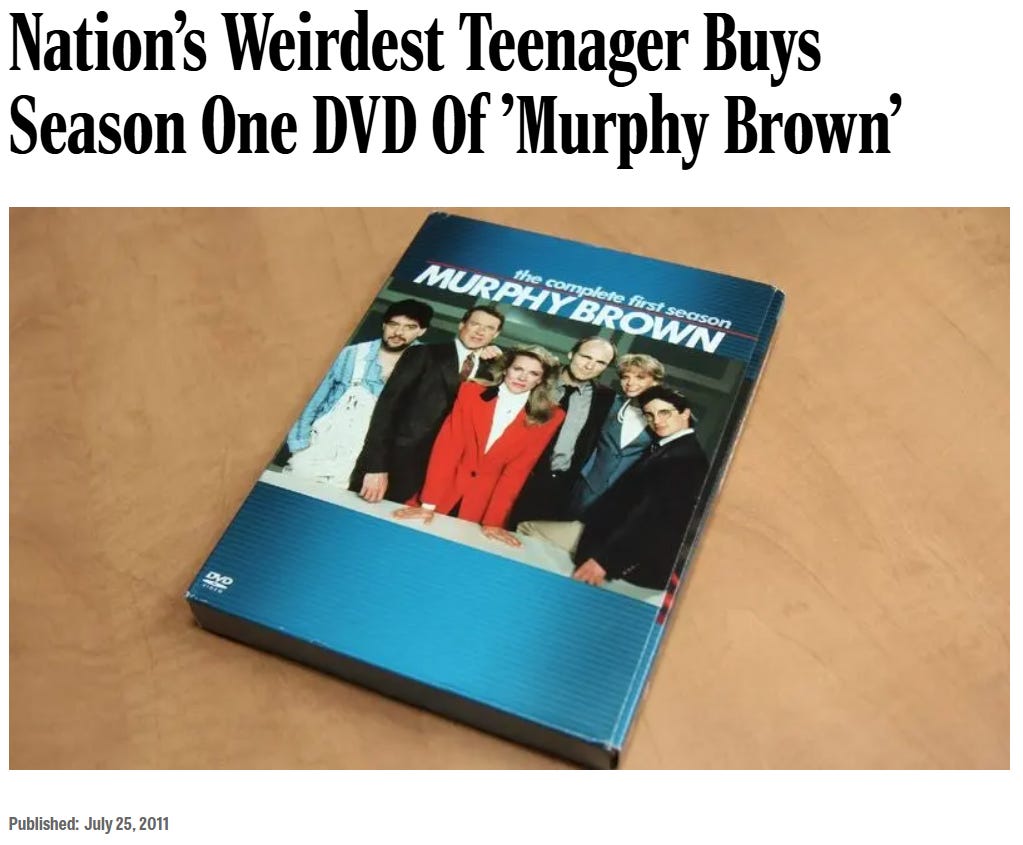
I saw this Onion article once and I thought it was pretty funny:
I’ve been teasing this for a few months and I know almost none of my regular subscribers will care, but after I finished watching Malcolm in the Middle, I decided to watch all of the original run of Murphy Brown. I know everybody was getting tired of my political and cultural takes (even me), so I decided to wait until now before reentering those choppy waters. I guess this was pretty good timing since the congressional midterm elections are only in a couple days.
I grew up watching a vast array of studio audience family sitcoms in the ‘90s and enjoying most of them, but I certainly wasn’t old enough to understand the shows for adults, particularly when you consider that the best seasons of Murphy Brown ran at the earliest before I was even in preschool and at the latest when I was in elementary school. It was also on at 9:00 on a school night so even though I knew about it, I never stayed up that late except on Fridays, when I did watch all the TGIF sitcoms, and often on Saturdays also.
When I was unemployed and failing to launch after graduating from college in the late 2000s, I started watching a bunch of adult sitcoms from the ‘70s to the ‘90s long after anyone cared about them on Netflix DVDs by mail. Murphy Brown was one of them, but only the first season was ever released, both because it didn’t sell and because of the exorbitant costs of the music rights. In the earliest and best seasons, nearly all episodes started with a classic soul song that would often be tied to the plot of the episode. Honestly, I think you could cut out most of those musical cues and it wouldn’t affect the show much if you put generic music instead. I really liked the first season and was interested in watching more, but it just wasn’t possible since despite being one of the most popular and acclaimed sitcoms in its heyday, it never lasted long in syndication and its legacy literally just disappeared as if it had never existed.
What got me into it again was a series of YouTube video essays by José, a Breadtuber who makes hour-long video essays mainly about 1980s-2000s sitcoms and I’ve watched a bunch of them (he’s also the one who got me to finally watch Malcolm in the Middle). I don’t agree with him on everything and I have no interest in his other content, but I do really like his TV reviews. After I watched his Murphy Brown review years ago, I wanted to seek it out and it was syndicated on some obscure cable channel I had for a while before I eventually dropped cable. I enjoyed the first three seasons and I really didn’t understand why it had such a bad reputation now and was mostly just the butt of jokes. I watched a bit of the 2018 revival, but not every episode. I finally found the entire original series on the Internet Archive and hunkered down, watching two episodes most days for month ‘cause I know almost anything on the Internet Archive (particularly video content) can be taken down at any time.
I think the reason I wanted to write about it was that I want to interrogate my nostalgia for the monoculture of my youth. It’s weird to remember a time when people generally respected the news media. 60 Minutes was the most popular show on American television in the ‘90s, and Murphy Brown, about the behind-the-scenes operation of a 60 Minutes-style show was in the top five. I watched the news way more diligently as a kid in the ‘90s than I ever did in my adulthood, and I genuinely felt I was better-informed. I watched Peter Jennings on World News Tonight like clockwork and while I probably venerated that era of journalism more than I should have, the news anchors of that day strove to adopt a stern, serious, sober veneer and they genuinely gave off an air of wanting to inform the public more than wanting to be entertaining (now, local news shows and morning talk shows were another matter). I’m sure if I looked back on it, I was credulously being fed loads of bullshit. But it’s so much harder now to know who on earth to trust when almost everyone wears their biases on their sleeves much more openly (I suppose you could argue that’s a good thing) and nobody seems to take anything seriously whatsoever. I didn’t understand why so many of my peers’ main source of news in college was Jon Stewart. Okay, yes, I did. Because he was openly against the Iraq War at a time when not many people in the media were. But the unfortunate effect of his popularity is that what people seemed to learn from him is not to have integrity on the issues but that the mission of news reporting is to entertain.
It’s kind of baffling now to remember a time when even conservatives respected the mainstream news media. Oh, they were griping about liberal bias in media for decades, don’t get me wrong. But mainstream conservatives believed in civility then in the “family values” era, and a lot of them didn’t like the crude, in-your-face, proto-barstool conservatism that has since taken over the entire conservative movement. Plenty of conservatives (especially conservative women) did not like rude, edgy shock jocks like Rush Limbaugh, Howard Stern, and Jerry Springer, who took pride in being offensive. While this was never okay, they actively wanted to censor edgy content like Married with Children… (ironically now remembered as a right-wing show), rap, metal, violent movies and video games. I’m not saying that was ever okay, but I’m still sometimes shocked by the whiplash of growing up in the family values era when conservatives were pearl-clutchers who believed you catch more flies with honey than with vinegar, and slowly over time watching people take pride in being offensive and seemingly increasingly believing that kindness is for suckers. And although the conservatives made this transition first, many people in my generation of liberals started reflexively acting in the same crude way, albeit with diametrically opposed politics.
Yes, growing up watching people like Peter Jennings probably made me more pompous and pretentious than I would have otherwise, and I know that era had its flaws (I’m sure there was an obvious bias towards neoliberalism as demanded by sponsors and there were hardly any non-white people on network news broadcasts, for instance). But before FOX News started in 1996, it was only really the fringe extreme conservatives who turned to people like Limbaugh at a time when the conservative mainstream as defined by Bob Dole or whoever still believed in civility and that you catch more flies with honey than with vinegar. At least people were more likely to be reacting to the same narratives and facts, whether they agreed with them or not, whether the reporting was accurate or not (but it was probably less inaccurate than now), and at least the newsmen weren’t trying to be comedians. What I miss and what I long for is an era when adults weren’t expected to be performative. I guess why I really decided I wanted to watch Murphy Brown this year was so I could get my head out of my ass and stop believing this was in any way an idyllic time.
Because the show really isn’t part of contemporary culture anymore and almost all my subscribers are younger than me, I guess I have to explain it. Murphy Brown was a sitcom that ran from 1988 to 1998 and was set at the newsroom of FYI, a fictionalized news show that was like 60 Minutes with each host having one investigative journalism segment a week, except unlike shows like 60 Minutes or 20/20, it was live, so wacky hijinks frequently ensued. Like almost all shows set at radio stations or TV stations, there were a certain set of stereotypical situations that appeared on many shows: someone Murphy is interviewing dies on set, someone holds up the set and hijacks a newscast, the set is destroyed and they have to go on location somewhere else, etc… I’ve seen most of these situations on other shows so you can argue that entire era of television wasn’t very original and I wouldn’t blame you. When you have to fill hundreds of episodes, you’re going to repeat yourself a lot or echo what others have done before you.
It was kind of a send-up of The Mary Tyler Moore Show in the same way Family Ties was for All in the Family. Just like how Family Ties inverted All in the Family’s “conservative parents, liberal kids” for the ‘80s and became revered by conservatives who didn’t realize Alex P. Keaton was supposed to be a joke because Michael J. Fox was a good enough actor to sell it, Murphy Brown, like Mary Tyler Moore, was set in a newsroom and spoke to the feminism of the time. Mary Tyler Moore was daring for the ‘70s because her character was one of the first on a mainstream show who never married, but she was also kind of polite, sweet, and saccharine, while Murphy was ruthless, obnoxious, and would do anything to justify getting a story, even if her reporting itself was typically ethical.
It was daring as one of the first times a female character was allowed to be openly obnoxious, just like men had been allowed to be before. Unfortunately, it seems like it might have accidentally been one of the pioneers of girlboss feminism, which I know most of us are tired of now, including me. Murphy Brown emerged in the late ‘80s era that also spawned Married… with Children, Roseanne, The Simpsons, and Seinfeld, and in an era when family sitcoms were dominating the cultural landscape in the wake of The Cosby Show’s pop cultural dominance, it seemed like a breath of fresh air to have shows where the characters didn’t have to be sweet and saccharine like Full House or whatever. The odd thing now about watching any of these (except Married… with Children, which would still be hated since it took pride in being offensive in a way the others really didn’t) is how tame they are now. Married… with Children and The Simpsons were a little edgier since they were on FOX, which was still an underground network until they landed the NFL in 1994, but back then, shows were still concerned with getting the highest possible overall ratings rather than catering exclusively to a group of affluent 18-45 year old yuppies once advertisers decided catering to specific demographics was preferable to catering to everyone. That meant pretty much all the shows except for HBO (which was very underground) were a bit compromised so as not to alienate normies. Ironically, I think that did grant these shows more power. If you have the eyes of all of America on you, intentionally shocking a part of your audience is arguably more daring than being much edgier but only catering to an audience who caters to that kind of material. I think that’s one of the reasons I do prefer mainstream shows, but the quality still has to be there, and I recognize that in this century, the best writers haven’t wanted to make anything like studio audience sitcoms, believing that they are “telling you when to laugh”. Yeah, I guess so. It’s just a different genre that has kind of gone out of fashion, but I don’t really think on principle either multi-camera or single-camera shows are intrinsically better than the other when they are different forms attempting to do different things. Obviously, how well it is made still matters.
The other big trend in the ‘80s was a reaction to the extremely male decade of pop culture. Besides family sitcoms, extremely male action shows also dominated that decade’s era of television, and there were extremely few shows where women held a lead role. The Golden Girls started to change this and then Designing Women, Murphy Brown, and Roseanne followed in its wake. I already liked The Golden Girls, Roseanne (no, I do not and have never endorsed her as a person but the show is good), and Roseanne ripoff Grace Under Fire (which is Chuck Lorre’s best show and it’s a pity no one remembers that when it was so much better than The Big Bang Theory, which I didn’t even hate as much as I think I should have, but still). And I liked all the Murphy Brown I’d seen, but Designing Women is terrible. I thought it was worth a shot to go through the whole thing once.
Murphy, played by Candice Bergen, is a recovering alcoholic who just returned from a trip in rehab and renounced alcohol and cigarettes. You want to know how silly the family values era was? CBS thought having her be a recovering alcoholic would be too edgy for mainstream viewers and tried to veto that storyline and they were also pushing for sex symbol Heather Locklear to play Murphy as well; I really don’t think she would have been able to play the grizzled veteran that Bergen successfully does. The only reason those things didn’t happen was because there was a writer’s strike in 1988 when the show started so CBS network executives weren’t able to edit the pilot and they had to let it through. It would’ve been a much worse show if they didn’t. I really don’t see how a recovering alcoholic didn’t fit the time. Around the same time, lots of boomer rockers like Aerosmith, Mötley Crüe, Eric Clapton, and Stevie Ray Vaughan were giving up on drugs and writing about their recoveries (sure, I’m not denying that the first three of those were assholes as people), so I don’t see why the execs were worried at all.
The other main characters were Jim Dial, a pompous veteran anchor who is strait-laced, stiff, and a little boring but widely respected despite taking himself comedically seriously, Corky Sherwood, an evangelical Christian Miss America winner who starts the series as a vapid airhead (in the pilot, she nearly mispronounces “Shiite”), but she grows much smarter as the series progresses without losing her sweetness), Frank Fontana, an ostensibly “sensitive” New Age guy who goes to therapy and uses his faux-sensitivity as a means of unsuccessfully picking up women (he’s the most boring character, but the show recognizes this and constantly jokes about how none of the show’s fans even recognize him), the producer Miles Silverberg (a 25-year-old recent Harvard graduate and extremely caricatured Woody Allen-style Jewish nebbish nerd, but thankfully without the sexual improprieties; although a cliche, at least he’s more realistic than Steve Urkel and I actually think Grant Shaud can nearly match Jaleel White’s charisma), the bartender Phil (whose eponymous bar is the characters’ popular hangout; clearly this is just riding the popularity of Cheers, but it works), and Eldin (Murphy’s housepainter and later nanny who occupies her house doing odd jobs for seven years and never leaves).
At the start of the series, Miles had just taken over as producer and hired Corky to fill in for Murphy while she was at rehab. But, because the audience loved Corky and the ratings actually went up instead of down, she was hired as a permanent anchor, which horrified the other anchors who believed her to be completely incompetent. She does actually become a pretty skilled anchor by the end of the series herself, but for years, they refuse to give her the hard stories and just assign her celebrity profiles and other soft stories, believing she can’t handle anything else.
One of my first reflections while watching is how similar it was to The West Wing a decade later. Eerily similar, in fact, even down to which seasons are good and which seasons are bad. Besides the shared liberal boomer politics, both Murphy Brown’s creator Diane English and The West Wing’s creator Aaron Sorkin helmed their respective shows for four very good seasons before leaving the new writers and showrunners in a messy cliffhanger after they left in Season 4. Both shows were consistently strong when their original creators were running them with a slight dip in Season 3, and then they were all over the place but usually pretty mediocre after English and Sorkin left. Both shows were favorites of the Emmy Awards, which have always had a bias towards any shows that pander to upper-crust professionals and against the hoi polloi or mass audience shows (Murphy Brown, Frasier, and The West Wing all deserved some Emmys, for sure, but not as many as they did win and they didn’t deserve to be overwhelming awards juggernauts like they were, especially when The Simpsons and Roseanne were never nominated for Best Comedy Series even once, despite both of them being better than Murphy Brown). And I can have no doubt that Murphy Brown was an important influence on everything Sorkin ever did as I can’t imagine The Newsroom existing without it (which I mildly liked, but it is a worse show).
The West Wing tends to be better respected because it comes out of the “prestige drama” era of television, a genre critics love, while Murphy Brown was a studio audience sitcom, which critics increasingly grew to hate. Furthermore, TV critics have often preferred shows that were run by one auteur rather than shows that had a team of writers splitting episodes. Certainly The West Wing had greater innovations in terms of its cinematic production style and nobody on Murphy Brown could write a pseudo-Shakespearean soliloquy like Aaron Sorkin. On the other hand, sometimes having a team of collaborators can be better because when you are full of shit (as Sorkin often was) you can have somebody calling you out on it. Murphy Brown definitely writes its male characters better than Sorkin ever wrote its female characters, and the gender dynamics seem to be more balanced, and that’s a big plus.
I know lots of people my age grew to hate The West Wing particularly for its neoliberal politics, which younger people grew to loathe. I still like it. The problem is that people took it as an aspiration for “what politics should be like”, when it is very clearly not. If you simply view The West Wing as a symbol of how Democrats act, it’s fine. If you consider the characters to be heroes to model your career after (as a lot of Obama staffers did - cringe), it’s a big problem. Murphy Brown in the long run didn’t have any long-term influence, so it’s hard to find its worst moments as cringeworthy now, I guess. I honestly think the writing quality between the two shows is pretty close, and the only reasons The West Wing is conventionally rated higher now are its slicker production values, Sorkin’s stylized dialogue, and his auteur status. But stylized dialogue is not necessarily better when it advocates for bad things, as Sorkin often did. If you forced me to pick, I would probably say The West Wing is better, but it’s really close and they have a lot in common.
The first four seasons of Murphy Brown are consistently strong, although the show did seem to be beginning to tread water at the end of season 3 (particularly in a dire two-parter fantasy episode where Murphy and Frank imagine themselves dead), but the show revives itself with its most famous storyline when Murphy becomes an unwed mother. In the ‘60s, she had briefly married the radical activist Jake Lowenstein, who impregnated her at the end of season 3, but he reveals in season 4 that he’s on the run from the feds and she will have to raise the baby alone. While babies on sitcoms are definitely viewed as desperation moves and this certainly was, it nonetheless worked. If you know anything about the show, it’s probably this. Somehow in the ‘90s, this actually became a national scandal in 1992 as Dan Quayle gave a speech on the L.A. riots a couple weeks earlier where he claimed, “It doesn’t help matters when prime-time TV has Murphy Brown, a character who supposedly epitomizes today’s intelligent, highly paid professional woman, mocking the importance of fathers by bearing a child alone and calling it just another lifestyle choice.” The subtext is that he was blaming the L.A. riots on crime in the black community while exonerating the cops who were committing police brutality and implying that black culture was depraved because of single-family households. Around the same time, George Bush infamously said that American families should be a lot more like the Waltons and a lot less like the Simpsons”. They both became the butt of jokes by taking on TV characters, which was probably a minor factor that swung the 1992 election to Bill Clinton.
It was beyond stupid for Quayle to invoke Murphy’s pregnancy in a discussion of inner-city riots, not only because it was racist but also because the show itself didn’t really appeal to any of the people on either side of the riots. However, in one teensy way, I feel like Bush and Quayle were right. I don’t think single-parent households are intrinsically a problem. My parents divorced when I was six, so I don’t think I could argue that. But the real problem here is that the more people you have in your life, the better. It seems to me like the most functional people are the people who have rich social lives and are well-integrated into their real world communities. It doesn’t matter if you’re in a single parent household if you still have other mentors in your life whether it’s relatives, teachers, friends, friends of parents, classmates, people you know from church or extracurricular activities, etc… The decline in community life outside the home is why single-parent households are often brutal. For a lot of kids, the only mentors they have are their parents, and they often aren’t great mentors. So, if you only have one mentor in your life instead of two, that can be a real problem. But if you only have one parent but you are well-integrated in a functional community (like an ethnic enclave for example), you’ll likely have more people who give a shit about you and have a better chance to develop into a functional person. And as people increasingly withdraw from community life mostly to stare at their screens, this is becoming more and more of a problem as people have fewer and fewer mentors at all, and it should come as no surprise that poor mental health has skyrocketed. As for Bush, I never watched The Waltons but from what I understand, it’s about the solidarity of a family suffering from the destitution of The Great Depression? I agree solidarity is a great thing! Pity that that had to come out of Bush’s mouth. And I don’t think people actually viewed The Simpsons as aspirational. They just thought it was funny. I’ll admit that another problem emerging in this era was people developing parasocial relationships with TV characters. I don’t think that was as bad as people doing so for pop music stars or streamers today, but it was still pretty bad.
What Bush and Quayle failed to realize (pretended to fail to realize?) was that the neoliberal politics they endorsed severed the old community bonds that led to strong family relationships. Like maybe I read too much Christopher Lasch and Robert Putnam, but it seems to me that the moment when community life in the United States began to decline and people began to withdraw from interacting with their neighbors in real life was around 1970, basically the same time neoliberalism began to be mainstreamed. When Margaret Thatcher was British Prime Minister, she famously said, “There is no such thing as society: there are individual men and women, and there are families”, but only the first clause of that was really remembered. Just like Reagan, Thatcher would’ve said she wasn’t anti-family but this way of thinking leads directly to the “look out for #1” ethos, which eventually also degrades family bonds. All the conservatives of this era venerated the nuclear family, but that was also a problem. Sure, it’s better for a kid to have two people advocating on their behalf than one (assuming they are good parents), but it’s better still for people to have a whole embedded community around them, and the neoclassical economics they endorsed eroded that community even faster.
So, predictably, Murphy Brown got the last laugh and the new writers who took over the show after English left started Season 5 with a two-parter mocking Quayle titled “You Say Potatoe, I Say Potato”, because Quayle had infamously “corrected” a child’s correct spelling of the word potato. In its most Sorkinian moment, Murphy Brown got more full of itself than it ever had before by sentimentally displaying a variety of nontraditional families to get back at Quayle, then the characters threw potatoes at his house at the end of the episode. He became one of the biggest laughingstocks in political history at that point, but it’s hard to care now. The Republicans to their detriment have been pandering to people who took pride in their stupidity for decades, starting with Reagan and continuing with Quayle, Sarah Palin, George W. Bush and Trump, while the Democrats to their detriment have been pandering to upper-crust professionals who went to college and sneering at everyone else. Quayle lost and he ended up being rendered basically powerless, while the others had more of a lasting effect. The other problem is that in retrospect, I kind of think Bill Clinton was worse than Bush could ever have dreamed of being.
My main criticism of Murphy Brown is actually that it isn’t political enough. Most people making fun of the series or talking about why people don’t watch it anymore say it’s about the topical humor. When Family Guy made fun of it, that show implied that all of Murphy Brown’s punchlines were funny names of politicians (“blah blah blah John Sununu”). Yeah, that’s a lie. It figures an inferior show like Family Guy that operates only in references would act like that’s what all other sitcoms do. No, most of Murphy Brown’s humor is character-based with the personalities of the characters bouncing off each other like any good sitcom. Yes, there are references to politicians and various TV journalists often, but even if the show does joke about them, I think the jokes are still mostly accessible to people who don’t know them, just like the comic strip Bloom County is (which people criticize for the same reason). Perhaps part of it is that I still remember many of these politicians since I did watch the news more diligently in the ‘90s than I did now. The only time I would say Murphy Brown actually creeps up on this is when they are referencing pop culture figures who were important at the time but are now forgotten. I’m talking about people like fashion designers, soap opera stars, supermodels, and the like. A lot of people like that were extremely famous in the TV monoculture era but nobody thinks or talks about them anymore while people still are far more likely to talk about politicians or pop musicians from the past. So, I had some problems with those kind of references but not really the political references, and for the most part, they still only referenced either famous politicians or made politicians up.
After the Quayle episodes, the show really rested on its laurels and got complacent for most of the rest of its run. I’m serious that more often than not the show ignored politics afterward and it was definitely to its detriment. It’s obvious that the new showrunners who took over from English didn’t have as much of an interest in politics. That might have been okay if they seriously investigated the life of a working mother, which would have at least broken new ground for television. Nope! The show never used Murphy’s son Avery properly from seasons 5 to 9 and he practically became window-dressing and was almost forgotten. They tried to write episodes addressing motherhood, and they were nearly all clunkers (how the hell did season 5 actually get an Emmy nomination?) The new writers didn’t want to write a political show anymore, but they weren’t good at writing a family sitcom either; the attempts at that were sub-TGIF level, and the writers quickly knew it and abandoned it and practically almost forgot she’d even had a kid, which in retrospect, rendered the whole thing toothless and made it completely irrelevant.
So instead, you get lots of slight stories about the characters’ lives and their dating relationships, and quite frankly, none of the characters’ dates or outside friendships are particularly interesting. There are more and more shows about literally nothing. Murphy accidentally steals President Clinton’s cat! Jim buys a piano bar but, har har, wouldn’t you know it’s secretly a gay bar! An entire episode set at a poker match on Phil the bartender’s boat! Barry Manilow shows up to serenade Murphy’s son! Murphy steals the mascot of a burger franchise she once frequented right before it goes out of business! It was at this point when I finally understood why the series has a bad reputation now. The problem with Murphy Brown was rarely the politics, which would be mostly tepid and uncontroversial today because again, they were concerned about not alienating their entire national-size audience. The problem was the increasing number of shows about nothing in later years. I don’t even think most of those are godawful (except the gay bar one), but they were shows about nothing. It’s like after a year of failing to be a family sitcom, they were instead trying to be Seinfeld and failed at that as well. As a general rule, if it’s a Murphy Brown episode and there are any scenes not on the set of FYI, in the newsroom, in Murphy’s house, or in Phil’s bar, it’s gonna be pretty bad.
And it’s frustrating because the show could’ve been truly great if it had the balls to go after Clinton like it went after Bush and Quayle, but it didn’t have the heart. The show “went to brunch” as we would now say and laid off Clinton, even though I think in retrospect Clinton was clearly worse and I did not expect to be saying that 30 years ago. You think about the best thing Bush ever did and I would say it was the Americans with Disabilities Act, which was a major breakthrough for a previously-underrepresented minority. Clinton’s best accomplishment is… the Family Medical Leave Act I guess, which was also an important followup in terms of disability rights, but if that’s the best thing he accomplished in eight years as President, WOW. The worst thing Bush did was probably the extremely racist Willie Horton campaign ads he used to get elected, but honestly, I think Clinton topped that numerous times (NAFTA, the crime bill, welfare reform, deregulating the banks and the media). And Clinton’s philandering and sexual peccadilloes were also very bad and they might not even make his top five. Not to mention his Epstein connections. Because Bush had a Democratic Congress, they kind of owned him and he couldn’t get anything done, whereas Clinton got way more bad legislation passed and gave the Republicans whatever they wanted. But people didn’t realize it for quite some time because he was “cooler” and because the economy was strong in the ‘90s (which had nothing to do with him: it primarily had to do with investment into the US surging after the Soviet Union’s collapse and people believing that the Internet economy was going to be more lucrative than it actually ended up being - the dot-com bubble).
For all I said, there are still two noteworthy reverse shark jumps, which again parallels The West Wing (which likewise had a terrible Season 5 before having a couple good seasons after that). I do generally like Season 6, where they finally give up on their awkward family episodes and engage in serious political topics again. I think the two best episodes of the series are from this season, especially since the characters show more growth and self-reflection than I saw in previous seasons. After that, it’s mostly back to wacky episodes about nothing, including an increasing focus on the network machinations of network boss Stan Lansing (played by film director and Happy Days creator Garry Marshall) and his simpering, sniveling, scheming nephew played by Paul Reubens (interestingly after the scandal). That stuff isn’t terrible, but I still would’ve rather seen them go after Clinton, and I have to say that disappointed me.
The second reverse shark jump came in the last season when English returned and revamped the show. Miles had left after season 8 and was replaced as producer by Lily Tomlin’s Kay (who was not as good as Miles, but she was still the only interesting thing about the lackluster season 9). English decided to shake things up by giving Murphy breast cancer. Most of the original fans had given up on the show years ago. It was still popular, but after years of dumber storylines, it seems like the people still watching were only watching for wacky newsroom hijinks, and this was a downer for sure. The ratings tanked and the show was canceled, but the quality did improve. There are still some duds in there, but the show can say it finished on a high note at least.
There was also a followup season 11. I watched some of the episodes of that when it was on. It was a baffling idea to revive the show since the general public didn’t care about it anymore, but it obviously only happened because the Roseanne revival was so popular and people thought, “hey, if one classic feminist-oriented sitcom that debuted in 1988 can strike it big, why not another?” And the difference is that Roseanne had a general audience and a lot of kids watched it while Murphy Brown had an exclusively boomer audience that was aging rapidly. The show never seemed to transcend its generation, and that is why it wasn’t remembered as a classic when people started shitting upon any art linked exclusively to boomers. It seems the only works people have nostalgia for are things that have youth appeal. Any work of art that doesn’t really cater to young people seems to quickly get forgotten, regardless of its quality.
In short. Do I think it’s great? No. Do I think it’s very good? Yes. I’d probably put it around Boy Meets World: not really essential but still worthy. Did it deserve some Emmys? Yes. Did it deserve nearly as many as it got (or any Best Comedy Series Emmys)? Probably not, but because it made bourgeois yuppies feel good about themselves, I guess it was inevitable that it would be an awards show favorite. It did not deserve the reputation it had then, but it probably desrves a better reputation than it has now.
I want to finish with a few words on boomers. It seems like a lot of people my age treat the words “boomer” and “reactionary” as synonyms and I would like to use this opportunity to push back on that a little bit. As someone who grew up on boomer art and is still vastly more familiar with it than most of the works of my own generation, I think people get a lot of the attitudes of boomers wrong. I do not think they are the most reactionary generation; I definitely think that’s Gen X. One of the undercurrents running through the show is a large emphasis on soul music. I think what a lot of younger people don’t understand is how much boomers actually venerated black artists. There was this odd movement amongst middle-age white boomers to co-opt soul music that nobody talks about now. As aging rockers like Phil Collins, Rod Stewart, and Billy Joel began to enter their adult contemporary phases, they took increasing influence from R&B and you saw this on television too. Murphy Brown was one of the foremost examples. For a show that had like four black people on it (very briefly) in its entire history, the soundtrack was littered with a Motown classic in most of the episodes in the original English run of the show. China Beach was another white show that had The Supremes’ “Reflections” as its theme, while Grace Under Fire’s original theme was Aretha Franklin’s cover of “Lady Madonna”. For a while there as the ‘80s turned into the ‘90s, boomers’ love of soul music was all over the culture (the revival of the blue-eyed soul of The Righteous Brothers in Dirty Dancing and Ghost is a similar example, even if they weren’t Motown).
But nowadays, it seems like a lot of people equate Donald Trump’s views with boomers as a collective. This is a mistake. Yes, boomers loved classic rock, but they also grew up with ‘60s radio stations that were not segregated and played rock & roll and R&B artists on the same stations. Radio was not segregated until the ‘70s when Lee Abrams invented the album-oriented rock format, the forerunner to classic rock, and essentially excised all the black artists other than Jimi Hendrix from the format, and that is what led to the increasing separation of rock and R&B for the next decade. But the boomers still usually/often liked blues, soul, and jazz even though they tended to hate rap and often hated disco, yet it seems like people strawmanning the generation now think that white boomers were all about rock and nothing but rock. Yes, there’s probably something clumsy about co-opting black artists for the use of white media properties, but those artists clearly loved and venerated this music and I don’t know if I can say the same thing for the next generation.
Don’t get me wrong, I like ‘90s alternative rock, but its influences were often much more limited than that of the classic rockers. The Gen X rockers grew up on segregated radio and it affected their thinking. So you would have venerable alt-rock producer Steve Albini saying “pop music is for children and idiots”, Kurt Cobain saying “I wouldn’t wear a tie-dyed tee-shirt unless it was dyed with the urine of Phil Collins and the blood of Jerry Garcia” (gee, Kurt, how pleasant), and Pearl Jam bassist Jeff Ament designing a t-shirt of Rock and Roll Hall of Fame snubs upon their own induction that included hardly anything except white male rock bands (either of the classic, punk, or alternative variety). It wasn’t white boomers who dismissed black music. It was more often Gen Xers.
I would also associate Gen X with the rise of the movement that took pride in being offensive (as those Albini and Cobain quotes prove; sure, Albini was technically a boomer but his sensibilities obviously helped pioneer Gen X), and I do not think that is a good thing. Yes, you can argue the boomers started it with the rise of David Letterman and the aforementioned Limbaugh, Stern, and Springer. But here’s the thing. The fans of an artist or media personality are usually going to be younger than those personalities themselves. Tons of boomers clutched their pearls at these people and did not like them and they were considered fringe and alternative personalities before their edgy aesthetic eventually took over Internet discourse for the worse. Sure, Trump was a boomer but I would say the people who brought him to power were largely Gen X. Lots of boomers grew up at a time when people were expected to have good manners and they would have found that kind of thing crude. Boomers weren’t the people who were watching when he became a pop culture celebrity with The Apprentice; they generally thought reality shows were stupid. Boomers grew up at a time when civility was taken for granted, while Gen X to their credit, realized how hypocritical they were being in terms of frequently selling out their own values. Unfortunately, they were better at criticizing than building anything, so that explains in part why they never built up as much political power and also why a lot of their pop culture was so dark, like early South Park (I never watched and yes, I know their values have changed, but for a long time, I know they made fun of people who took anything seriously). We’re still struggling to get out of this morass now since people still haven’t stopped believing that ironic detachment is a virtue, even though I never did.
So, I guess that’s one of the reasons I end up preferring boomer art to the more acclaimed Gen X art it seems like most of my fellow millennials grew up with. Boomers may have sold out their ideals but at least at one point they had ideals, which is why I find them easier to respect. While the Joe Biden movement was stupid also, I think this was really the boomers’ final hurrah as a cohort. A bunch of early boomers who were pissed off at COVID managed to outvote the later boomers/Gen Xers who went for Trump. But people just use boomer and reactionary as synonyms and it drives me up the wall. They grew up believing in civility and many of them continued to even as the world devolved into something they could not understand. Bill Clinton and George W. Bush definitely came closer to embodying the boomers at their worst as a voting cohort than Trump did and I do largely blame the boomers for those two, but somehow even as navel-gazey as it can get, I still admire the art. Maybe it just comes down to the fact that boomer art was the last that tried to speak to the entire population rather than the mass narrowcasting of the cable and streaming era. I know I need to get over my monoculture nostalgia, but I guess that will have to be another day.
I did unenthusiastically vote today and I spent way too much time watching fictional politics and not paying attention to my own. I honestly wasn’t planning on voting but Mom decided she wanted to fill out her absentee ballot at the last moment, so I walked that down to the polling place and I voted too. I had voted in every even-numbered year except 2022 (I was really depressed after losing my job and I couldn’t make myself give a shit), but I haven’t been following the news for a long time because I don’t know who to trust. Obviously, I know the national news has significantly degraded since the ‘90s era that I’m sure I overrate, but most people prefer Internet news instead and I kind of don’t. The one thing that was better about television news was that at least as bad as it got, it was theoretically under the jurisdiction of the FCC so TV news can be regulated. Internet news? No such regulation. By the extremely neoliberal era that the Internet came to be, basically neither the Democrats nor the Republicans believed in regulating shit, so it never stopped being the Wild West. People can make any kind of claim they want, few people will check it, and there are far fewer consequences for being wrong when a story is inaccurate. Furthermore, as reporting (like all forms of media) increasingly narrowcasts into smaller and smaller niche audiences, people become increasingly beholden to the group of people who watch or listen to your show (say, Patreon subscribers) over the general public and then you’ll want to play to your base, which can honestly be just as bad in some ways as playing to your advertisers. I’m sure I could do loads of research to try and find the most accurate sources, but screw it, I just prefer being with my mom or writing my racing statistics rather than curating a proper media diet, although it was really dumb of me to watch a hundred hours of fictional news instead (don’t worry, I was almost always entering racing data in the background, so I was still working on this project). It’s not like you’re gonna vote neoliberalism out of office anyway.
I didn’t do too much research on my local candidates, and that’s particularly rough in a year like this when there was neither a Presidential nor a New York State U.S. Senate election. One thing I will say is that I was genuinely pleased by how normie most of the local candidates sounded - that none of them seemed to be playing for the social media audience, and that’s a BIG plus for me, even if I still find both parties’ platforms loathsome. Obviously, the people up for re-election who had been there for years I was still familiar with, but I hadn’t heard of either the sheriff candidates, and many of the others were obscure for me. So, before I went off to the polls, I did a 15-minute blitz like a teenager writing his essay at the last minute to try to find as much as I could about the more obscure candidates before I ultimately and reluctantly just voted blue no matter who anyway, which I will probably continue to do as long as the Republicans don’t move to the left of the Democrats on economics (which they probably never will), even though I switched my registration from Democrat to Independent a couple years ago. But I sure didn’t feel good about it.
Anyway, I made my selections for the best ten episodes of Murphy Brown if you want a sampler along with my grades for each season. And no, I do not have the Dan Quayle episodes on the list: I don’t even think they’d make my top 50.
Respect (Season 1, Episode 1): The pilot does excellently set the stage for the rest of the show, with Aretha Franklin’s two most famous songs bookending the episode, and as I mentioned above, the show got really lucky that the writers’ strike prevented them from meddling with it.
Subpoena Envy (Season 2, Episode 15): Murphy gets arrested for refusing to reveal a source and she’s initially excited to go to prison believing it is the mark of greatness as a reporter, only to find that because she is rich and famous, she is sent to a country club instead of doing hard time in the big house.
I Want My FYI (Season 2, Episode 16): CBS is attempting an FYI spinoff for kids, albeit with a radical Nickelodeon-style aesthetic for the MTV generation and shallow news stories. When the FYI anchors realize how much the kids remind themselves of them growing up, they decide to take them under their wing and teach them to become real reporters, only for the show to be canceled because it wasn’t entertaining enough. Features Zack Morris of Saved by the Bell and Mayim Bialik before she was Blossom. The kids took the loss of the show in stride and were more professional than the grown-ups, who were devastated and threw a bit of a fit.
The 390th Broadcast (Season 3, Episode 1): Sort of “I Want My FYI” all over again, the network bosses decided to revamp the show because focus groups felt the anchors (mainly Murphy) weren’t warm and inviting enough, so they instead turn the show into a morning talk show clone with a fancy living room setting adorned with comfy couches where all the anchors sip coffee simultaneously in a clearly-synchronized moment, but the episode turns into a disaster when they randomly select an interview guest from the phone book and she turns out to make racist comments against five different ethnicities before Murphy dunks on her on the air. Yeah, it’s kind of a forerunner to SNL-style clapter, but I thought this was funny.
Birth 101 (Season 4, Episode 26): This was considered one of the most important episodes in television history at the time and its final image of Murphy reprising “(You Make Me Feel Like) A Natural Woman”, which she sang at the end of the pilot, was expected to be an unforgettable television moment before it was quickly forgotten, except for The Simpsons’ parody of it, which ended up being bigger.
Angst for the Memories (Season 6, Episode 2): If you think boomers are incapable of self-reflection like a lot of people think, this is up there with Don Henley’s “The Boys of Summer” as one of the best counterexamples. Martin Sheen (gee, another West Wing connection!) plays a countercultural author who Murphy had envied in college. However, when he actually appeared on the show, he had renounced his ‘60s values and started spewing Rush Limbaugh talking points, how the country turned into hell in a handbasket when Ronald Reagan was elected… because he wasn’t conservative enough! After wondering how her hero had let her down like this, Murphy and the other FYI anchors (yes, even Corky is a liberal, which is not realistic for that time period, but whatever) reflect upon how they too have become more conservative in their thinking without even realizing it.
Political Correctness (Season 6, Episode 4): Best episode in the series. I was into this episode after seeing it on YouTube before being into the show in general. War correspondent Peter Hunt (played by Quantum Leap’s Scott Bakula) has just joined the show and later becomes a Murphy love interest, but his character isn’t very important to the series at large. Nonetheless, he refers to some women in the military as “girls” and Murphy calls him out for his sexism. At the next show, they are live on location at a fictional Virginia town which had had a military base that was the center of the town close down, losing to mass unemployment (imagine actually reducing military spending now, geez! Would be great). They start the show by apologizing for their insensitivity on the air after some lawyers got to them, which culminates in Murphy (rhetorically) asking people to say what they find offensive. This results in all the representatives from every demographic group fighting each other, like in that scene from Do the Right Thing where everybody is bigoted at everybody else. Some people are offended by things for good reasons, like the Native American who calls out the names of the then-Washington Redskins, Cleveland Indians, and Atlanta Braves, while on the flip side, you have one woman who says she’s not tall but “vertically-enhanced”. The topper is when some mild-mannered unemployed guy does a proto-”healthcare pls” by saying, “Look, I don’t care what anyone calls me. I just want a job.” Murphy acknowledges that’s what’s truly important, but the crowd could not give less of a shit and seconds later they return to voicing petty grievances and all the serious issues are forgotten. Man, does that not summarize the entire last 15 years of social media discourse or what? This episode can reveal anyone’s hidden Bernie Bro.
The Best and Not-So-Brightest (Season 7, Episode 13): Wallace Shawn, who is maybe the best actor the series ever had, periodically pops up as an annoying pest who was one of the original FYI anchors before the current anchors lobbied to have him fired. After that, he goes on a wild ride where he becomes a tobacco lobbyist and is accused of committing arson, but in this one, he is elected to Congress and participates in a debate with an establishment Democrat and an establishment Republican. He starts off spewing far-right talking points that would make Rush Limbaugh look like a leftist, including talking about reinstating slavery. But what stands out to me more about this episode is that they finally went after the Democrats. The Democrat and the Republican had almost exactly the same talking vapid points with tiny distinctions (although obviously still preferable to Shawn’s). I wish they had done this more.
The Feminine Critique (Season 8, Episode 7): Murphy returns to her old college campus both to give a speech and for a segment on the show. This was another good episode for self-reflection, as none of the students in the women’s studies department she helped launch want anything to do with her, as both the liberal and conservative students end up trash-talking her for different reasons.
The Last Temptation of Murphy (Season 10, Episode 12): After Murphy is diagnosed with breast cancer, a businessman who has just gotten out of prison for insider trading decides to attempt to win back public support by setting up a charity race to raise money for breast cancer research, and he wants to have Murphy interview him on the show and to name the race after her. Murphy eventually realizes this is a scam when the crook raises $1 million, invests it in the stock market (presumably due to insider trading again) and comes back with $2 million. She still reluctantly participates in the race, but at the end of the street, a bunch of people come up to her. Half of them praise her for helping others with breast cancer, while half of them condemn her for working with that sleazebag. And I was like, “Wow, they’re going after effective altruism before it even had a name! This is really ahead of its time.” There are so many of those effective altruist guys who want to make as much money as they can by any means possible and claim that is the best way to do the most good, regardless of who they step on to make that money. This was a relatively new idea, and I couldn’t believe there was a sitcom episode at the start of 1998 about it. But nobody was watching season 10 of Murphy Brown (well, okay, the show apparently had a tangible effect on women getting mammograms, which was the best thing it probably ever did, so clearly some people were) so nobody noticed or cared about this, but I was impressed years after the fact. The show doesn’t attempt to have an opinion on whether what she did was right or wrong, which helps.
Season 1: 8
Season 2: 8
Season 3: 7
Season 4: 8
Season 5: 3
Season 6: 7
Season 7: 5
Season 8: 5
Season 9: 4
Season 10: 7
After this, I will be back to my regularly scheduled Bubble Wrap posts, but if I was going to do a political post any day, this wasn’t a bad choice.