

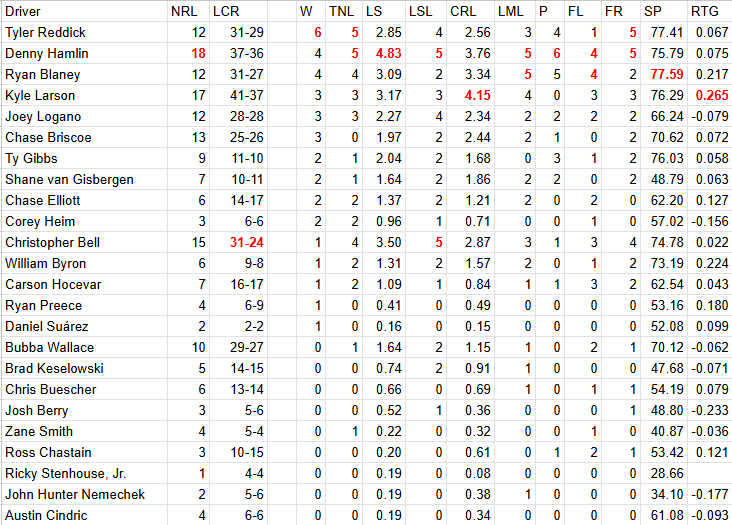
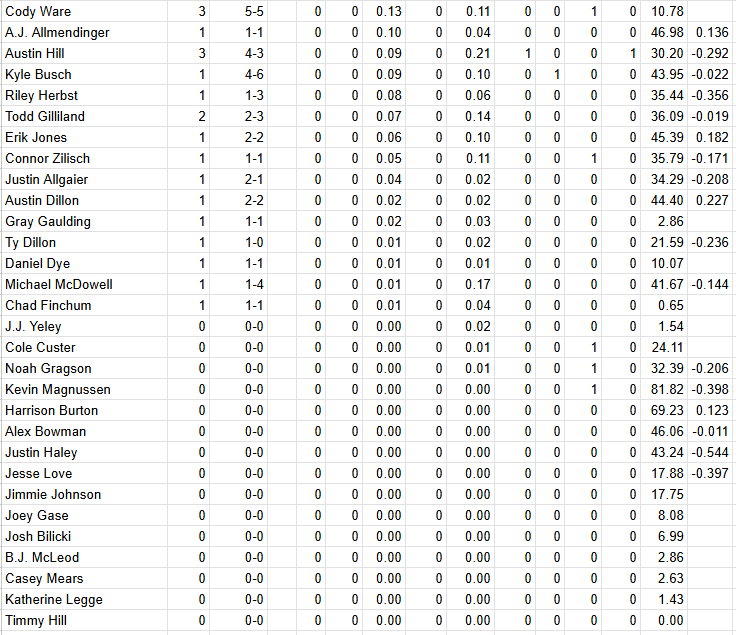
I finished my 2026 NASCAR statistical table (shown above in cropped form but here is a more scrollable version). I also updated both my NASCAR and IndyCar historical tables for each driver on this spreadsheet. There are still a few things missing, such as updated driver ratings for 2024 and many past IndyCar seasons from the ‘70s and earlier decades where I’ve already calculated all the lead change data, and I intend to make these sorts of tables for other series starting with F1 at some point.
The top five NASCAR drivers were pretty indisputable this year. This year’s top five points finishers were also the only drivers to lead in any statistical categories and they also all led in multiple categories and were by far and away the five highest-rated drivers in Ryan McCafferty’s model also. This convergence of five drivers makes it pretty obvious that they and only they were elite this year. But how do you rank them?
My first instinct as the season was drawing to a close was to rank them in this order: Kyle Larson, Ryan Blaney, Denny Hamlin, Tyler Reddick, Christopher Bell, and then after I finished calculating my model update after the 2026 season ended, I discovered that my instincts exactly matched what my model spat out. I can’t really do this in the “quick and dirty” format that I did for IndyCar and IMSA because I’ve been ruminating for a while, so my thoughts are already more fully formed, but obviously I will expound on them further in the top 200 list.
E
1. Kyle Larson - No matter how many points Hamlin would have won by in any full-season championship format, I think Larson and Blaney both clearly outperformed him because the gap between Larson and all the other Chevy drivers and Blaney and all the other Ford drivers was larger than the gap between Hamlin and the other Toyota drivers, which in my opinion, was relatively narrow. The question wasn’t really between Larson and Hamlin. It was between Larson and Blaney. I went with Larson for three main reasons:
1) Because he won the title when all three of his Hendrick Motorsports teammates were underachieving while Blaney’s advantage over his teammates somewhat narrowed.
2) I know a lot of people will disagree with this, but if a racing series is going to make the last set of races matter more than the regular season towards evaluating the championship, it is obvious that the teams and drivers will place more emphasis on those races, so analysts should adjust accordingly. That doesn’t mean always putting the Chase winner at #1. But what it does mean is that if some races are weighted more than others, analysts need to adjust their mindset accordingly to reflect this. That’s why I put Joey Logano in the C+ tier in 2024 even though the numbers weren’t quite there, why I think I’d rather put Logano in E- for 2018 (although I keep moving that season back and forth between E- and C+ and can’t make up my mind), and why I prefer to rate sports car drivers based on marquee race wins more than titles (because the teams and manufacturers themselves rate the marquee races more). While clutch performance is always overrated, it’s a lie to act like it doesn’t matter.
3) His dirt performances will always add something to his seasons that the other drivers except Christopher Bell don’t have, since versatility should always help a driver on this sort of list.
2. Ryan Blaney - If you believe all the races should be weighted equally for analytical purposes, there’s a strong case to be made that Blaney was the best NASCAR driver this year just like he was last year. He did lead McCafferty’s model and although he only ranked fourth in mine, my stock car model has always had this nagging bias of significantly underrating all the post-Kurt Busch Hendrick drivers. I believe it’s because Brad Keselowski was beaten thoroughly by his Hendrick Motorsports teammates and Kurt Busch in his early seasons and Joey Logano was beaten thoroughly by his Joe Gibbs Racing teammates in his early seasons and for many years they were only teammates with each other as they were both improving. Because it was kind of a zero-sum game between Keselowski and Logano, who were both weighted down by their seasons before they were good, their ratings couldn’t improve to their actual ability, which underrated everybody else. I suspect that if the Penske drivers weren’t underrated in my model to the extent they are that Blaney probably would’ve been #1 in my model this year also.
What I didn’t like and why I switched Larson and Blaney this year is primarily that Logano was a lot closer to him in all my on-track passing for the lead, lead share, and CRL data than I expected even if he still crushed him in overall pass differential, speed, my model, and consistent running and performance. Blaney certainly had a vastly higher floor than Logano this season, but he only narrowly had a higher ceiling and that’s a major change from the past three years. Don’t get me wrong: I still think he crushed Logano, which is why Logano is only C+, but I am less impressed by the margin he beat Logano than the margin Larson beat his teammates. Additionally, Blaney went for a long time this season without causing an incident that brought out a caution - longer than any other driver except Ty Dillon. However, he did crash at Bristol and Talladega. While I don’t think he was the main cause of either of those crashes, I wouldn’t say he was 0% responsible for them either, and that slight slip in races that counted more is probably something I have to dock a little. But he will definitely be in the top 25.
E-
3. Denny Hamlin - Formula 1 fans understand like when Lando Norris narrowly won the title over Max Verstappen last year that Verstappen was the better driver, or even when Damon Hill won in an apparent blowout in 1996 and Michael Schumacher finished the season four races behind that Schumacher was still better, but that logic has not really extended to NASCAR yet as fans seem to think “full-season champion” and “best driver” have to be the same person. Hamlin was one of the best drivers, sure, and he deserved a title for his career, which now looks like it will never happen, yes. But I don’t think he was ever actually the best driver in any single season.
Hamlin had the best numbers this season in terms of both leading the full-season points for most of the year as well as leading most of the statistical categories I track this year. He did in fact have more red ink on my chart this year than in any other, but I think that is more because of how dominant the Toyotas were in speed than because he was that dominant. It might be a hot take to say his 2026 was a weaker season than his 2025 when I ranked him 25th in the last E slot, but I think it was. Hamlin followed the proper strategy in the 2025 knockout playoffs and only got hosed by a bad pit call immediately before an overtime restart, but this year his Chase never really launched. He was slower than he’d been in the regular season and if I do believe that analytically, the later races of the season should matter more than the earlier ones because the teams obviously put emphasis on that themselves, then he has to be docked for not really coming untracked.
The other thing is his advantage over his teammates rapidly diminished compared to 2025. Bell was much closer to Hamlin in 2026 than 2025 (even despite an injury), Ty Gibbs was obviously much closer (Chase Briscoe you can debate I guess because I also think this Briscoe year was worse than his 2025). Not to mention that Hamlin’s own 23XI Racing cars seemed a lot faster in 2026 than 2025 as Reddick and Corey Heim combined for eight wins this year after the team only won once last year. The Toyotas pretty much spread the love around fairly evenly while the Fords and Chevies didn’t as much. This all explains why I do think Hamlin had a great season, but it definitely wasn’t as great as how people are heralding it.
4. Tyler Reddick - After Reddick became the first driver to win the first three races of the season and then won five out of nine, it looked like he was going to have a generational season. Reddick’s greatest strength is that he might be the best duelist in the sport in a late-race battle. His 17-9 record on the final lead change of a race is not far off of Jimmie Johnson’s 80-35 (percentage-wise), making him secretly one of the most clutch drivers in the sport, but nobody realizes this and will probably start arguing that he isn’t clutch because he hasn’t won a title pretty soon, much like the driver he most closely resembles, Carl Edwards. Reddick’s chase was pretty bad despite the win at Phoenix and near-miss at Homestead, so I can’t have him higher, but he still won the most races this season while his full-time teammate Bubba Wallace went winless, led the points standings for the longest period of time from the start of the season since Lee Petty in 1955 (I think this is correct but finding out pre-1975 points per race is a pain in the ass), and he lost the points lead to his boss at first because he was unlucky. He didn’t start just running badly until the tail end of the regular season, and that mainly happened because of his greatest weakness.
For whatever reason, Reddick is fast everywhere except for short tracks and 1-mile ovals, where he pretty much seems lost most of the time (except for his oddly unexpected win at Phoenix). I acknowledge his season is likely inflated because of his two drafting track wins in addition to the Toyota dominance. His Daytona 500 win was really stupid as it only happened because his hapless then-teammate Riley Herbst accidentally wrecked any of his competition who could have overtaken him. The Atlanta win where he drove his battle-scarred car back to victory the next week convinced me he could finally drive drafting track races though. But his relative lackluster performance on sub-1.5-mile ovals (where Wallace is definitely better) is the main thing he will have to work on if he wants to win a championship.
5. Christopher Bell - Bell had kind of a weird season in that he definitely ran significantly better and closer to Hamlin than you might expect, especially after he fractured his wrist in a crash at Michigan. Amazingly, he went on a tear for the second half of the regular season and put up some monster passing numbers despite not winning. He had great momentum entering the Chase, and this continued after he won the first Chase race in the Southern 500, even passing Larson to do it. But then, like all the Toyotas, he weirdly kind of fell off and he also made a couple stupid mistakes that caused him to be eliminated from title contention early in the season finale, namely pulling a Ryan Briscoe and crashing while entering the pits at Talladega, then speeding at Martinsville, which helped him finish behind Larson in a race he needed to bury him to make a comeback. Bell’s passing numbers and his lead share and CRL data are great. I did not expect that he would have both the best lead change percentage and rank second in lead shares and fourth in CRL (both ahead of Reddick, and he was even ahead of Larson in lead shares).
For all everyone talks about how unclutch Bell was this season, I am actually not so sure. He had a 4-3 record on the final lead change of the race, which is obviously vastly better than Gibbs’s 0-2 or Briscoe’s 0-4. Even though both of them beat Bell to wins, they did so because their pit crews got them out ahead of him when Bell was previously leading and Bell couldn’t repass them. Now it can be very difficult to pass with the Next Gen chassis and Briscoe is an aero-blocker par excellence, sure, but Bell’s struggles to make it back to the lead at the end of the race cost him dearly when winning now awards in my opinion way too many points (at least when the rest of the points structure remains unchanged). Was he playing it safe because he didn’t want to reinjure himself or was this actually a liability in his driving style?
C+
6. Joey Logano - I’m not going to discuss the rest of these drivers as long. Logano did not have a good first half of the season so his overall consistency metrics as well as his rating in my model are pretty awful, but he did perform substantially better in the races in the second half of the season that mattered more, and although I really struggled ranking all the guys from 6th-13th this year because they initially all seemed the same to me (unlike the top five that had a very clear order), I think I prefer Logano to all the other guys because his on-track passing numbers were way closer to Blaney’s than they honestly should have been. When I talked about Logano’s win at North Wilkesboro after months of him doing nothing, I assumed that was a one-off just because he had tested there vastly more than the other drivers had, but nope! He pretty much kept it up on every short track and 1-mile oval for the rest of the season. Clearly, Team Penske spent so long going all-in on Phoenix when it was the winner-take-all finale and their setup advantage from those years is still being felt today even though now it is a set of ten tracks that matter, not Phoenix alone. I prefer him to any of the other Toyotas because I don’t think any of them were that close performance-wise to Hamlin, Reddick, and Bell, and you could almost argue every Chevy driver except Larson and Carson underachieved.
7. Chase Briscoe - I wanted to rank Corey Heim over him, but I couldn’t talk myself into it. I continue to think Briscoe is the most overrated driver in the NASCAR Cup Series, but while I had once dismissed him as merely the millennial Jeremy Mayfield, I will now upgrade that to Mayfield’s replacement Ryan Newman. Briscoe had the fastest pit crew in the Cup Series and the once-not-great crew chief James Small seemed to be putting him into the lead again and again and again, and it irritates me personally to see a driver repeatedly benefit from passing others in the pits rather than taking the lead through their own efforts. That’s why it took me years to (finally) acknowledge Álex Palou was the best driver in the IndyCar Series when I kept wanting to argue for Scott McLaughlin or Pato O’Ward or Colton Herta because I valued their hard-charging styles more. But what I will say for Briscoe is that his aero-blocking really impresses me. Sure, he derped against Larson at Kansas, but the one difference between Briscoe and Newman (who also relied on pit strategy a lot to win) is that Briscoe genuinely is hard to pass in a late-race battle most of the time while Newman had the worst passing record for the lead against major drivers in Cup in my lifetime. That is a skill and it is his greatest skill, and if James Small wants to play to that by putting him in the lead in awkward situations, I guess I can’t blame him. Sure, you can say it’s hard to pass with this car regardless, but I think Briscoe is better at preventing passes than anyone else in that situation regardless. He showed it in both his Southern 500 wins, the Pocono win last year, and both races he held off Bell this year.
8. Corey Heim - I know y’all are gonna say I’m wildly overrating him here by taking him over guys like William Byron, Ty Gibbs, Carson Hocevar, Shane van Gisbergen, or Bubba Wallace who might’ve had better seasons on paper. I realize he ran inconsistently and was sometimes outrun by his godawful teammate Herbst. I don’t care. I think one of the things I’ve realized over the years is that I really don’t care how consistent drivers’ performances are throughout a season, unless they are battling for a championship. In that case, it matters that you run well every race. But if you are far out of the championship hunt or in Heim’s case not even running for points, what matters is what you do in your best races. That is what people will remember. That is why people remember wildly inconsistent hard-charger Jerry Nadeau more fondly than Ted Musgrave who never did much of anything even if he was more consistent.
Legacies are built on standout races, and Heim delivered in spades. He became the first intended part-time driver to win two races since Davey Allison and Tim Richmond in 1987 and he did not back into either of them, as he outdueled Reddick at Coronado when Reddick was leading the points, and then outdueled his boss Hamlin for the Brickyard 400 win, another high-profile race. This gave him a 2-0 TNL lead change record for the season, tied with Byron and Chase Elliott for the best. I realize there are a lot of drivers with better numbers, but I am pointedly ranking Heim above them for these reasons:
1) It has proven extremely difficult for any drivers to learn the Next Gen chassis, unlike previous generations of cars (especially what we now call the Gen 4, which wasn’t a “generation” at all, but I digress) and it usually takes a couple years for anyone to build up speed at all, which Heim did seemingly instantly. I realize truck drivers seem to adapt faster than O’Reilly drivers, but this was still something pretty historic.
2) I realize that the #67 car was running part-time and probably did not have the same caliber of equipment or especially pit crews as the other 23XI Racing cars.
3) In context, I guess I do grade on a curve based on expectations to a certain degree. If a driver improves a team’s performance from one year to the next, that impresses me more than obtaining the same stat line with a team that was already on top. So I tend to rate pivot years where drivers are on the rise higher than their raw statistics might warrant, while I tend to be harsher on veterans fading from their peak than their statistics may warrant, but I do think this tends to age well. Although I realize a lot of the gain in speed was just from him having a Toyota.
4) Part of it is just that I listed him in the top 100 last year and it would feel weird if I ranked him lower when he actually won two Cup races. And it would also feel weird to me if I ranked him below Wallace when he won 2 races as a part-timer and Wallace won 0 races as a full-timer.
On paper, this looks wrong, but I think in retrospect, it will look right. Does it even matter if he didn’t have consistent performance when he wasn’t even running for points?
9. William Byron - It’s a boring season to talk about. I have basically nothing to say about it. Even his Martinsville win was really boring, but he was far closer to Larson in both speed and my model than he was to Elliott, and he actually ranked third overall in my model, which I can’t say I understand, so I’ll give him my last Cup Series slot in the top 100.
C
Chase Elliott - He does get props for winning twice in gallant races at Texas and Martinsville at a point in the season when the Chevies were kind of running like garbage, but his second half was terrible as Alan Gustafson kept bringing slower and slower cars to the track as the season progressed. While his late season collapse wasn’t as bad as Chris Buescher’s and at least he had those two tentpole races, he has to be docked for running worse in the late-season races, particularly as Larson was getting faster. And why is Byron’s crew chief being replaced instead of Elliott’s next year?
Ty Gibbs - He proved himself to be more than a nepo baby at his grandfather’s team and he wasn’t that far off his teammates in performance, but while Gibbs was particularly electrifying on short tracks, he was almost a reverse Reddick as he was nowhere near as good anywhere else. I guess I have to take him a tier down from Briscoe because Briscoe was a very scrappy driver while defending the lead and even though he spent most of his races just aero-blocking, I did kind of think Briscoe’s aero-blocking skill was pretty awesome and I saw nothing like that from Gibbs. Like Briscoe, Gibbs did not make a pass for the win this season. His 0-2 TNL record was not as bad as Briscoe’s 0-4, but at least Briscoe has made passes for the win before. Gibbs’s career TNL record of 0-4 now matches Briscoe’s 2026 record, and that is not good. At least Briscoe can pass for the win. He just didn’t do it this year. Gibbs still needs a little more help, and that’s why I took him lower even though his stats are similar. He did get a TNL though because he won the pole at Sonoma and Shane van Gisbergen beat him out of the pits. The weirdest thing is that he was apparently the fastest Joe Gibbs Racing driver this year. Huh?
Carson Hovercar - He was arguably top ten on performance for elevating a once-garbage Spire Motorsports team into the upper echelons and for a while, they seemed to be on the verge of overtaking Hendrick Motorsports as the top Chevy team. That didn’t last long and there’s still the controversy about all the data Chris Gabehart supposedly pilfered for them after he left Joe Gibbs Racing, which might have inflated all of them. I dropped him here even though the performance might have been more C+ both for that reason and because I have to dock him for all the wrecking (both intentional and unintentional) and all his other general dipshittery, right?
Shane van Gisbergen - SVG was one of the three drivers I really didn’t know what to do with this season along with Heim and Carson Hocevar. He continued to be overwhelmingly the fastest driver on road courses and he indeed remains one of the best road course drivers in the field, but his dominance on them was nowhere near as pronounced in 2026 as in 2025, particularly in the absolutely wild Coronado race, where it looked like at various points 12 different guys could’ve won, but I imagine SVG probably would’ve won if Austin Hill hadn’t wrecked him, which would have prevented that stupid Preecebomb that knocked him out of the Chase. On the other hand, his oval performances vastly increased and he was often faster than Ross Chastain even on ovals, even battling for the lead on short tracks sometimes. He crushed Chastain at Trackhouse Racing numbers based on all dominance-based statistics, but Chastain was actually faster and higher in my model. That’s probably why I didn’t consider him too strongly for the top 100. I also didn’t want to rate this season higher than last year, because it feels weird to me to rate a 2-win sophomore season over a 5-win rookie season, even if Trackhouse’s cars were slower this year and his oval performances have increased. If I’m going to make the argument I’m making for Heim this year, I now know I need to bump up SVG’s 2025 to C+ for consistency’s sake. I’m going to swap him and Herta. I had Herta near the very bottom of my top 100 last year because I thought it would be weird to only have four IndyCar drivers in my top 100, but in a year when Palou led the points for half the season, maybe only him, Pato O’Ward, Kyle Kirkwood, and Christian Lundgaard actually deserved it last season. Since SVG kept it up while Herta fell flat on his face, I think this is a swap no one could dispute.
Bubba Wallace - The stats say C+ but I kind of think this was a bad career year for him as solid as his advanced stats were when he failed to win while his teammate Reddick won a season-high six times and his part-time teammate Heim won twice. Heim stands a very real chance of overtaking Wallace as the #2 23XI driver next season, but Wallace is still performing well enough to remain viable despite the fact that his racecraft isn’t as good as his speed. Still, as far as bad career years, I will grant that this wasn’t as legacy-destroying as Colton Herta’s, Scott McLaughlin’s (in IndyCar), or George Russell’s.
C-
Justin Allgaier - I initially didn’t think I was going to list him this year. I know he was the best O’Reilly Series driver for the entire year, but I did think the fact that Connor Zilisch utterly annihilated him in 2025 despite two injuries and being a rookie was kind of a reputation-destroying year for Allgaier that would be impossible to come back from. Well, I was wrong. He did bounce back by winning six races (the most in his career) en route to his second championship. He did overtake Jack Ingram for the most wins in the current season for a driver who did not primarily compete in the Cup Series. He’s nowhere near as good as Ingram overall, mind you, as Ingram actually has 183 wins, as I just revealed, but probably the best series regular of this generation for however little that’s worth when the Cup Series is the big prize.
Ross Chastain - I could have not listed him, as he seems to have gotten really complacent. The guy who once made his name wildly overachieving in questionable JD Motorsports, Niece Motorsports, and Premium Motorsports cars or trucks seemed to kind of stop giving a shit at points this season. I’m still listing him because he was faster than SVG even though it really didn’t seem like it, but his season was really lacking in noted highlights. He still has sufficient talent that a complacent Chastain will still outperform say, a complacent Buescher, but it feels like because Justin Marks came from the road racing world that SVG will now be his golden boy for the rest of his career. Chastain probably needs to find his footing somewhere else to make a comeback, but I have no idea if anyone’s offering.
I’ll decide whether I’m going to list Kaden Honeycutt and/or Layne Riggs later (it depends on how the rest of the bubble turns out), and obviously I’ll sharpen these and I might write entirely different entries for the actual paywalled top 200 list. These were still more vibes-based, while obviously my top 200 posts tend to go really deep into the nitty-gritty to the point of unreadability (sigh).
Finally, before I go tonight, here are the updated career Cup season driver ratings through 2026. I was too lazy to do it in DataWrapper. I just wanna get this done and get to more bubble posts.
Jimmie Johnson: .243 → .241
Kyle Larson: .218 → .219
Chase Elliott: .207 → .198
Kyle Busch: .199 → .198
Denny Hamlin: .159 → .156
William Byron: .124 → .126
Tony Stewart: .121 → .122
Ryan Newman: .118 → .121
Christopher Bell: .119 → .111
Brad Keselowski: .111 → .103
Ross Chastain: .094 → .102
Chris Buescher: .093 → .095
Ryan Sieg: .076 → .077
Carson Hocevar: .097 → .073
Joey Logano: .075 → .068
A.J. Allmendinger: .054 → .064
Ryan Blaney: .049 → .062
Alex Bowman: .064 → .056
Grant Enfinger: .031 → .048
Parker Kligerman: .005 → .040
Corey LaJoie: .039 → .025
Ricky Stenhouse, Jr.: .017 → .024
Jamie McMurray: .023 → .023
Austin Dillon: -.001 → .008
Stewart Friesen: .005 (NEW)
John Hunter Nemechek: .035 → .004
Erik Jones: -.009 → .000
Matt Crafton: -.014 → -.006
Chase Briscoe: -.026 → -.007
Ryan Preece: -.043 → -.010
Ben Rhodes: -.026 → -.017
Tyler Reddick: -.036 → -.018
Brennan Poole: -.018 → -.019
Shane van Gisbergen: -.084 → -.021
Justin Allgaier: -.030 → -.037
Michael McDowell: -.016 → -.037
Regan Smith: -.036 → -.045
Ty Gibbs: -.073 → -.048
Daniel Suarez: -.073 → -.052
Bubba Wallace: -.055 → -.054
Corey Heim: -.002 → -.059
Connor Zilisch: .092 → -.060
Noah Gragson: -.048 → -.064
Elliott Sadler: -.066 → -.066
Chandler Smith: -.055 → -.066
Casey Mears: -.069 → -.069
Daniel Hemric: -.087 → -.070
Zane Smith: -.085 → -.081
J.J. Yeley: -.086 → -.086
Justin Haley: -.098 → -.094
Cole Custer: -.109 → -.100
Parker Retzlaff: -.120 → -.113
Todd Gilliland: -.130 → -.116
Austin Hill: -.058 → -.119
Gray Gaulding: -.130 → -.131
Matt DiBenedetto: -.135 → -.134
Sheldon Creed: -.123 → -.138
Andrew Ranger: -.138 → -.156
Austin Cindric: -.174 → -.157
Bayley Currey: -.153 → -.160
Ty Dillon: -.160 → -.164
Cody Ware: -.171 → -.170
Jesse Love: -.175 → -.171
Josh Berry: -.154 → -.171
D.J. Kennington: -.160 → -.175
Josh Williams: -.159 → -.190
Timmy Hill: -.202 → -.202
Harrison Burton: -.231 → -.223
Kaz Grala: -.230 → -.228
Chad Finchum: -.241 → -.241
Anthony Alfredo: -.227 → -.242
David Starr: -.250 → -.250
Jeb Burton: -.261 → -.259
Daniel Dye: -.269 (NEW)
Garrett Smithley: -.279 → -.277
B.J. McLeod: -.300 → -.299
Matt Mills: -.296 → -.299
Riley Herbst: -.299 → -.307
Brendan Gaughan: -.311 → -.311
Joey Gase: -.322 → -.321
Ryan Ellis: -.327 → -.328
Josh Bilicki: -.373 → -.373
Justin Marks: -.377 → -.378
Travis Pastrana: -.388 → -.396
Dario Franchitti: -.404 → -.403
Conor Daly: -.454 (NEW)
Spencer Boyd: -.712 → -.713