

I already did the other two legendary Grand Prix drivers who became heroes of the French Resistance, Robert Benoist and Jean-Pierre Wimille already. While Grover-Williams had the least impressive driving career of the three, he was a much more central figure in the war effort and he brought both of them into the fold to begin with, so I tried to focus more on his heroism here while making sure not to neglect his driving career as well. I have nothing much to say about any of this weekend’s races, which were all pretty boring, albeit none of them were truly awful (except maybe the O’Reilly Auto Parts race), so here’s some more LearnedLeague review.
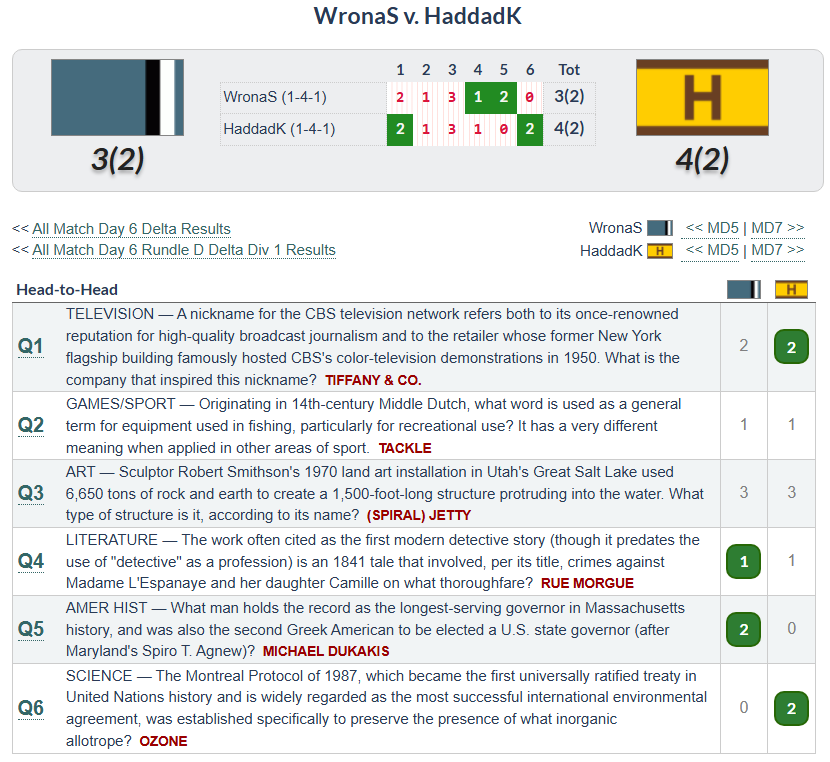
If Question 1 had been asked the opposite way (“what American broadcast network was nicknamed Tiffany”) I probably would’ve gotten it, but I couldn’t pull up the name this way. I put Woolworth’s. I put rod for Question 2. Had nothing for Question 3. Question 6 was probably my stupidest answer the entire round. I’d never seen the word allotrope before, so that probably would have helped. I vaguely remember all the stuff about saving the ozone layer when I was an extremely little kid, but that environmental disaster was one of the few that was actually mostly resolved as we moved away from aerosol cans and the use of CFCs. Anyway, I was thinking Canada + nature, so I put maple leaf lol. We both got tackle wrong even though it was ostensibly the easiest question in terms of both average defensive rating and percentage of people who got the question correct.
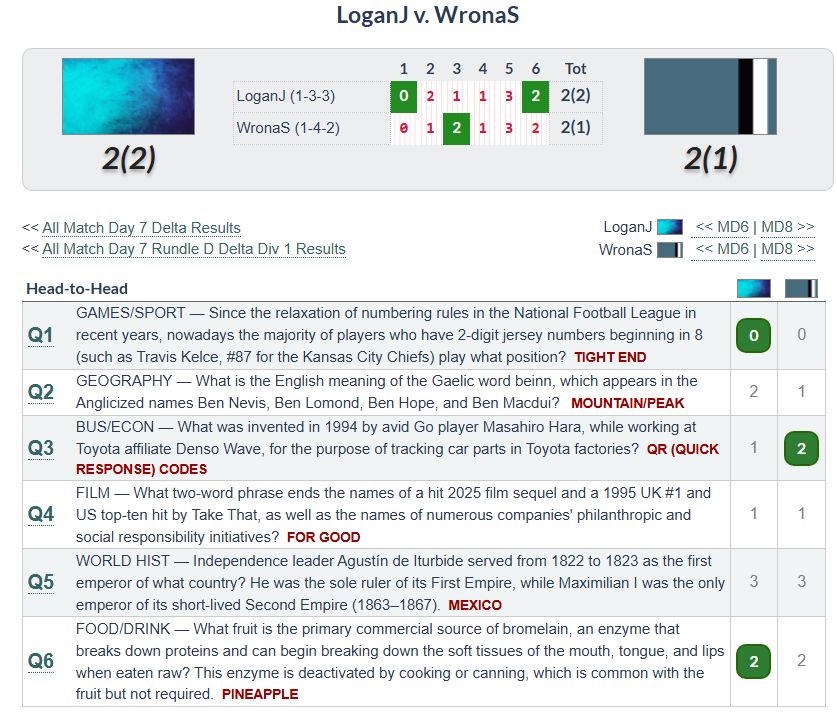
I was never into football and I guess it was only me. I considered it my dad’s sport an we had a frosty relationship, although I also think people who unironically use the word “sportball” to be really ridiculous. All I knew about Kelce was his relationship with Taylor Swift, and Mahomes is the only Chief who I would have correctly matched up with his position. I put wide receiver for #1, “son of” for #2, “Whole World” for #4 (most embarrassed by this one I think since I should have probably at least heard of that Take That song; I knew they had a single hit here despite being huge in the UK but forgot the title), Spain for #5, and watermelon for #6.
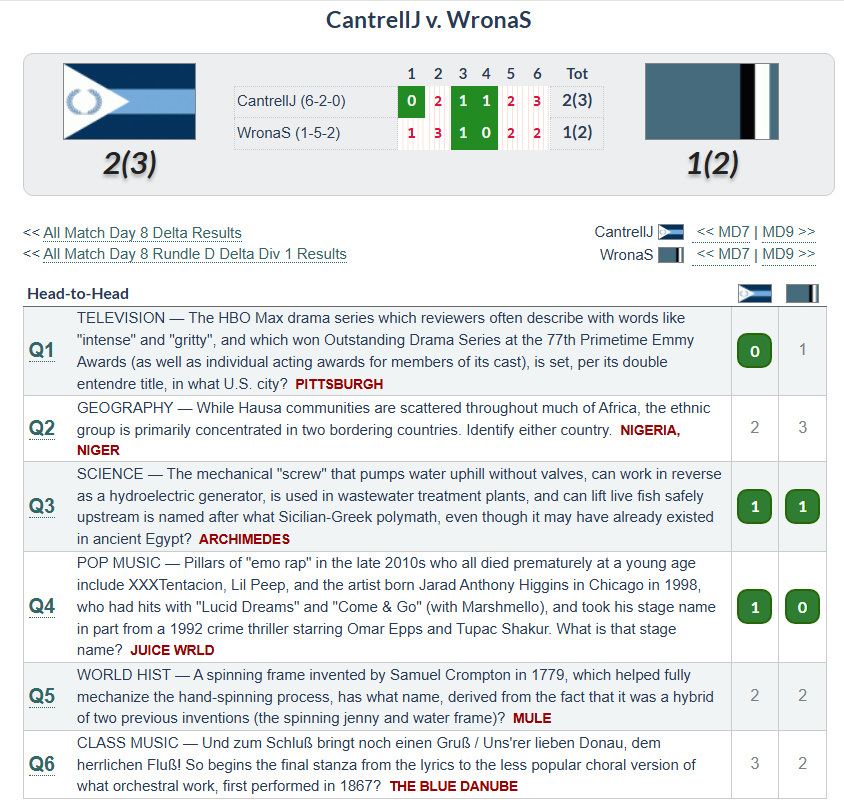
I highly doubt I was playing the Alice in Chains guitarist. Anyway, the first question was considered one of the easiest in the entire round but I didn’t really know shit about streaming television and it seems like really recent stuff from the past couple years I always miss (even if it’s news), as I’m always 20 years behind culturally. This question did introduce me to The Pitt and allowed me to get a bar trivia question on it the first week I won, so I guess I have to thank LearnedLeague for that. I put Fargo (at least I knew there was a Fargo TV show). I put Rwanda for #2, sewing machine for #5, and Beethoven’s Ninth for #6. None of those were very good guesses, but at least at this point, I knew to guess on everything in case you randomly luck into something.
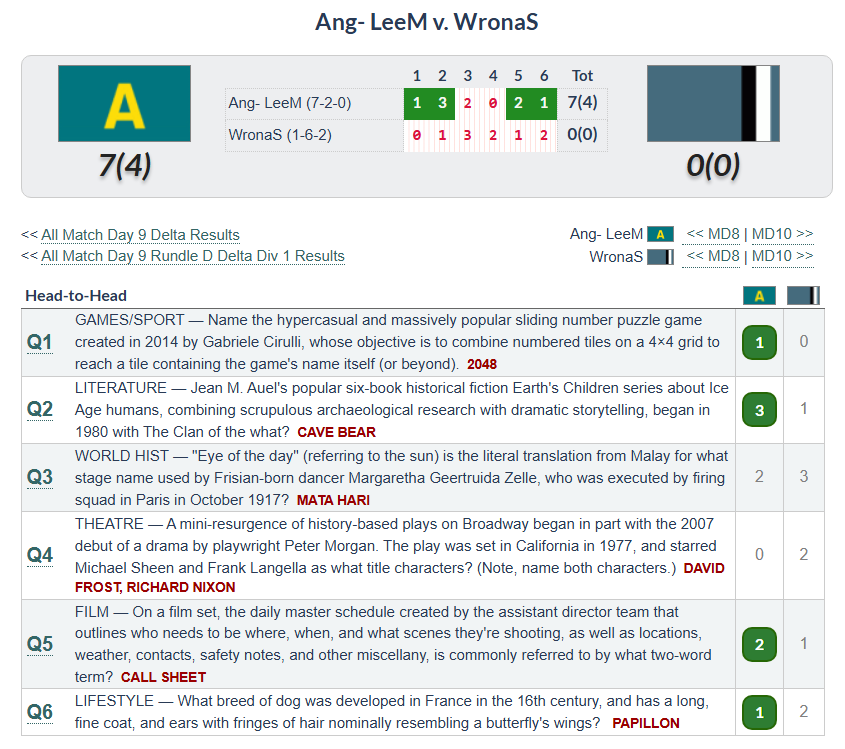
Yeouch! This was the only day I was shut out and I had mostly not even heard of any of this stuff. Okay, I knew about the Frost/Nixon movie, but I didn’t not know that it was adapted from a play. I did consider that as an answer, but I went with Steve Jobs and Steve Wozniak instead because California in the ‘70s makes me think of Silicon Valley and obviously 2007 was probably around the height of interest in Apple due to the release of the iPhone. I had heard of call sheets just because I’ve listened to a lot of TV show rewatch podcasts, but the term just didn’t come to me. The other four things I had never heard of. Maybe I could have gotten to 2048 if I had thought of powers of two ‘cause I have all of those memorized up to 67,108,864, and if I’d thought the game was named after a year (which I guess it must’ve been), that might’ve been gettable, but I’d definitely never heard of it. I put Infinity for #1, Neanderthal for #2, Zsa Zsa Gabor for #3, tape day for #5, and terrier for #6, but at least there was nowhere I could go but up from here.
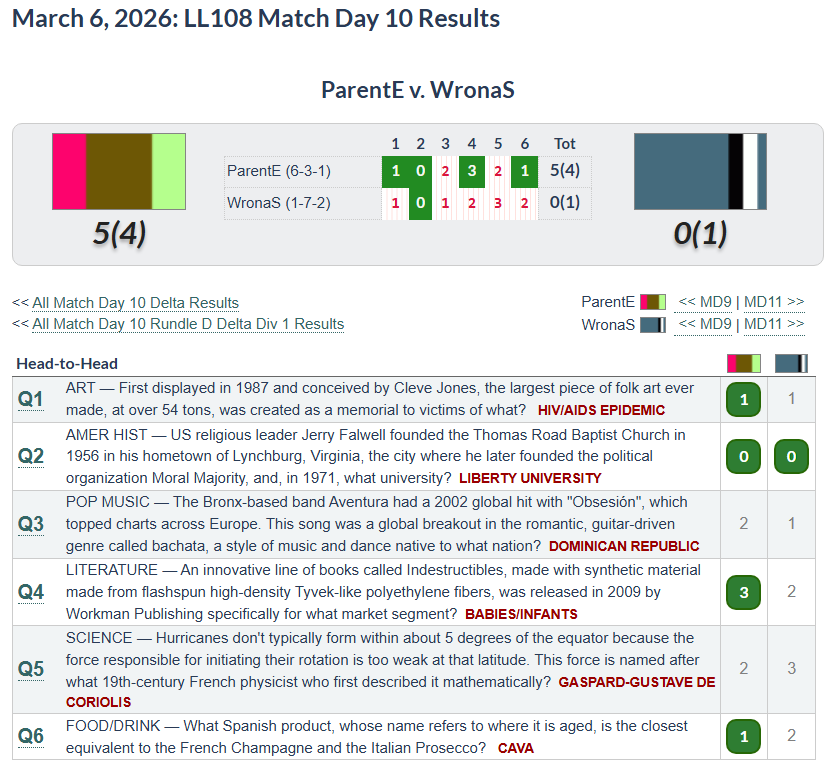
Once I saw the answer to the first was AIDS, that made sense. I put communism lol. I don’t actually think that was a bad guess considering the impending end of the Cold War and the contemporary Reagan-era jingoism, but I suppose that answer would have been in bad taste and generally (at least in that era), folk art is more about solidarity than polarization, so I absolutely should’ve gotten that. I again answered Spain incorrectly for #3. I put construction for #4, which at least I think was a good guess. I put Beaufort for the Beaufort Scale for #5, again a good guess I think. And then given my eating disorder, I have almost never heard of almost any of the answers to the food/drink questions, because this league is made for sophisticated cosmopolitan foodies and not people like me who solely consist on processed glop. Seriously, cava was rated as the easiest question in terms of defensive ratings? I’d never even heard of it. (Although a lot more people got the Liberty one…)
WILLIAM GROVER-WILLIAMS………UK
Born: January 16, 1903
Died: March 23, 1945
Best year: 1929
Best drive: 1929 Monaco Grand Prix
The first Monaco Grand Prix winner but better known for his war exploits, William Charles Frederick Grover was born in France to a British father and a French mother. When the prince for whom his father bred horses was transferred to Paris, his parents moved there but he was sent to live with relatives in England. After World War I ended, the family reunited in Monaco, where Grover obtained his driver’s license and began racing motorcycles. Wanting to hide such a dangerous hobby from his parents, he used the pseudonyms “W Williams” or “Williams”, which would eventually be appended to his formal name.
The venerable Irish painter William Orpen hired Grover-Williams as his chauffeur in Paris; he would eventually marry Orpen’s mistress. After finishing fifth in the 1926 Monte Carlo Rally and entering numerous hillclimb events, he earned his first major win in the 1928 French Grand Prix, which that year was a sports car race because they couldn’t attract enough open wheel entries. However, the next year, he defended that win in a flag-to-flag open wheel race and also won the inaugural Monaco Grand Prix, driving from fifth to take the lead at the start and leading all but six laps after a duel with Rudolf Caracciola. His win was a dramatic upset because Grover-Williams’s Bugatti had no factory support while Caracciola had considerable factory backing from Mercedes. He won the ten-hour 1931 Belgian Grand Prix in a shared drive with Caberto Conelli and three straight Grands Prix on the beaches of La Baule in 1933 before retiring.
When World War II broke out, Grover-Williams joined the Special Operations Executive, where he assisted the French Resistance in their attempts to overthrow the Nazis. His fluency in both French and English proved advantageous, and he convinced two French Grand Prix legends, Robert Benoist and Jean-Pierre Wimille, to join his underground sabotage and espionage network, which was headquartered at Benoist’s estate. However, after Benoist’s brother Maurice was captured and tortured, he ratted out the others and Grover-Williams was sent to the Sachsenhausen concentration camp and executed only a few weeks before the war in Europe ended. Benoist was also executed, but Wimille managed to escape. There was a long-standing rumor that Grover-Williams had survived and escaped and was living under an assumed identity after the war, but that turned out to be untrue.
Grover-Williams is primarily remembered for his war heroism to the point that his brief driving career is effectively a footnote, but he is a legendary Grand Prix driver all the same. The fact that he won against several of the ‘30s’ biggest Grand Prix stars despite minimal factory backing is impressive, even if he wasn’t quite as diverse as contemporaries like Tazio Nuvolari who were also prolific sports car winners and even if the fields he raced against were pretty shallow. He had enough marquee race victories over a short enough period for inclusion, but obviously his sacrifice for the Allies will remain the cornerstone of his legacy.
Year-by-year: 1928: C+, 1929: 3, 1931: E, 1932: C+, 1933: C+