

Since I suppose the centerpiece of this article is Jamie McMurray, perhaps the most borderline of borderline NASCAR drivers, I thought I would “celebrate” with the following graphic:
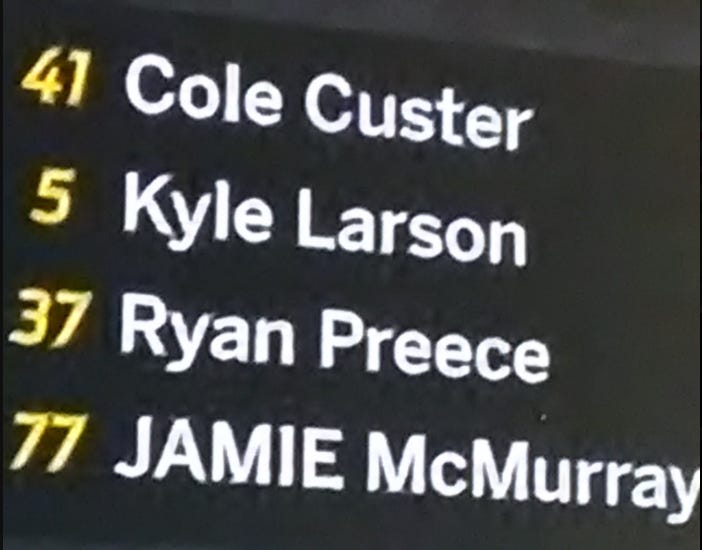
This was displayed during the commercial break in the first Duel qualifying race for the 2021 Daytona 500, where McMurray made his final NASCAR Cup Series start and ended on a high note with a top ten, albeit only because most of the faster cars crashed. The fact that his name and only his name was displayed in the on-screen leaderboard in all capital letters became a running joke on the Discord where I posted. Many times when we referenced him after that for years afterward, we’d write JAMIE instead of Jamie well after the point it stopped being funny. But that stupid graphic enchanted us, and for that reason, I hereby honor it with the dubious distinction of making my Mt. Rushmore of Stupidest Text-Based NASCAR Graphics.
What are the other three? Glad you asked. These would be my picks, and all of these are so much dumber than the JAMIE graphic.
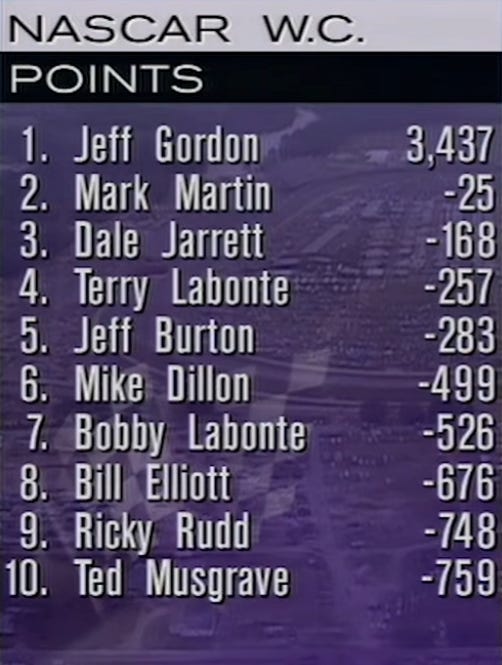
This of course comes from the 1997 Southern 500 when Dale Earnhardt famously blacked out after taking the green flag and couldn’t find pit road. While it was never really properly explained to my satisfaction what happened there, Earnhardt’s car owner Richard Childress recruited his stepson Mike Dillon, who was even worse than Mike’s sons Austin and Ty, to take over the #3 car to collect championship points, even though by that point they were many, many laps down. There was actually a big uproar about that because Darlington Raceway typically had all sorts of weird, arcane rules against rookie participants. For instance, when there were multiple days of qualifying, they used to not allow rookies to qualify on the first day until this was finally waived for Jeff Gordon in 1993. Maybe it was NASCAR in this case, I don’t remember. But there was a general rule that rookies were not supposed to be allowed to be relief drivers, and not only was Dillon a driver who had never started a Cup Series race before, he was also Childress’s stepson (yes, people cared about nepo babies back then, but thankfully that stupid term had not entered the lexicon yet), and he wasn’t even a good Busch Series driver. Remember how bad Ty Dillon is and then look up and see how much infinitely worse Mike’s record in NASCAR’s second-tier series is. Nonetheless, NASCAR eventually let Mike Dillon take over the #3 car and they were credited with a finish. That stupid “finish” where Earnhardt himself drove fewer than ten laps, possibly fewer than five, enabled Earnhardt to be the second driver after Cale Yarborough in his 1977 title season to have 0 DNFs in a full-time season, by the way. That should have been proof to anyone even then that avoiding DNFs was not necessarily a measure of skill. And then the icing on top of the cake came two years later when Rick Mast in 1999 had a 0 DNF full-time season despite finishing 32nd in points. Nobody should’ve taken avoiding DNFs as a measure of skill seriously after that. But the ESPN tech crew apparently got the clever idea here to find and replace. “Wherever it says Dale Earnhardt, put Mike Dillon” and they forgot to change it after the race, leading to that hilarious graphic. (If it were me, I’d have left it as Earnhardt for the entire race even when he wasn’t in the car since by NASCAR rule, the driver who starts always gets the points, no matter who is in the car.)
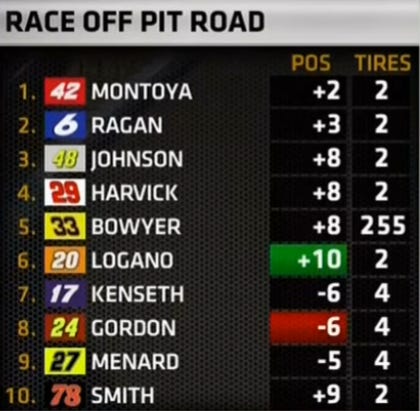
This is maybe the most iconic stupid graphic, this time from ESPN’s second stint covering NASCAR. While all the other drivers on these caution flag pit stops in the 2011 Brickyard 400 took either 2 or 4 tires, somehow Clint Bowyer’s team took a staggering 255 and still gained 8 positions in the pits! Now, I notice that 255 is one less than 256, which is 2^8. When I was a kid, I used to remember playing with the DOS alt codes for printing ASCII characters, and since the character set started with 0, that meant 255 (or 11111111 in binary code) was the last character in the main DOS ASCII set, which was simply a non-breaking space. It makes me seriously wonder if they were entering the number of tires in binary, but I’m probably overthinking this. The 5 is directly above the 2 in the numeric keypad, so that’s probably what their data entry techs were using, and somehow there wasn’t some safeguard to limit that field in their database to only single-digit character strings.

And then finally, you wouldn’t think I could’ve forgotten this one, could you? Legendary sprint car driver/terrible NASCAR driver J.J. Yeley was accidentally listed as the 2009 Formula 1 champion in qualifying for the 2023 spring Martinsville race. I kind of get how this happened because Jenson Button actually had driven the #15 Rick Ware car (for some reason) earlier that year at Austin, so you could argue this is the Earnhardt/Dillon error all over again. Ctrl+F “old driver”, replace with “new driver”. But hold up. Not so fast. At least the Dillon error happened in the same race. This happened three races later. Button started Race #6 of the Cup Series season and this was Race #9. Yeley had actually started the previous two races in the car. Did the error happen even then and nobody caught it? Or did they somehow replace correct graphics in Race #7 and #8 with this incorrect one three races later? I’m not going to bother to research this, but you can if you like. And the thing is Yeley has some legit accomplishments to hype. His single-season USAC Triple Crown may not be an F1 title, but it was certainly very impressive.
So that’s two FOX boo-boos (and I’m sure that list can be extended much further) and two ESPN ones. Congratulations NBC on not making this list! Anyway, I thought that was a fun way to set the stage for the JAMIE post.
Jamie McMurray (15)
Summary: 21st-century NASCAR driver who earned an impressive string of marquee race victories, including sweeping the Daytona 500 and Brickyard 400 in 2010 (making him one of only three drivers along with Dale Jarrett and Jimmie Johnson to do that), the 2014 All-Star Race, and the 2015 24 Hours of Daytona.
Case for: The best thing about McMurray’s career was the time in which he raced. The 2002-2013 era, in general, had the best competition in NASCAR history and all of McMurray’s wins came within this period. In his two stints for Chip Ganassi Racing, he posted an above-average rating in my model in all his Ganassi seasons through 2016. Even though he only actually won on four tracks, he showed signs of competitiveness on all track types, like when he led the most laps in the 2014 Bristol night race or when he led 30 laps from the pole at Sonoma in 2007. He won in his second start in an era when that was historically rare. You could argue he was an underrated driver since despite 7 Cup Series points wins, he had 8 TNL and 8.81 lead shares, suggesting he put himself in the lead more than he won. In six of his seven wins, he passed champions for the win (Kyle Busch three times, Kevin Harvick twice, and Bobby Labonte once). On the surface, the guy whose baseline statistics McMurray most reminds me of is Morgan Shepherd. JAMIE has 7 wins, 63 top fives, 169 top tens, 11 poles, 1,903 laps led, and an average finish of 18.2, while Shepherd has 4 wins, 63 top fives, 168 top tens, 7 poles, 2,155 laps led, and an average finish of 19.7 (deflated because he had a lot more starts in seasons after he was washed up). I have Shepherd as a lock, perhaps dubiously, which is a favorable comparison for McMurray.
Case against: However, there are numerous strikes against his career as well, making him an ultimate bubble candidate. Although it is harder to understand now, at a time when NASCAR was at its popularity peak, his dominance from 2003-2005 over teammates Sterling Marlin and Casey Mears in his first Ganassi stint caused him to be hyped as the biggest prospect in the sport. There was literally a bidding war over his services between Roush Racing and Team Penske, with Roush winning in 2005. They ended up paying him so much money that from what I have read, defending champion Kurt Busch left to take over the Penske ride Rusty Wallace vacated because he was pissed that McMurray was being paid more. With that much hype, McMurray was a drastic disappointment at Roush Racing (which became Roush Fenway Racing). He took over Busch’s championship-winning ride and managed to run off legendary crew chief Jimmy Fennig in seven races, who gave all his full-time drivers from 1989-2009 (Dick Trickle, Hut Stricklin, Jimmy Spencer, Derrike Cope, Mark Martin in the winningest of his second-place points finishes, Busch, and David Ragan) their best career points finishes. He only won two races for Roush, both on restrictor plate tracks. When Roush was forced to drop down from five cars to four for the 2010 season, McMurray was dropped even though he had outperformed Ragan because he underachieved that gargantuan contract more than Ragan underachieved his more modest one. And he had below average ratings in my model in all four of his Roush/Fenway seasons.
But it’s what he did in his best seasons that matters more than what he did in his worst, right? Sure, fine. I agree! My feeling is that all the Dodge drivers in the Cup Series were inflated after the Dodges got a special spoiler adjustment in the middle of the 2001 season because they had underachieved at the start of that year. I think this continued through the 2006 season. I have many points of evidence for this. Bill Elliott went winless for 7 years and forged a comeback where he won in all three of his final seasons. Sterling Marlin went winless for 5 years before suddenly posting the best season of his career in 2001, then leading the points standings for over half the season in 2002. Jeremy Mayfield ran so badly for Penske in the 2001 season that he was fired before the season was over but came back and made the first two NASCAR Chases in 2004 and 2005. Kasey Kahne had had an extremely lackluster Busch Series career and was fast enough to win from day one. He and Ryan Newman both won the most races in a season even though they were in retrospect only second-tier stars. McMurray won in his second start. And then McMurray and Mears got out of Dodge and moved to Roush Racing and Hendrick Motorsports, ostensibly two of the big three teams along with Joe Gibbs Racing, where they both ran worse than they did at the supposedly inferior Ganassi team. I think that’s more than enough evidence to argue that the Dodges were making all their drivers look better than they actually were for quite a while. Look, I’m Marlin’s biggest analytical defender and I will go to my grave thinking that he was basically interchangeable with Jeff Burton and Bobby Labonte, who are conventionally much higher rated, but it’s still goofy that right after going winless for five years he was suddenly leading the championship nonstop at age 44-45? And then McMurray won at Charlotte with the same chassis that Marlin had also dominated at Charlotte the previous year. This is a major, major strike against McMurray, especially since he did not exactly show many signs of dominance like most of these other drivers did at times.
Yes, he outran Marlin and Mears in 2003-2005, but that isn’t worth a lot to me since I think Marlin was mostly washed up after his Richmond and Kansas crashes in 2002 and Mears was never good to begin with. I think that inflated him and made him look better than he actually was. Hell, Mears even fought for the win a couple times at the end of the 2005 season in a year McMurray hardly led at all. Sure, McMurray outran him, but that’s a strike against, too.
In his second Ganassi stint, I do really like his 2010 when he won three times, twice in marquee races in gallant fashion. I rate that season pretty highly as he ranked fifth in lead shares with 2.23. For a driver who never dominated that much, this feels like a standout season. But again, that season he had dominant Earnhardt Childress Racing engines that Kevin Harvick led the full-season points for most of the year with even though he wasn’t really running all that well. Even though I rate McMurray’s 2010 highly, other analysts don’t, as Ryan McCafferty’s model only ranked McMurray 17th in a year he had McMurray’s teammate Juan Pablo Montoya 10th. (He also had him as only the best driver in a race three times in his career and in none of his wins, which I also think is a strike against.) I don’t think Montoya had a better season than McMurray, but I can kind of see where his numbers came from (even in the Brickyard 400 that McMurray won, Montoya had dominated and outran him). But if even that year is contentious, that is not a good sign. He ran well in 2014 and 2015, but I almost wonder if that’s more because the feedback from his new teammate Kyle Larson helped him before Larson was ready to fully master the Cup Series himself, kind of like how I feel Tony Stewart’s feedback elevated Bobby Labonte in 1999 and 2000 before Stewart, like Larson, outperformed his teammate every subsequent year by a massive margin.
As for his marquee race wins, it’s worth noting that most of them came at a time when a lot of fans started believing the marquee races no longer mattered much. McMurray’s Daytona 500 win in 2010 came during the much-maligned tandem drafting era, which also resulted in the left-field fluke Trevor Bayne winning the following year’s race. Obviously I’m more impressed by McMurray outdueling Harvick for the win than I am by Bayne only inheriting the lead because Ragan committed a restart violation, but that era of restrictor plate racing still feels somewhat hollow to me. And many would argue that the Brickyard 400 stopped being a marquee NASCAR race after the infamous 2008 tire debacle. The All-Star Race had also lost its luster before he won it. And do you really think McMurray was an important contributor to his 24 Hours of Daytona win? He was not. I actually have lap times from this. He greatly benefited from co-driving with three superior drivers Scott Dixon, Tony Kanaan, and Larson. Perhaps surprisingly, Larson actually had the fastest average speed in that race (and he wasn’t even a particularly good Cup Series driver yet), while Dixon was 3rd, Kanaan was 6th, and McMurray was 16th. He still had above-average speed in the Prototype class, but he clearly brought up the rear amongst his teammates and Dixon was clearly the team leader since he led 198 of the team’s 264 laps.
McMurray also seems to have a reputation for being a clutch performer because of his gallant restrictor plate wins, particularly outdueling Kyle Busch in a photo finish at Daytona in 2007. This really isn’t well-founded. Yes, he has more TNL than wins, which normally indicates a clutch driver. However, his TNL record on the final lead change of the race is 8-17, worse than his overall lead change record of 95-109. He already wasn’t a strong passer to begin with and then his record on final lead changes was even worse. This is almost the inverse of Buddy Lazier, who was one of the best-ever duelists against some of the worst IndyCar fields of all time. But I’d definitely rather fight for him.
Finally, McMurray’s rating in my model is not amazing at .023. However, I realize that that might be unfair since he had more teammates during his bad Roush seasons than in his good Ganassi seasons, which meant his Roush seasons carried more weight, and I also include non-Cup Series races in my model. If I look at just Cup races and multiply his annual rating by his number of starts, while dividing by the sum of races finished where he had a teammate, he goes up to .059. That’s definitely better, but it places him just behind Ward Burton (.063), who is not presently on the list, and A.J. Allmendinger (.064), who I have on the bubble even though he certainly did more outside of NASCAR, and just above Alex Bowman, who won’t make the list. Even making this favorable adjustment, he’s still on a portion of the list surrounded by mostly drivers that won’t make it. And that decides it.
Now, admittedly, some may scoff that I am about to drop McMurray when I have Ken Schrader and Shepherd as arguably dubious locks when he won more races in a more competitive era. Here’s the thing: both of them are way more prolific winners overall. Schrader famously won in numerous races in numerous types of cars over numerous decades, and according to The Third Turn, he has 166 overall wins in his career and Shepherd has 73. McMurray has only 27 wins, and I don’t think McMurray’s superior competition makes that deficit up.
Furthermore, as for Shepherd (since their baseline stats are so similar), I would argue that he was a rookie in the NASCAR Cup Series at age 39, which was about the same age that McMurray was washing up. When compared to other drivers historically in his age cohort, Shepherd was great and would have won many more races had he started earlier. Indeed, he did win tons of Late Model Sportsman races before he got a Cup opportunity, and I would say his cars were worse on average as well. Shepherd improved on future Cup champion Dale Jarrett, who was 35 at the time, in his fifties at the Wood Brothers. McMurray sure didn’t do nothin’ like that. So yes, I have no qualms saying Shepherd was substantially better than McMurray. McMurray feels like he’s more in the tier with drivers like Chris Buescher, Bowman, Bobby Hamilton, and Ward Burton, none of whom I have on the list.
Verdict: Drop. This was a real tour de force and having gone through all of it, I actually think McMurray’s career is weaker than it looks on paper. I don’t care about things like how he never earned a top ten points finish in his career, but I do think the Dodges inflated him in his first Ganassi stint, the Childress Chevies inflated him in 2010, and his passing numbers are also pretty devastating to me. He was a very good driver for sure, but not every very good driver needs to make the list. I would prefer to list dominant grassroots drivers over mediocre major leaguers, and while I wouldn’t quite call him a mediocre major leaguer, there are certainly low-key elements of mediocrity present.
Jimmy McRae (16)
Summary: The father of 1995 World Rally Champion Colin McRae, Jimmy won five national titles in the British Rally Championship in 1981, 1982, 1984, 1987, and 1988 and two Irish Tarmac Rally Championships in 1980 and 1981.
Case for: If I do believe in listing grassroots legends over mediocre major leaguers, McRae certainly was one of the best regional rally drivers of the ‘80s, even though he only rarely entered WRC rallyes, typically only the British Rally each year, where he did finish third overall in 1983 and 1987. Not counting his many historic rally wins at the tail end of his career, McRae won 29 rallyes, including 13 British Rally Championship wins, 17 European Rally Championship wins, 14 Irish Tarmac Rally Championship wins (but nearly all his wins counted for either two or even all three of these series). He did have a 2-2 record against Henri Toivonen in 1982, who has a legendary reputation.
Case against: There are a lot of regional rally drivers who won a lot of titles without being competitive internationally, and the question is how well does he stand up to the rest of those. Since he did make WRC starts, he is eligible for my rally drivers’ model whenever I finish that. His 18-12 record is fine. It’s acceptable and indicates he’s a very good driver, but not, I think, enough to distinguish him internationally. He had an 0-2 record against World Champions Walter Röhrl and Ari Vatanen, and counting all WRC winners, he’s 3-8 against them, Pentti Airikkala, Toivonen, Per Eklund, and Kenjiro Shinozuka. He’s also only 3-2 against his contemporary Russell Brookes, who won only two British Rally titles. That’s not enough. He also never won more than 3 races in a British Rally Championship season, so he didn’t really hit a high peak either.
Verdict: Drop. He is primarily fondly remembered for being Colin’s father but I don’t think he distinguished himself enough amongst international competition to be one of the truly great regional rally drivers, although I definitely will have drivers like that on here.
Vitor Meira (16)
Summary: Meira is widely acknowledged as the best driver to never win an IndyCar race, and I get why as he had an extremely unlucky career with 3 TNL, 2.49 lead shares, 2.65 CRL, 2 poles, 2 races with the most laps led, and even 6 fastest laps in his career. He did literally everything but win. Although he never quite won a major league race, he did win the Brasileiro de Marcas title in 2015 and two races there. That series kind of served as the Nationwide Series to Stock Car Brasil’s Cup Series, in that it was definitively the second-tier series, but some of the top-tier Stock Car Brasil stars were competing there full-time, so it had a little prestige.
Case for: Meira became a figure of real pathos for a lot of hardcore IndyCar fans when he became the top driver at Team Rahal in 2005 even though no one really acknowledged it or noticed it at the time. Meira had played an ancillary role to Buddy Rice in his breakout season in 2004 when Rice won three races including the Indy 500, but he was often almost as fast, and indeed, he famously lost to Rice by .005 seconds in one of the closest photo finishes in history at Kansas. Meira became the team leader at Rahal after Rice was injured in a crash for 2005 Indy 500 practice, but nobody in the media cared because he had a certain rookie teammate named Danica Patrick. She became a national celebrity by becoming the first woman to lead the Indy 500 and the media coverage, anchored by ABC’s Todd Harris, the worst play-by-play guy in motorsports history, was so fawning that Harris literally compared her leading laps in a green-flag pit cycle as being as historic an accomplishment for womankind as the pursuits of Amelia Earhart and Sally Ride! The breathless hyperbole surrounding her so-called historic drive intensified after she did pass Dan Wheldon for the lead before he re-passed her for the win, but it’s forgotten that she also triggered several crashes including wrecking out Sébastien Bourdais to claim Rookie of the Year at the end, and that she still finished behind Meira, who finished second to her fourth, but Meira got next to no attention. Her ridiculous overhype was mocked at the time. My favorite piece on this came from Russell Jaslow, one of my favorite IndyCar writers (although he’s pretty much only written about F1 since Champ Car folded), who was one of the most adamant pro-CART, anti-IRL voices but he was always very informed and his stuff was always well worth reading: Since When Is A Mistake Filled Race A Brilliant Drive? And believe it or not, Mark Shapiro, the guy who ruined ESPN, was actually complaining that the IRL wasn’t promoting her enough!
At the following race at Milwaukee, Rice, Meira, and Wheldon showed up with custom-made T-shirts emblazoned with “Danica’s teammate”, “Danica’s other teammate”, and “Actually won the Indy 500” to mock the ridiculous media coverage. That made Meira something of a hardcore fan favorite as he led the team but consistently got zero press coverage.
He left the Rahal team in 2006 to go to Panther Racing, replacing Tomas Scheckter. He finished 5th in points in his first season with the team, the best since Sam Hornish, Jr. left and better than either Scheckter managed before or Wheldon managed after. Although it’s forgotten now, it was also Meira who put Panther on the map at Indianapolis. Despite back-to-back IRL titles with Hornish, they had never really been competitive at Indy even with Hornish, Scheckter, and Scott Goodyear, who either won or fought for wins with other teams. In 2008, Meira gave Panther its first of four consecutive runner-up finishes at Indianapolis, and he was actually the TNL before eventual winner Scott Dixon beat him out of the pits. He then went to the A.J. Foyt team in 2009. While a crash in that year’s Indy 500 caused him to miss the rest of the season, he came back in 2010 and actually gave Foyt its best points finish between 2002 and 2024 before his final season in 2011. His ratings of .045 in my open wheel and .152 in my touring car model are solid.
Case against: While I think most people list Meira as the best IndyCar driver to never win a race these days because his 7 second-place finishes are the most for a non-winner ever, I beg to differ. I would have to pick his fellow Brazilian Raul Boesel, who only finished second five times but he spent his peak years with Dick Simon Racing, a team that went winless in over 15 years of full-time competition. I’m personally more impressed by Boesel fighting Nigel Mansell when he’s the defending World Champion with a fledgling team than Meira failing to win in Rahal cars that were fast enough, even though admittedly Meira is ahead in my model. Additionally, I have Boesel as a lock because he did a lot of other things including a World Sportscar Championship, a 24 Hours of Daytona win, multiple Stock Car Brasil wins, and so on. But this is not a competition between Boesel and Meira. (And yes, I must acknowledge here that I easily think David Malukas is more talented than both of these guys, and he’s my actual answer for this question until he finally wins, but he will.)
The fact remains, Meira is a near miss driver. I do not yet have Malukas on the list. I do not have Scott Goodyear on the list. I do not have George Amick on the list. I do not have Roberto Guerrero on the list. I do not have Bobby Marshman on the list. I don’t even have Rice on the list even though he hit a much higher peak. Did he deserve to have a couple wins probably? Sure. But if he had 2 wins instead of 0, would I suddenly think he deserved it? No. And like Mike Skinner, I think his reputation is probably stronger now because he didn’t win than if he had won some random race somewhere. I think the fact that he suffered an injury and also that he never got the respect he did at the time due to Danicamania has caused some people to overrate him.
And there’s also the oligopoly problem. I mentioned this in the Darren Manning entry, and it applies again here. Hélio Castroneves, Dixon, Dario Franchitti, Hornish, Tony Kanaan, and Wheldon combined to win 44 of 48 races from 2005-2007. This is right as Meira was peaking. Did he deserve to pick off a couple of their wins? Sure. But that is a huge gap to the real stars of that time, and that is such a level of dominance that it’s hard to argue anyone else from this period deserves to be on the list. He did get some impressive points finish punching above his weight for teams that didn’t seem capable of that at the time, but he reminds me more of a guy like Oriol Servià or Santino Ferrucci who was really good at overachieving in weak cars, but ended up having a shorter career than he should have because he kind of had a low ceiling. That applies to all these guys and I’m not listing them either.
Verdict: Drop. I was never going to list him but I will acknowledge that his career deserves more respect and discussion than it gets.
Christian Menzel (15)
Summary: After three more famous drivers, we move on to two more obscure unrelated German drivers with the same last name. This Menzel won three minor league titles in the Porsche Carrera Cup Germany in 2005 and the Porsche Carrera Cup Asia in 2009 and 2010. His biggest win came in the 1998 24 Hours of Nürburgring, but he also earned class wins in the 1997 24 Hours of Spa and 2001 24 Hours of Daytona, and another 24 Hours of Nürburgring.
Case for: Besides his major sports car wins, he was most effective in the Nürburgring Endurance Series VLN, where he earned 4 overall wins and 31 class wins. As a Porsche System driver, he won 19 races in the Asia series, 6 races in the German series, and he earned three top five points finishes in Porsche Supercup in 2004, 2005, and 2007 including a second in 2004 with one overall win and another in class.
Case against: The Porsche Carrera Cup series are minor leagues while Porsche Supercup is the major league series and he was not amazing there. While Porsche Carrera Cup Germany almost has comparable prestige to Porsche Supercup because most of the top drivers in the Porsche system typically compete in both, I think his Porsche Supercup mediocrity is probably more important than his Porsche Carrera Cup title. Menzel did beat Richard Lietz in 2005, who I have as a lock but he’s the only other driver who I’m likely to list from that series, give or take what I decide on Menzel. The Asia titles came against much weaker fields. There was nobody list-worthy in 2009, although Craig Baird finished third in 2010 and I have him as a lock too. Baird was in contention to win that title although Menzel was slightly ahead until Baird skipped the final round, so it’s not like he destroyed him or anything. As I’ve already discovered, there are over a thousand drivers with VLN wins and there are probably at least a hundred who have as many as Menzel has, so I don’t find that compelling either.
The 24 Hours of Nürburgring win was his first major league overall win, so I kind of think he was along for the ride relative to his experienced teammates Marc Duez and Hans-Joachim Stuck. Hundreds if not thousands of drivers have Nürburgring class wins so that means little to me. The 24 Hours of Spa was his first major league class win, so I kind of feel similarly about that as I do the overall Nürburgring win. He didn’t even win when he finished 2nd in Porsche Supercup points in 2004. His rating in my touring car model is only .008. His overall second at the 24 Hours of Daytona is a career highlight, but he was Lucas Luhr’s teammate and Luhr was always the leader of every sports car team he drove for, and if I’m not gonna list Klaus Graf, who went on a dynasty run with Luhr, should I list Menzel? No.
Verdict: Drop. Okay, I wasn’t sure but this is pretty obvious.
Harald Menzel (15)
Summary: A stronger contender than the other Menzel I think, Harald won 8 races in Deutsche Rennsport Meisterschaft, the forerunner to today’s DTM, and 13 races in its predecessor DARM. He never won a title in either series, but he earned top five finishes four times in 1969, 1970, 1972, and 1973. He also had five non-points German touring car wins and five more in class and a European Touring Car Championship class win.
Case for: What I like about Harald compared to most of these other drivers is that he hit a higher peak. That’s a fairly substantial number of wins considering they all came in a six-year period from 1968 to 1973. And this is kind of the reverse of what I said about Morgan Shepherd. Although Menzel is so obscure that we don’t even have a confirmed birthdate for him, it is believed that he was born in 1948, so that means all his wins came from age 20-25.
Case against: Despite how much success he showed at such a young age, after the 1973 season Menzel retired to take over his family’s Fiat dealership in Dannenberg. The question comes down to this: Did he do enough before his retirement to make the list?
He didn’t win a title, which is a mark against. I think I have to judge this based on the competition.
Menzel did win the second-most races in 1972 with five behind only Hans-Joachim Stuck’s nine wins in ten races, but he was competing in Division II, which was not the same division that Stuck was competing in. That year, the only potentially list-worthy drivers in Division II were lock Hans Heyer, who was only part-time, and Jörg Obermoser, who is also on the bubble (I’ll get to him).
In 1973, Heyer and Menzel both competed in Division I and both won three times, but Heyer finished ahead in the points standings and he wasn’t the highest points finisher in his division either time. Menzel did beat Heyer in three 1-2 finishes. Stuck also entered seven races in Division I, but DNFed from 5 and won the other 2.
In 1969, he and Dieter Glemser both went undefeated winning 7 races in their respective DARM classes, but Glemser won the tiebreaker. That means they weren’t competing against each other exactly and the rest of the competition was negligible. In 1970, he lost the title to Dieter Hegels, who wasn’t even on my list of drivers to consider.
Verdict: Drop. Okay, the competition wasn’t strong enough for how short his career was, even as dominant as he was.
Weird that this is the first one where I rejected all five drivers because I don’t think this is the worst group in terms of average ability as they were all kind of close misses, but I do think they are definitely all misses.